Use mineral-rich substrate
Mix a small portion of fine, well-washed sand with your usual substrate to mimic the gritty, mineral-rich habitats this lichen favors and support more compact, healthy apothecia (fruiting bodies).

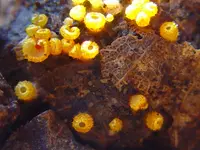
Sulphur Disco, Calycina claroflava, is a small cup fungus known for its bright yellow, disc-shaped fruiting bodies. It typically appears in scattered groups on rotting wood, especially in damp forests and woodland habitats.
This species is saprophytic, meaning it feeds on dead organic material and helps break down decaying wood. It stays low to the substrate and does not form a leafy or stemmed plant structure.
In nature it prefers cool, moist, shaded conditions with plenty of well-decayed wood. Enthusiasts who care for Sulphur Disco in controlled environments usually focus on maintaining stable humidity, gentle airflow, and consistently damp, but not waterlogged, woody substrate.

Care Difficulty
Moderate Care

Light Preference
Partial Shade

Water Requirements
Moderate Water

Temperature Preference
Cool Climate

Hardiness Zone
Unknown

Soil Texture
Loamy, Sandy, Organic-rich

Soil pH
Acidic (5.5–6.5)

Soil Drainage
Moist but well-drained

Fertilization
Minimal (feed rarely)
Scan your plant to receive care tips personalized for your specific plant
Available on iOS and Android
Calycina claroflava prefers bright, open conditions with moderate, indirect to lightly filtered sun exposure.
Calycina claroflava benefits from consistently moist but not waterlogged conditions in a freely draining substrate.
This species performs best in cool to mild conditions and is sensitive to both hard frost and prolonged extreme heat.
This fungus grows well in moderately moist air and does not demand tightly controlled humidity.
Calycina claroflava develops best on moist, well-aerated, organically enriched substrates rather than compact mineral soils.
This species can be grown in shallow containers that allow a stable, evenly moist substrate layer.
Calycina claroflava is adapted to low-nutrient habitats and usually needs little to no fertilizer under garden conditions.
Pruning for Calycina claroflava is minimal and mainly focuses on health and access to light.
This species is more often grown in the ground than in containers, so focus on careful transplanting rather than frequent repotting.
Propagation of Calycina claroflava is usually done on a small scale and may require patience and stable conditions.
Calycina claroflava is generally cold hardy in its adapted climate and needs little active winter care once established.

Plant Health Check
Not sure what's wrong with your plant? Check your plant's health inside the app.
This fungus forms small, bright sulfur-yellow cup- to disc-shaped fruiting bodies on dead conifer wood, which makes it relatively easy to recognize in the field compared with many duller cup fungi.
It is strongly associated with decaying conifer wood, especially pine and spruce, where it grows as a saprotroph, breaking down wood components and helping recycle nutrients in forest ecosystems.
Identification in scientific work relies on microscopic characters such as smooth, hyaline (transparent) spores and the structure of the asci and paraphyses, which distinguish it from similar yellow cup fungi in the Helotiales.
The bright yellow fruiting bodies are highly visible to insects, but they are not nectar sources. They may incidentally attract small flies and other decomposers rather than garden-pollinating butterflies or bees looking for flowers.
Keep your plants happy and healthy with plant identification, disease detection, and easy care guidance.