Robust support setup
Install a strong, permanent support such as a metal trellis or sturdy wires fixed to a wall or fence before planting, because mature vines become heavy and can pull down weak structures.

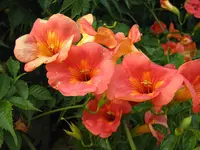
Chinese trumpet vine, Campsis grandiflora, is a vigorous, deciduous climbing vine grown mainly for its large, trumpet-shaped orange to reddish flowers. It attaches itself to supports with aerial roots and can quickly cover fences, walls, or arbors, giving a strong vertical presence in the garden.
This species is native to China and parts of East Asia, where it grows in warm, temperate regions. It is generally considered easy to grow, but its strong growth requires space and regular control in small gardens.
For those learning how to care for Chinese Trumpet Vine, it favors full sun, moderate moisture, and well-drained soil, and it tends to bloom best in warm summers.

Care Difficulty
Moderate Care

Light Preference
Full Sun

Water Requirements
Moderate Water

Temperature Preference
Warm Climate

Hardiness Zone
6–9

Soil Texture
Sandy, Loamy, Clay

Soil pH
Acidic (5.5–6.5), Slightly acidic (6.5–7.0)

Soil Drainage
Moist but well-drained

Fertilization
Minimal (feed rarely)
Scan your plant to receive care tips personalized for your specific plant
Available on iOS and Android
This vigorous climbing vine flowers best in bright outdoor sites with strong sun exposure.
This woody vine prefers evenly moist, well-drained soil rather than constantly wet conditions.
This vine is adapted to warm temperate climates with moderate seasonal cold.
This vine handles a wide humidity range and usually does not need special humidity management outdoors.
Campsis grandiflora grows best in deep, well‑structured, free‑draining ground.
This vigorous climber can be grown in containers but needs careful setup to stay stable and adequately rooted.
Campsis grandiflora benefits from moderate feeding to support vigorous vine growth and flowering in poor or depleted soils.
Pruning Campsis grandiflora helps control size, maintain structure, and maximize bloom on new growth.
This vigorous climber is usually grown in the ground, so transplanting Campsis grandiflora is more common than container repotting.
Campsis grandiflora is commonly propagated to expand plantings or replace older vines.
This vine is moderately cold hardy but still benefits from basic winter care in cooler regions.

Plant Health Check
Not sure what's wrong with your plant? Check your plant's health inside the app.
Campsis grandiflora is native to China and parts of Japan, where it grows in warm, humid regions and scrambles over trees and rocky slopes at low to mid elevations.
The large, flared orange to reddish trumpets are tubular and nectar-rich, an adaptation for pollination by long-billed birds and large insects that can reach deep into the corolla.
Compared with the North American Campsis radicans, this species is considered less aggressive and typically spreads more slowly, although it can still climb vigorously and reach several meters in height with support.

In traditional Chinese gardens, this species has long been grown on trellises, walls, and entrance structures, and its showy summer blooms have been associated with festive displays and ornamental gateways for centuries.
This species spreads vigorously by seed and by producing many shoots from the base. In suitable climates it can become difficult to control. Use strong supports, prune regularly, and remove unwanted suckers to keep growth within bounds.
Keep your plants happy and healthy with plant identification, disease detection, and easy care guidance.