Campsis hybrid (C. radicans × grandiflora) Care (Campsis × tagliabuana)

Campsis hybrid (C. radicans × grandiflora)

About Campsis hybrid (C. radicans × grandiflora)

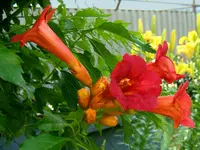
Campsis hybrid (C. radicans × grandiflora), also known as Campsis × tagliabuana, is a vigorous deciduous climber grown mainly for its large, trumpet-shaped summer flowers. It is typically trained on walls, arbors, or sturdy supports, where it forms a dense, woody framework with showy clusters of orange to red blooms.

This hybrid originated from crossing North American trumpet vine with Chinese trumpet vine, combining cold tolerance with abundant flowering. It can spread strongly by stems and aerial roots, so it needs space and firm structures.

Once established, it is relatively easy to grow if given full sun, well-drained soil, and moderate moisture. Gardeners who learn how to care for Campsis hybrid (C. radicans × grandiflora) usually find it a durable, long-lived feature plant.

Main Plant Requirements

Care Difficulty

Moderate Care

Light Preference

Full Sun

Water Requirements

Moderate Water

Temperature Preference

Cold Hardy

Hardiness Zone

5–9

Soil Texture

Sandy, Loamy, Clay

Soil pH

Acidic (5.5–6.5), Slightly acidic (6.5–7.0)

Soil Drainage

Well-drained

Fertilization

Minimal (feed rarely)

Get Personalized Care Plan

Scan your plant to receive care tips personalized for your specific plant

Available on iOS and Android

How to Care for the Campsis hybrid (C. radicans × grandiflora)

This vigorous climber thrives in strong outdoor light with plenty of direct sun for reliable flowering.

  • Provide 6–8 hours of direct sun daily; full sun promotes the heaviest blooms on Campsis hybrid (C. radicans × grandiflora).
  • Allow light afternoon shade in hotter regions to reduce leaf scorch, especially on south- and west-facing walls.
  • In cooler seasons or cloudy climates, prioritize unobstructed morning sun and avoid dense shade, which causes weak growth and poor flowering.

This vine prefers consistent soil moisture during the growing season but does not tolerate waterlogged conditions.

  • Water when the top 3–5 cm of soil feels dry, applying a deep soak rather than light splashes, especially in the first 1–2 years.
  • Ensure sharply draining soil; add organic matter if needed so excess water runs off and roots do not sit in standing water.
  • In summer heat, monitor for wilting, dull leaves, or dry, shrinking soil; yellowing, soft foliage and soggy soil indicate overwatering.

This hardy climber tolerates a wide temperature range but flowers best in warm, frost-free conditions during the growing season.

  • Active growth and flowering are strongest around 70–85°F (21–29°C), with buds forming reliably in sustained warmth.
  • Established plants often tolerate down to about 0°F (−18°C), but young vines benefit from protection when temperatures drop below 20°F (−7°C).
  • In heat above 95°F (35°C), mulch roots to moderate soil temperature and reduce stress, and expect some temporary leaf scorch on exposed sites.

Trumpet vine hybrids handle a wide humidity range and rarely need special humidity management outdoors.

Campsis × tagliabuana grows best in deep, moderately fertile, well-drained ground that still holds some moisture.

  • Use a loamy soil with a mix of mineral particles and organic matter so roots have both moisture and air access.
  • Aim for slightly acidic to neutral pH, around 6.0–7.0, which supports nutrient availability and steady growth.
  • In heavy clay, improve drainage and aeration by working in coarse sand plus well-rotted compost to at least 25–30 cm depth.
  • Avoid compacted, waterlogged, or very shallow soils, which lead to weak root development, poor flowering, and increased root-rot risk.

This vigorous climber can be grown in large outdoor containers if the pot is chosen and managed carefully.

  • Pick a wide, heavy container to reduce tipping risk as long vines and woody stems make the plant top-heavy in wind.
  • Use a deep pot, at least 40–50 cm, to give the strong root system room to anchor and buffer against drought.
  • Select a thick-walled or non-porous pot material if placed in full sun, as this slows overly rapid drying of the root zone.

Trumpet vine hybrids benefit from moderate feeding to support strong growth and flowering without becoming excessively vigorous.

  • Apply a balanced slow-release fertilizer (around 10-10-10) at half label rate once in early spring as new growth starts.
  • In richer garden soil, supplement instead with a thin layer of compost around the root zone each spring.
  • Avoid high-nitrogen products, which encourage leafy growth at the expense of blooms on Campsis hybrid (C. radicans × grandiflora).
  • Do not feed in late fall or winter, as the plant is dormant and extra nutrients are unused and may leach away.

Campsis × tagliabuana responds strongly to pruning, which helps control size and improve flowering.

  • Plan main structural pruning for late winter or very early spring before buds swell.
  • Remove dead, damaged, or crossing stems first, then thin congested shoots to open the framework.
  • Shorten last year’s flowering shoots to 2–3 buds to encourage new, flower-bearing growth.
  • Use sharp bypass pruners or loppers and make clean cuts just above outward-facing buds or side branches.

This vigorous climber is more often transplanted in the ground than repotted in containers.

  • Transplant young plants in early spring or early fall when temperatures are mild and soil is workable.
  • Look for slow top growth, circling roots, or roots emerging from drainage holes as signals a container plant needs a larger pot.
  • Move to a container 1–2 in wider using free-draining soil, keeping the crown at the same depth as before.
  • Water deeply after transplanting and provide shade and consistent moisture for 1–2 weeks to reduce transplant shock.

New plants are commonly produced from cuttings and layering, with seeds used less often for named cultivars.

  • Take semi-ripe stem cuttings in mid to late summer, 10–15 cm long, with 2–3 nodes.
  • Insert cuttings in a free-draining mix, keep at 68–75°F with bright, indirect light, and maintain high humidity.
  • For simple layering, pin a flexible stem to the soil surface in spring, cover the middle section, and sever once rooted.
  • Sow fresh seeds in spring in a moist, well-drained seed mix at 65–75°F, noting that seedlings may vary from the parent.

Established plants are generally cold hardy in much of the US and need only modest winter care.

  • In zones near the hardiness limit, add a 5–8 cm mulch layer over the root zone after the ground cools, not touching stems.
  • Leave sturdy framework stems in place for winter, removing only obviously dead wood in late winter.
  • For container-grown plants in colder regions, move pots into a sheltered unheated garage or against a protected wall to reduce freeze-thaw stress.

Care Tips

Early framework training

In the first 2–3 years, select 2–4 strong main shoots and tie them loosely but firmly to a sturdy support (wire, pergola post, or trellis) to create a permanent framework that will carry flowering side shoots for many years.

Manage invasive suckers

Inspect the soil around the base several times a season and promptly cut out any root suckers at their point of origin below soil level to prevent the plant from spreading into unwanted areas and diverting energy from the main framework.

Support weight load

Before maturity, assess the weight and wind exposure of the vine and upgrade to masonry anchors, heavy-gauge wires, or a steel trellis if needed, since mature stems become woody and heavy and can strain weak fences or light timber structures.

Stimulate flowering wood

In late winter, shorten the previous year’s flowering laterals back to 2–3 buds along the main framework, which concentrates growth into short, strong spurs that produce more flowers at comfortable viewing height.

Monitor sap-feeding pests

From late spring, check the undersides of leaves and soft tips every 1–2 weeks for aphids or scale, and at first signs use a strong water spray or a labeled horticultural soap to control them before they cause sooty mold or sticky honeydew, which is a key part of caring for Campsis hybrid (C. radicans × grandiflora).

Common Pests and Diseases

Aphids

These insects cluster on young shoots and buds, sucking sap and causing distorted growth and sticky honeydew that can lead to sooty mold. This pest is especially attracted to the lush new growth produced in warm weather.

Solution

Prune off heavily infested shoot tips, then wash remaining stems and leaves with a firm stream of water to dislodge insects. For ongoing issues, apply insecticidal soap or a ready-to-use neem oil spray in the early morning, repeating every 7–10 days until populations are controlled.

Spider mites

These pests thrive in hot, dry conditions and feed on the underside of leaves, causing fine stippling, bronzing, and sometimes light webbing between leaf veins. Symptoms include dull, dusty-looking foliage that may drop prematurely under heavy infestations.

Solution

Increase humidity around the vine and regularly hose down foliage, paying attention to leaf undersides. When populations are high, use a miticide-labeled horticultural oil or insecticidal soap, applying thoroughly and repeating at 5–7 day intervals as needed.

Scale insects

These insects attach firmly to stems and sometimes leaves, appearing as small bumps that excrete honeydew and weaken the vine over time. This pest can cause dieback of finer shoots if left unchecked.

Solution

Gently scrape or rub off individual scales with a gloved hand or soft brush, then cut back heavily infested stems. Follow with a targeted application of horticultural oil during the growing season or as a dormant spray to smother remaining scales and crawlers.

Powdery mildew

This disease produces white, powdery patches on leaves, especially in warm days with cool, humid nights and poor air movement. Symptoms include distorted, yellowing foliage and reduced flowering when infections are severe.

Solution

Improve air circulation by thinning crowded stems and avoid overhead watering late in the day. Remove and discard affected leaves, then apply a sulfur-based or potassium bicarbonate fungicide labeled for ornamental vines at the first sign of infection, repeating as directed on the label.

Leaf spot

This disease causes small brown or purplish spots on leaves that may merge into larger blotches, leading to premature leaf drop on stressed vines. Symptoms include a generally thin canopy and reduced vigor when defoliation repeats over seasons.

Solution

Rake and remove fallen leaves to reduce reinfection, and avoid wetting foliage when irrigating. Prune to improve airflow and, if spotting is persistent year to year, use a copper-based or chlorothalonil fungicide at the first appearance of new lesions, following label directions for ornamental vines while growing Campsis hybrid (C. radicans × grandiflora).

Interesting Facts

Hybrid trumpet ancestry

This vine is a stable horticultural hybrid between Campsis radicans and Campsis grandiflora, combining the cold tolerance and vigor of C. radicans with the larger, showier flowers of C. grandiflora.

Flowering on new wood

The plant produces its trumpet-shaped blooms on new-season shoots rather than older stems, which means hard pruning in late winter does not reduce flowering and can actually improve flower display.

Specialized pollinator appeal

The long, tubular, orange to red flowers are adapted for pollination by long-tongued insects and hummingbirds, which can reach nectar deep within the corolla while transferring pollen between blooms.

Botan icon

Did you know?

This hybrid rarely produces viable seed and is primarily propagated vegetatively, so most plants in gardens are clones derived from a limited number of original crosses rather than genetically diverse seed-raised individuals.

FAQs about Campsis hybrid (C. radicans × grandiflora)

Lack of flowers usually comes from insufficient light, excessive nitrogen fertilizer, or heavy pruning in spring that removes young flowering shoots. Ensure strong sun, use balanced fertilizer, and prune right after flowering to preserve next year’s buds.

Grow Healthy Plants with Botan Care

Keep your plants happy and healthy with plant identification, disease detection, and easy care guidance.

Botan plant care app — identify plants on mobile

Explore More Plants