Wire support training
Install sturdy horizontal wires or a trellis at 30–45 cm intervals and fan out the long stems, tying them loosely with soft ties to encourage dense flowering along the whole framework rather than just at the tips.

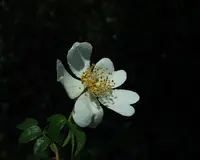
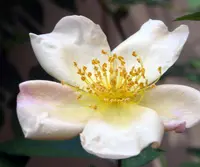
Evergreen rose, Rosa sempervirens, is a climbing or scrambling rose with glossy, dark green foliage that stays on the plant through mild winters. It produces slender, flexible canes and small, simple white flowers with a light fragrance, followed by small red hips. In nature it occurs in the Mediterranean region, often growing through shrubs or over rocks in sunny, well-drained sites. It is generally robust but can be somewhat vigorous, so it suits gardeners who can prune and guide its growth. Light, free-draining soil and good air circulation make it easier to care for evergreen rose.

Care Difficulty
Moderate Care

Light Preference
Full Sun

Water Requirements
Moderate Water

Temperature Preference
Warm Climate

Hardiness Zone
7–10

Soil Texture
Sandy, Loamy, Rocky

Soil pH
Acidic (5.5–6.5), Slightly acidic (6.5–7.0)

Soil Drainage
Well-drained

Fertilization
Minimal (feed rarely)
Scan your plant to receive care tips personalized for your specific plant
Available on iOS and Android
This vigorous climbing rose prefers consistent sun exposure for strong growth and flowering.
This species prefers evenly moist but not saturated soil, with short dry periods between waterings.
This rose is relatively hardy and adapts to a wide range of outdoor temperatures when established.
Humidity is rarely critical for evergreen rose in typical outdoor conditions.
Soil should be well-structured, free-draining, and moderately fertile to support Rosa sempervirens roots and long-term growth.
This species can be grown in containers outdoors if the pot is large, stable, and drains efficiently.
Rosa sempervirens benefits from light, measured feeding rather than heavy fertilization.
Pruning Rosa sempervirens focuses on maintaining a healthy framework and encouraging good flowering.
This species is usually grown in the ground, so focus on careful transplanting rather than frequent repotting.
Rosa sempervirens is commonly propagated by cuttings and layering to maintain desired traits.
This rose is fairly cold hardy in mild climates but still benefits from basic winter preparation.

Plant Health Check
Not sure what's wrong with your plant? Check your plant's health inside the app.
This species is one of the few truly evergreen wild roses in mild climates, keeping its glossy foliage through winter and forming dense, scrambling thickets on rocky slopes and woodland edges.
It is naturally distributed around the Mediterranean basin, where it stabilizes dry, calcareous soils and often grows in garrigue and maquis vegetation alongside evergreen shrubs.
Rosa sempervirens was widely used in early European rose breeding, especially in the 18th–19th centuries, as a parent for vigorous climbing and rambling roses with improved foliage and disease tolerance.

In parts of its native range, this species can climb several meters into tree canopies, using its hooked prickles to anchor onto branches and form semi-evergreen curtains that provide shelter for birds and other small animals year-round.
This species is a vigorous, scrambling climber with long, flexible canes that can be trained on trellises, fences, or trees. Without support it forms a dense, arching thicket, spreading outward more than upward.
Keep your plants happy and healthy with plant identification, disease detection, and easy care guidance.