Host tree matching
Select or work under established compatible hosts such as Douglas-fir or other conifers, since this ectomycorrhizal fungus depends on specific tree partners and will not fruit reliably without them.

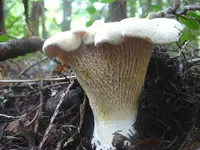
White chanterelle, Cantharellus subalbidus, is a wild mycorrhizal fungus, not a typical houseplant. It forms a symbiotic relationship with tree roots, helping trees absorb nutrients while receiving sugars in return. The fruiting bodies are thick, pale cream to white, with shallow forked ridges instead of true gills and a pleasant, mild aroma.
This species occurs mainly in conifer and mixed forests of western North America, emerging from soil and forest litter rather than wood. It is considered difficult to cultivate because it depends on living host trees and stable forest conditions, so attempts to care for White Chanterelle at home rarely succeed. In nature it favors cool, moist, well-drained forest soils with dappled light.

Care Difficulty
Hard Care

Light Preference
Partial Shade

Water Requirements
Regular Water

Temperature Preference
Cool Climate

Hardiness Zone
6–9

Soil Texture
Loamy, Sandy, Organic-rich

Soil pH
Strongly acidic (4.5–5.5), Acidic (5.5–6.5)

Soil Drainage
Moist but well-drained

Fertilization
Minimal (feed rarely)
Scan your plant to receive care tips personalized for your specific plant
Available on iOS and Android
This forest mushroom prefers conditions that mimic dappled woodland light rather than open-field sun.
Moist but not waterlogged soil is essential for this mycorrhizal forest mushroom.
This species fruits best in cool to mild conditions typical of temperate forests.
This mycorrhizal mushroom requires consistently moist, cool air outdoors rather than controlled indoor humidity.
This ectomycorrhizal fungus depends on naturally developed forest soil rather than a manufactured substrate.
This forest-dwelling chanterelle is not suitable for container growing, since it relies on long-term symbiosis with tree roots in undisturbed soil profiles.
This wild ectomycorrhizal fungus relies mainly on its tree host and surrounding soil, so direct fertilization is usually unnecessary for White Chanterelle.
As a wild mushroom, Cantharellus subalbidus is not pruned in the horticultural sense and needs no structural pruning.
This fungus forms a symbiotic relationship with host tree roots, so it is not suited to conventional repotting or frequent transplanting.
Propagation of this ectomycorrhizal mushroom is complex and not reliably achieved through standard home methods, so practical cultivation is limited.
This species is naturally cold hardy in its native range and generally requires no special winter care in the landscape.

Plant Health Check
Not sure what's wrong with your plant? Check your plant's health inside the app.
The cap surface is typically creamy white to pale buff but often develops orange to apricot stains where handled, due to pigment changes in the outer tissue when bruised or aged.
This species produces a pale yellow to creamy spore print, which helps separate it from some similar white chanterelles and is used as a key identification feature by field mycologists.
It is native to western North America, especially the Pacific Northwest and parts of coastal California, where it is most often associated with coniferous forests on acidic, well-drained soils.

This chanterelle forms ectomycorrhizal partnerships with trees such as Douglas-fir and other conifers, exchanging mineral nutrients and water from the soil for sugars from the host tree, and in doing so plays a measurable role in forest nutrient cycling and tree health.
Yes, this species is considered a choice edible mushroom when correctly identified. It has a mild, nutty flavor and firm texture. Only harvest in clean areas and always confirm identification with a reliable, local expert before eating.
Keep your plants happy and healthy with plant identification, disease detection, and easy care guidance.