Rodent protection
Install a low, loose wire mesh or hardware cloth cylinder around young plants to prevent rodents from chewing the stem, keeping it a few centimeters away from the epidermis to avoid rubbing damage.

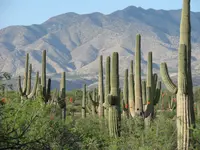
The saguaro, Carnegiea gigantea, is a very long-lived columnar cactus native to the Sonoran Desert of the southwestern United States and northern Mexico. It forms tall, branching stems with prominent ribs and a dense forest of protective spines.
Mature plants often develop upward-curving arms and produce white flowers followed by red, fleshy fruits that feed many desert animals. Its slow growth and eventual large size make it a challenging choice for small spaces.
This species prefers very bright light, low humidity, and fast-draining, mineral-rich soil. Understanding how to care for Saguaro helps prevent rot and other stress problems in cultivation.

Care Difficulty
Hard Care

Light Preference
Full Sun

Water Requirements
Low Water

Temperature Preference
Tropical / Frost Sensitive

Hardiness Zone
8–11

Soil Texture
Sandy, Rocky, Loamy

Soil pH
Slightly acidic (6.5–7.0), Neutral (7.0)

Soil Drainage
Well-drained

Fertilization
Minimal (feed rarely)
Scan your plant to receive care tips personalized for your specific plant
Available on iOS and Android
This desert cactus needs intense, direct sun to maintain healthy growth and structure.
This cactus is highly drought-adapted and must dry thoroughly between waterings to avoid root damage.
This species is adapted to hot desert climates but has defined limits for both heat and cold.
Humidity is not a significant factor for Carnegiea gigantea, which is adapted to very dry desert air.
Carnegiea gigantea needs very fast-draining, mineral soil to prevent root rot.
This species can be grown in containers only when small and requires careful attention to stability and drainage.
This desert cactus needs very light feeding, if any, when grown in containers or managed landscapes.
Carnegiea gigantea needs almost no pruning and is usually left to develop its natural columnar form.
This species is rarely repotted and should only be transplanted when truly necessary, due to its slow growth and sensitive roots.
New Carnegiea gigantea plants are produced almost exclusively from seed and require very specific conditions.
This desert cactus is sensitive to prolonged hard frost and benefits from targeted winter protection in cooler regions.

Plant Health Check
Not sure what's wrong with your plant? Check your plant's health inside the app.
This cactus is naturally restricted to the Sonoran Desert of Arizona, southeastern California, and northwestern Mexico, where its distribution is tightly controlled by winter frost limits and summer rainfall patterns.
Young saguaros typically germinate and survive only under the partial shade of nurse plants such as palo verde or mesquite, which protect seedlings from extreme heat, sun, and cold during their most vulnerable years.
Mature saguaros provide nesting cavities, food, and shelter for many species, including Gila woodpeckers, gilded flickers, elf owls, and desert bats, making them a classic keystone species in Sonoran Desert ecosystems.

Individual saguaros often live 150–200 years, and they usually do not grow their first side branches or “arms” until roughly 50–75 years of age in typical wild conditions.
This species grows very slowly, often less than 2–3 cm per year in the first decade. Growth rate depends on warmth, light intensity, soil drainage, and moisture. Consistent conditions and avoiding overwatering are key to healthy development.
Keep your plants happy and healthy with plant identification, disease detection, and easy care guidance.