

American hornbeam Identification (Carpinus caroliniana)

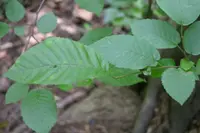
Recognize American hornbeam by its smooth, muscle-like gray trunk, simple alternate leaves, and sharply double-serrated leaf edges. The leaves are oval to elliptic and typically about 2 to 5 inches (5 to 13 cm) long.

It usually grows as a small tree with a rounded crown and dense branching.

Carpinus caroliniana Identification

Scan to Confirm American hornbeam

Take or upload a photo to confirm your plant ID with Botan.

Clear images work best. Avoid photos taken too close or too far away

  • 1 free identification
  • No sign-up
  • 30,000+ plants in database

Use a few easy structure checks before looking closer.

  • Small tree with a rounded crown, often 20 to 35 feet tall (6 to 11 m).
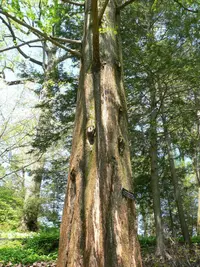
  • Trunk and larger branches look sinewy and fluted, like smooth muscles under thin bark.
  • Leaves are alternate, oval, and sharply double-toothed, usually 2 to 5 inches long (5 to 13 cm).
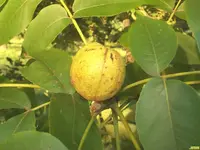
  • Fruits hang in small clusters, each nut attached to a three-lobed leafy bract.

The fluted trunk plus doubly toothed leaves is a strong visual combination.

American hornbeam shows several visible stage changes that can help confirm identification.

  • Seedling: Seedlings have a slender green stem with simple, alternate leaves already showing the species’ sharp double-serrated edges and strong straight side veins.
  • Young plant: Young plants are usually a multi-stemmed sapling or small tree, with smooth gray bark and a narrow crown; leaves often measure 2-4 inches (5-10 cm) long.
  • Mature plant: Mature plants develop the distinctive fluted, muscle-like trunk and larger spreading crown, while bark stays smooth gray rather than breaking into rough plates.
  • Fruiting stage: Fruiting branches carry dangling clusters of small nutlets attached to three-lobed leafy bracts, a conspicuous feature not present before seed set.

In spring, Carpinus caroliniana leafs out with fresh light green foliage as small catkins become visible. By late summer into fall, dangling clusters of three-lobed leafy bracts hold the nutlets and are often one of the clearest seasonal clues. Fall color usually shifts to yellow, orange, red, or scarlet. After leaf drop, the smooth gray bark and sinewy, muscle-like trunk and branches stand out and make winter identification easier.

A few small eastern trees are regularly mistaken for American hornbeam.

musclewood(Ostrya virginiana)

Often confused because both have oval, serrated leaves and smooth gray twigs. Ostrya virginiana usually has shreddier bark and papery hop-like fruit clusters, while Carpinus caroliniana has fluted, muscle-like bark and small dangling nutlets with a three-lobed bract.

European hornbeam(Carpinus betulus)

Similar leaf shape and hornbeam form can confuse planted specimens. European hornbeam more often has a denser, upright crown and a less sinewy trunk; its leaves are typically more strongly pleated, while the native species shows smoother leaf surfaces and more obviously muscular bark.

Carpinus caroliniana is native to eastern North America, from southeastern Canada through the eastern and central United States into eastern Mexico. Its range is broad, but it is most often encountered in the East and Southeast. For identification, habitat is useful because this species typically grows in moist woods, streambanks, floodplains, swamps, and other bottomland sites, often as an understory tree. Finding a small hornbeam in shaded, damp woodland helps narrow it down more than geography alone.

Scan. Check. Confirm.

Use Botan to compare a photo and help verify the plant, so you can avoid mix-ups with similar species.

FAQ

Yes. In late summer to fall, this plant bears small nutlets attached to three-lobed leafy bracts in dangling clusters. That hop-like fruiting structure is a useful feature for identifying American hornbeam.

More Plant Identification Guides

From Plant ID to Plant Info

Identify a plant from a photo with Botan, then get species-specific plant details, care information, and common problems.

Botan app identifying a plant from a photo
How Long Can Flowers Go Without Water? Everything You Need to Know

6 min read · 10 Jul 2026

How Long Can Flowers Go Without Water? Everything You Need to Know

Flowers can survive without water anywhere from 1-2 hours to several months, depending on the plant type, species, and growing conditions. Some strong-looking flowers are drought-sensitive, while delicate-looking plants may tolerate long dry periods surprisingly well.

Plant Care
How Long Can Flowers Go Without Water? Everything You Need to Know
Top 15 Plants That Don’t Need Sunlight

8 min read · 17 Sept 2026

Top 15 Plants That Don’t Need Sunlight

Some plants thrive in dim rooms, shaded corners, and places with indirect light. In this guide, you’ll explore the top 15 species best suited to low-light conditions and how to care for them.

Plant Recommendations
Top 15 Plants That Don’t Need Sunlight
How Often to Water Fruit Trees

7 min read · 11 Aug 2026

How Often to Water Fruit Trees

Irrigation needs change as roots establish and weather shifts. This guide gives practical starting intervals, explains how soil and tree type change them, and shows how to recognize both excess moisture and drought stress.

Plant Care
How Often to Water Fruit Trees