


pecan Identification (Carya illinoinensis)

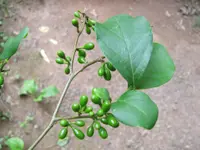
Recognize pecan by its long, alternate compound leaves, usually with 9 to 17 narrow leaflets, plus a tall single trunk and broad crown. Mature bark forms long, interlacing ridges.

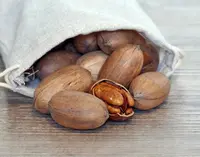
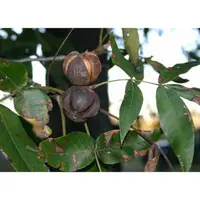
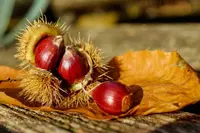
Another strong clue is the fruit: oblong nuts in smooth green husks, typically borne in small clusters.

Carya illinoinensis Identification

Check Your Plant with Botan

Use a clear photo to confirm what plant you have.

Clear images work best. Avoid photos taken too close or too far away

Check the overall leaf and fruit structure first.

  • Leaves are alternate and pinnate, usually 12-20 inches (30-50 cm) long.
  • Each leaf commonly has 9-17 long, narrow leaflets with finely toothed edges.
  • The crown is tall and broad, with a straight main trunk and strong upright limbs.
  • Bark forms long, narrow ridges and furrows that look tight rather than shaggy.
  • Fruits hang singly or in small clusters; the husk is smooth, oval, and splits into four sections.

Use several traits together, especially leaflet count, bark pattern, and the four-part husk.

Carya illinoinensis shows clear visual shifts from seedling leaves to heavy fruiting branches.

  • Seedling: Seedlings start with a slender upright stem and a few alternate compound leaves, each with fewer, broader-looking leaflets than later growth.
  • Young plant: Young plants form a narrow crown with strong upward shoots; compound leaves lengthen and commonly carry 9-17 slimmer, sickle-curved leaflets.
  • Mature plant: The mature tree develops a tall straight trunk, broad rounded crown, and thicker scaffold branches, giving a much heavier structure than younger plants.
  • Fruiting stage: Fruiting branches show hanging clusters of elongated husked nuts about 1-3 inches (2.5-7.5 cm) long, adding visible weight and slight branch droop.

In spring, pecan leafs out with long compound leaves as dangling male catkins become visible and small female flower spikes appear near new shoots. By late summer into fall, clusters of green husked nuts become easy to spot. Leaves turn yellow to yellow-brown before dropping, which reveals the tree’s stout twigs, pointed buds, and furrowed bark through winter.

Several hickories can be mistaken for pecan at a glance.

water hickory(Carya aquatica)

Similar pinnate leaves and shaggy young growth can confuse IDs. Water hickory usually has 7-13 leaflets, often broader and more sickle-shaped. Its fruit is nearly round, not elongated.

bitternut hickory(Carya cordiformis)

Also a tall tree with long compound leaves. Bitternut usually has 7-11 narrower leaflets and distinctive sulfur-yellow buds. Its small husked nuts are rounder and lack the long, smooth pecan shape.

shellbark hickory(Carya laciniosa)

Large leaves and stout twigs make this another realistic match. Shellbark has fewer leaflets, usually 5-9, and very large round nuts with thick husks, unlike pecan’s longer, thinner nuts.

Native to the south-central and southeastern United States and northeastern Mexico, Carya illinoinensis occurs naturally from river systems in Texas and Oklahoma east to the lower Mississippi Valley. It is most often found in bottomland forests, floodplains, alluvial river terraces, and streambanks. That setting helps with identification because a wild hickory growing on deep, moist river soils is more likely to be pecan than an upland species from drier woods.

Check Your Plant ID

Use Botan to compare a photo and help confirm the plant, which can save time before you label or buy it.

FAQ

The most reliable clue is the long, pinnate leaf with usually 9 to 17 narrow leaflets. In pecan identification, the leaflets are sickle-shaped, finely toothed, and often larger toward the tip of the leaf.

Everything About pecan

More Plant Identification Guides

Identify Your Plant and Learn More

Upload a photo to identify the plant, then get species-specific care information, safety notes, and common problems.

Botan app identifying a plant from a photo
Best Bedroom Plants – Top 10 to Grow in Your Space

8 min read · 8 Jul 2026

Best Bedroom Plants – Top 10 to Grow in Your Space

Discover the top 10 houseplants that are suitable for growing in your bedroom. Compare their light and water needs, pet safety, and benefits. Find out where best to place greenery in your relaxation space and what species to avoid.

Plant Recommendations

Best Bedroom Plants – Top 10 to Grow in Your Space
12 Best Landscaping Trees for Your Garden

8 min read · 6 Oct 2026

12 Best Landscaping Trees for Your Garden

Choosing the landscape tree depends on what your garden needs most. These 12 options include compact flowering specimens, colorful deciduous trees, shade varieties, and evergreens suitable for screening and year-round structure.

Plant Recommendations
12 Best Landscaping Trees for Your Garden
12 Best Cold-Hardy Vegetables for Cold Weather

7 min read · 13 Oct 2026

12 Best Cold-Hardy Vegetables for Cold Weather

Cold-hardy vegetables can keep a garden productive through chilly fall, winter, and early spring weather. This guide covers 12 reliable crops, their frost tolerance, and practical growing tips for better cold-season harvests.

Plant Recommendations
12 Best Cold-Hardy Vegetables for Cold Weather