
shagbark hickory Identification (Carya ovata)

To recognize shagbark hickory, check for long compound leaves with 5 leaflets, usually a larger terminal leaflet, and alternate leaf arrangement. Mature trees also show loose, peeling bark in long vertical strips.

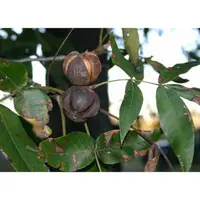
Look for a tall single trunk and egg-shaped nuts enclosed in a thick husk that splits into four sections.

Carya ovata Identification

Is This shagbark hickory?

Take a photo and use Botan to confirm your plant identification.

Clear images work best. Avoid photos taken too close or too far away

Check the bark, leaves, and fruit shape first.

  • Mature trunks have long, loose bark plates that peel away in shaggy strips.
  • Leaves are compound, usually with 5 leaflets, sometimes 7, on one stalk.
  • The end leaflet is noticeably larger than the side leaflets.
  • Leaflets are oval to lance-shaped, with coarse teeth along the edges.
  • Fruits are nearly round, about 1.5-2 inches (4-5 cm) wide, with a thick husk that splits into 4 sections.

Use several traits together, especially the shaggy bark and 5-leaflet leaves.

Carya ovata shows clear visual shifts from seedling foliage to shaggy-barked, fruiting adulthood.

  • Seedling: First growth shows a straight stem with large compound leaves that often look oversized for the plant, each leaf usually carrying 5 leaflets.
  • Young plant: Bark stays tight and relatively smooth, so the trunk lacks the loose peeling strips seen later; branching is upright and the crown remains narrow.
  • Mature plant: The trunk develops long, curling bark plates that hang away from the stem in strips, while the crown broadens and heavy limbs create a taller, open framework.
  • Fruiting stage: Female flowers mature into rounded husked nuts about 1.5-2.5 inches (4-6 cm) across, hanging singly or in small groups near twig tips.

In spring, Carya ovata leafs out with large compound leaves, and dangling yellow-green catkins become visible as the tree flowers. By late summer into fall, round husked nuts are often easy to spot. After leaf drop, winter identification improves because the long, loose strips of shaggy bark stand out clearly on the bare trunk and larger branches. Fall foliage usually turns yellow to golden-brown before dropping.

A few hickories are regularly mistaken for Carya ovata.

shellbark hickory(Carya laciniosa)

Often confused because both have shaggy bark and large compound leaves. Shellbark usually has 7 leaflets, often broader, and much larger nuts, about 2 to 3 inches (5 to 7.5 cm) long.

mockernut hickory(Carya tomentosa)

Similar in leaf size and overall form. Unlike shagbark hickory, its bark stays tighter and more ridged rather than peeling in long loose strips; the leaf undersides are also densely hairy.

pignut hickory(Carya glabra)

Can look similar from a distance by leaf shape and branching. It differs by tight, non-shaggy bark and smaller pear-shaped fruits with a thinner husk.

Carya ovata is native to eastern North America, from southern Ontario and Quebec south through the eastern United States to parts of the Southeast and west into the central states. It is most often found in upland hardwood forests, open woodlands, and along stream terraces and well-drained slopes. Seeing it in eastern deciduous woodland helps narrow identification, especially where hickories are a regular part of the forest canopy.

Confirm It from a Photo

Use Botan to compare a photo and help verify the plant, which can reduce mix-ups before you rely on the identification.

FAQ

The standout trait is the bark. On mature trunks, long gray strips loosen at both ends and peel away in shaggy plates. For identifying shagbark hickory, this bark is the clearest single feature.

More Plant Identification Guides

One Photo. More About Your Plant.

Use Botan to identify it from a photo, then get plant details, care information, and common problems for that species.

Botan app identifying a plant from a photo
12 Best Plants That Repel Spiders For Your Home and Garden

8 min read · 24 Jul 2026

12 Best Plants That Repel Spiders For Your Home and Garden

Spiders constantly appear in places you don't want them. A few common plants can help repel them using scent alone. Here are 12 options suitable for both indoors and outdoors, plus care tips for each.

Plant Recommendations
12 Best Plants That Repel Spiders For Your Home and Garden
How Long Can Flowers Go Without Water? Everything You Need to Know

6 min read · 10 Jul 2026

How Long Can Flowers Go Without Water? Everything You Need to Know

Flowers can survive without water anywhere from 1-2 hours to several months, depending on the plant type, species, and growing conditions. Some strong-looking flowers are drought-sensitive, while delicate-looking plants may tolerate long dry periods surprisingly well.

Plant Care
How Long Can Flowers Go Without Water? Everything You Need to Know
Plants That Repel Bugs – 20 Effective Options

12 min read · 16 Jul 2026

Plants That Repel Bugs – 20 Effective Options

Mosquitoes on the patio? Gnats in the kitchen? Some plants keep them away with the scent of their own leaves. Here are 20 that deal with mosquitoes, flies, aphids, and more, plus where to put them so they help.

Plant Recommendations
Plants That Repel Bugs – 20 Effective Options