Trunk training
Stake the young tree with a sturdy post on the windward side for the first 2–3 years, loosely tying the trunk in 2–3 places so it develops a straight, strong leader that can support heavy flower clusters later.

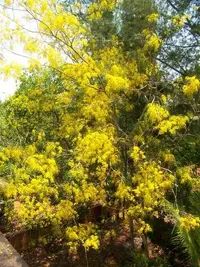
The golden shower tree, Cassia fistula, is a medium-sized deciduous tree valued for its long, hanging clusters of bright yellow flowers. It forms a rounded crown and is often used as an ornamental street or garden tree in warm climates.
This species is native to the Indian subcontinent and parts of Southeast Asia, where it grows in seasonal tropical conditions. It prefers full sun, warmth, and well-drained soil, and does not tolerate frost well.
In suitable climates it is moderately easy to establish but needs space, consistent warmth, and protection from hard freezes. Understanding how to care for golden shower tree helps it flower well and maintain a healthy structure over many years.

Care Difficulty
Moderate Care

Light Preference
Full Sun

Water Requirements
Moderate Water

Temperature Preference
Tropical / Frost Sensitive

Hardiness Zone
10–12

Soil Texture
Sandy, Loamy, Organic-rich

Soil pH
Slightly acidic (6.5–7.0), Neutral (7.0)

Soil Drainage
Well-drained

Fertilization
Minimal (feed rarely)
Scan your plant to receive care tips personalized for your specific plant
Available on iOS and Android
Cassia fistula needs strong, direct light to flower well and grow with a sturdy structure.
Cassia fistula prefers deep, infrequent watering that allows the soil surface to dry between soakings.
This species is a tropical–subtropical tree that grows best in consistently warm conditions without frost.
Cassia fistula tolerates typical outdoor humidity and rarely needs special humidity management.
Cassia fistula grows best in well-drained, slightly sandy to loamy soil that does not stay waterlogged.
This species can be grown in containers when young, but long-term container culture is challenging due to its eventual size.
Cassia fistula benefits from light, targeted feeding rather than heavy fertilization.
Cassia fistula responds well to modest structural pruning to maintain a healthy, flowering canopy.
Golden shower tree is usually grown in the ground, so focus on careful transplanting rather than frequent repotting.
Cassia fistula is most often propagated from seed, which allows many new trees from a single parent.
Cassia fistula is a tropical to subtropical tree that needs protection in climates with freezing winters.

Plant Health Check
Not sure what's wrong with your plant? Check your plant's health inside the app.
Cassia fistula is the national tree and national flower of Thailand, where its bright yellow blossoms, called ratchaphruek, are associated with royalty and the celebration of Songkran, the traditional New Year.
In many parts of South Asia, this species flowers just before the summer monsoon, producing leafless branches heavily laden with drooping racemes of yellow flowers that can almost obscure the rest of the tree.
Although the tree itself does not fix nitrogen, it often associates with soil bacteria in the rhizosphere that can enhance soil fertility, which partly explains its success on relatively poor, sandy or lateritic soils in tropical regions.

Genetic and morphological studies place this species firmly within the legume subfamily Caesalpinioideae, and its distinctive long, cylindrical, multi-seeded pods are a key trait used by botanists to distinguish it from visually similar but unrelated yellow-flowering trees in the tropics.
Insufficient sunlight, young age, or heavy pruning can reduce flowering. Trees usually need several years to mature before blooming well. Poor nutrition or drought during bud formation also limits flowers. Maintain stable care; avoid cutting off developing tips.
Keep your plants happy and healthy with plant identification, disease detection, and easy care guidance.

-1-200x133.webp)