


Seasonal rest handling
Once leaves yellow and drop, gradually reduce watering to almost none and move the plant to a slightly cooler, bright spot so the pseudobulbs complete dormancy without rotting.

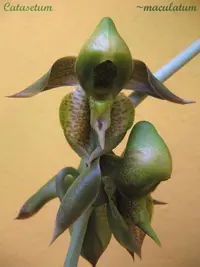
Catasetum maculatum, commonly called spotted catasetum, is a deciduous epiphytic orchid that grows on trees in warm, seasonally dry forests from Mexico to Central America. It forms swollen pseudobulbs with broad leaves that drop in the dry season, followed by dramatic, spotted flowers on arching stems. The plant shows strong seasonal growth, with an active warm, wet phase and a pronounced dry rest, which is the main factor that affects how easy or difficult it is to grow. Those who learn how to care for spotted catasetum usually find it manageable, given bright filtered light, regular moisture in growth, and a sharp reduction in water during dormancy.

Care Difficulty
Hard Care

Light Preference
Partial Sun

Water Requirements
Moderate Water

Temperature Preference
Tropical / Frost Sensitive

Hardiness Zone
11–12

Soil Texture
Sandy, Organic-rich

Soil pH
Acidic (5.5–6.5)

Soil Drainage
Well-drained

Fertilization
Heavy (weekly, diluted)
Scan your plant to receive care tips personalized for your specific plant
Available on iOS and Android
This orchid prefers strong, filtered light with some direct sun to build firm pseudobulbs and promote flowering.
This species needs very different watering between its active growth phase and its dry rest period.
This orchid prefers warm conditions in the growing season and a cooler, dry rest without exposure to frost.
This orchid prefers moderately high humidity but adapts if moisture and air movement stay balanced.
Catasetum maculatum grows best in a very airy, fast-draining medium rather than traditional potting soil.
This species is well suited to container growing when pot choice supports fast drainage and root aeration.
This orchid responds well to steady feeding during active growth but should be kept almost unfed when dormant.
Pruning needs for Catasetum maculatum are minimal and focus on hygiene rather than shaping.
Repotting is important for healthy Catasetum maculatum growth because the medium breaks down quickly.
Catasetum maculatum is most reliably propagated by division of mature clumps.
This species is not frost tolerant and needs a cool dry rest period under protection in winter.

Plant Health Check
Not sure what's wrong with your plant? Check your plant's health inside the app.
This species can produce either male or female flowers on the same plant, and the balance between them shifts with light intensity and nutrition, an example of sexual plasticity in orchids.
Its flowers have a sensitive trigger that catapults sticky pollinia onto visiting male euglossine bees, using a spring-like structure to ensure precise attachment to the insect.
In its native seasonal forests of Central America and Mexico, the plant survives dry periods by shedding leaves and relying on swollen pseudobulbs that store water and nutrients until rains return.

In natural habitats, this species relies heavily on perfume-collecting male euglossine bees that are attracted by complex floral fragrances, creating a highly specialized pollination system in which only a narrow group of bee species effectively transfers its pollen between plants.
Flowering often fails when the plant lacks a strong, mature pseudobulb, receives insufficient seasonal light changes, or misses its dry rest. Overpotting, low nutrients, or stress from frequent repotting can also interrupt bud formation.
Keep your plants happy and healthy with plant identification, disease detection, and easy care guidance.

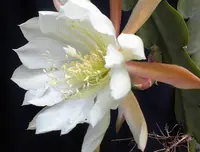
crenate orchid cactus
Disocactus crenatus

Begonia variegata
Begonia variegata
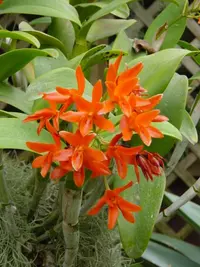
Guarianthe aurantiaca
Guarianthe aurantiaca

arrowhead vine
Syngonium macrophyllum
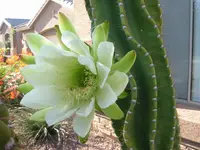
lady of the night cactus
Cereus hexagonus

Persian Ivy
Hedera colchica 'Dentata Variegata'
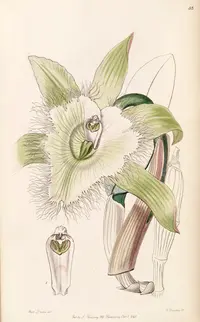
Digby's Beaked Laelia
Rhyncholaelia digbyana
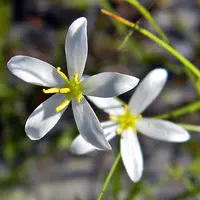
shortleaf rose gentian
Sabatia brevifolia