bent alligator-flag Care (Thalia geniculata)

Also known as: alligator flag, Fireflag
bent alligator-flag

About bent alligator-flag

Bent alligator-flag (Thalia geniculata) is a tall, tropical aquatic perennial often used in water gardens and natural ponds. It forms dense clumps of large, paddle-shaped leaves on long, arching stems.

The plant produces upright flower spikes with purple or violet blooms that rise well above the foliage, followed by decorative seed heads. It naturally occurs in wetlands, marshes, and pond margins in tropical and subtropical regions of the Americas and Africa.

This species prefers consistently wet or shallowly flooded conditions and warm temperatures, so it suits ponds more than typical garden beds. Once sited in stable water and strong light, it is relatively straightforward to care for bent alligator-flag.

Main Plant Requirements

Care Difficulty

Moderate Care

Light Preference

Full Sun

Water Requirements

Aquatic

Temperature Preference

Tropical / Frost Sensitive

Hardiness Zone

8–11

Soil Texture

Loamy, Silty, Organic-rich

Soil pH

Acidic (5.5–6.5), Slightly acidic (6.5–7.0)

Soil Drainage

Waterlogged tolerant

Fertilization

Moderate (every 2–4 weeks)

Get Personalized Care Plan

Scan your plant to receive care tips personalized for your specific plant

Available on iOS and Android

How to Care for the bent alligator-flag

This aquatic perennial needs abundant sun but tolerates some shade, especially in hot climates.

  • Provide 6–8 hours of direct sun daily, ideally strong morning sun with some light afternoon shade in very hot regions.
  • Site bent alligator-flag in open, unshaded pond margins or boggy beds; it copes with light dappled shade but stems may stretch and flowering can decrease.
  • In intense summer sun, monitor for leaf scorching or bleaching and offer partial shade, while in cooler seasons ensure maximum direct exposure to maintain vigor.

This marsh plant thrives in consistently saturated conditions and does not tolerate drying out.

  • Maintain soil or substrate fully saturated; in ponds or bog gardens, allow water to cover the crown by 2–15 cm, ensuring no exposed dry pockets form.
  • If grown at pond edges, never let the top 2–5 cm of soil dry; drooping leaves and crisp margins signal underwatering, while foul odor and black, mushy roots indicate rot.
  • Reduce added water only slightly in cooler months if rainfall is high, but for Thalia geniculata avoid complete drawdown or prolonged low water levels.

This tropical species prefers warm conditions and reacts poorly to cold and frost.

  • Aim for 70–86°F (21–30°C) during the main growing season for strongest leaf and flower production in ponds or bog gardens.
  • Plant in climates where winter lows stay above 50°F (10°C); light chill down to about 41°F (5°C) may be survived, but foliage will often die back.
  • Protect from frost, as freezing can kill rhizomes; in hot spells above 95°F (35°C), ensure ample water depth and some afternoon shade to reduce heat stress.

This marginal aquatic prefers very humid air, matching its naturally swampy habitat.

  • Aim for 60–80% humidity for bent alligator-flag, especially in warm weather.
  • Crisping leaf edges, stalled growth, and browning tips indicate air that is too dry.
  • Group plants near water features, use trays of wet gravel, or grow above a pond to raise humidity.

This species thrives in permanently wet, organic, muck-like substrates rather than conventional potting soil.

  • Use a heavy loam or clay-loam rich in organic matter, such as garden loam mixed with compost or well-rotted manure.
  • Allow no drainage in true bog or pond-edge culture; the root zone should stay saturated or shallowly submerged at all times.
  • Maintain slightly acidic to neutral conditions, roughly pH 6.0–7.0, for stable nutrient availability and root health.
  • Avoid fast-draining sandy mixes or peat-based potting blends that dry out, as the rhizomes are adapted to anoxic, waterlogged conditions.

This tall wetland plant can be grown in large containers if the setup allows constantly saturated or shallowly flooded roots.

  • Choose a wide, heavy tub or half-barrel to prevent tipping as the tall foliage catches wind and becomes top-heavy.
  • Use a solid container or lined cachepot with no open drain holes so water can stand 5–15 cm above the soil surface.
  • Position the container inside a larger water feature or trough to buffer temperature swings and keep the water level consistently high around the root zone.

Thalia geniculata responds well to steady nutrients in warm months, especially in water gardens or rich, wet soils.

  • Use a balanced, slow-release aquatic or general fertilizer (around 10-10-10) at half strength at the start of the growing season.
  • Supplement with compost or well-rotted manure around the root zone to support strong foliage and flowering when growing bent alligator-flag.
  • Feed every 6–8 weeks in spring and summer, avoiding over-application in small containers or ponds.
  • Reduce or stop feeding in fall and winter when growth slows or the plant enters dormancy.

Pruning supports tidy growth and encourages fresh foliage and flowering in Thalia geniculata.

  • Carry out main pruning in late winter or early spring before strong new growth starts.
  • Cut back dead, damaged, or frost-burned stems to the base using clean, sharp pruners.
  • Thin crowded shoots to improve air flow and maintain an open, upright clump form.
  • Remove spent flower stalks down to the foliage line to direct energy into new growth and rhizome strength.

This marginal aquatic is more often transplanted or divided than repotted, especially in ponds and large containers.

  • Transplant or divide in spring when new growth begins and water temperatures start to rise.
  • Look for roots circling a container, crowded rhizomes, or reduced vigor as signals a move or division is needed.
  • Every 2–3 years, lift clumps, trim damaged roots, and replant divisions into fresh, rich, moisture-retentive soil.
  • Keep roots consistently wet after transplanting, provide shade for a few days, and avoid heavy fertilization until new growth stabilizes.

Thalia geniculata is most commonly propagated by division, with seed used mainly for larger-scale growing.

  • Divide mature clumps in spring, when new shoots are 10–15 cm tall and easy to separate.
  • Lift the rhizomes, slice into sections with at least 1–2 healthy buds, and discard soft or diseased tissue.
  • Replant divisions into warm, saturated soil or shallow water, keeping the crown just above the soil surface.
  • For seed, sow in warm (70–80°F), consistently moist conditions and provide bright light to encourage germination.

This tropical to subtropical aquatic is frost-sensitive and benefits from targeted winter care in cooler climates.

  • In mild, frost-free areas, plants can remain outdoors with little more than stable water levels.
  • Where light frosts occur, mulch the root zone heavily and allow top growth to die back naturally.
  • In colder regions, move container-grown plants indoors to a frost-free greenhouse or bright, cool room.
  • Keep roots barely moist, not waterlogged, indoors over winter, then resume full water and feeding in spring.

Care Tips

Aquatic pot choice

Use wide, heavy aquatic baskets lined with fine mesh so the rhizomes can spread while the weight keeps tall stems stable in windy or exposed pond margins.

Secure water depth

Position containers or plantings so crowns sit in stable shallow water (about 5–20 cm above the crown) and place bricks or blocks under pots if water levels in the pond or bog fluctuate through the season.

Rhizome division timing

Divide clumps in late spring, once growth is active and water is warming, and replant divisions immediately at the same depth to reduce transplant shock and maintain strong stands when growing bent alligator-flag.

Stem wind management

In open, windy sites, group multiple plants or place them near solid structures or taller marginal plants to act as windbreaks and reduce bending or snapping of the tall flower stalks.

Nutrient containment

If grown in a lined pond, use slow-release aquatic fertilizer tablets pushed deep into the basket substrate so nutrients stay near the roots and do not fuel nuisance algae in the surrounding water.

Common Pests and Diseases

Canna leafroller

This pest is a small caterpillar that bores into and rolls emerging leaves, causing distorted, tattered foliage and ragged holes along the midrib of bent alligator-flag leaves. Symptoms include webbing and frass (insect droppings) inside tightly rolled leaf spears.

Solution

Handpick and destroy rolled leaves that contain larvae, pruning out heavily infested shoots before the caterpillars pupate. Encourage birds and beneficial insects, and if needed apply a biological insecticide containing Bacillus thuringiensis (Bt) to new foliage, thoroughly wetting leaf surfaces in late afternoon when young larvae are most active.

Spider mites

These insects are tiny sap-feeding arachnids that thrive in hot, dry weather and on plants grown at the water’s edge but not kept constantly wet. Symptoms include fine stippling on leaves, bronzing, and delicate webbing on the undersides of foliage and along midribs.

Solution

Rinse foliage frequently with a strong but gentle stream of water, focusing on leaf undersides to knock mites off. In more serious cases, use insecticidal soap or a horticultural oil labeled for mites, repeating every 5–7 days while temperatures stay below 85°F to avoid leaf burn.

Leaf spot

This disease causes brown to purplish water-soaked spots on leaves that may enlarge, merge, and lead to yellowing and premature leaf collapse, especially in crowded or poorly ventilated ponds. Symptoms include irregular lesions often starting on older leaves near the water surface.

Solution

Remove and discard affected leaves promptly and avoid overhead splashing from pumps that repeatedly wets foliage. Improve spacing and water circulation around the clump, and if the problem persists, apply a fungicide labeled for ornamental pond plants, treating early when new spots first appear.

Rust

This disease produces small yellow to orange spots on the upper leaf surface with corresponding rusty pustules underneath that release powdery spores. Symptoms include gradual weakening of the plant and unattractive foliage, especially under warm, humid, stagnant air conditions near ponds or water gardens.

Solution

Trim and dispose of infected leaves as soon as pustules appear and avoid leaving plant debris around the rhizomes. Improve air movement around the stand and consider a protective fungicide labeled for rust on ornamentals, applied at the first sign of infection and repeated as directed during humid periods.

Aphids

These insects are soft-bodied sap feeders that cluster on young shoots, undersides of leaves, and flower stalks, excreting sticky honeydew that can attract sooty mold. Symptoms include curled or distorted new growth and the presence of ants tending the colonies on stems near the waterline.

Solution

Spray plants with a firm stream of water to dislodge colonies, repeating every few days as needed. For persistent infestations, use insecticidal soap or a light horticultural oil, coating stems and leaf undersides thoroughly while avoiding application during the hottest part of the day.

Interesting Facts

Jointed zigzag stems

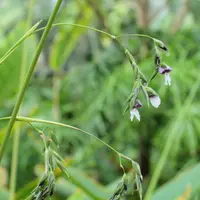
This species has distinctively bent, jointed flowering stalks that zigzag at each node, which is the origin of the common name bent alligator-flag and helps position the flowers over shallow water for better pollination and seed dispersal.

Specialist bee visitors

In its native range, the flowers are frequented by specialized large bees that can handle the sturdy inflorescences and effectively transfer pollen between the small purple and white blossoms.

Wetland stabilizing roots

Its robust rhizomes and dense root system help bind soft, silty substrates in marshes, ditches, and pond margins, making the plant useful in constructed wetlands and shoreline stabilization projects under appropriate climate conditions.

Botan icon

Did you know?

Thalia geniculata is one of the few marginal aquatic ornamentals that forms tall, banana-like foliage while tolerating permanent standing water, which has led to its use in warm-climate water gardens as both an architectural foliage plant and a habitat-creating emergent for amphibians and aquatic invertebrates.

FAQs about bent alligator-flag

This species spreads by rhizomes and self-seeding in shallow water or saturated soil. In warm climates it can form dense clumps, so edging, containers, or periodic division help keep it within the desired area.

Grow Healthy Plants with Botan Care

Keep your plants happy and healthy with plant identification, disease detection, and easy care guidance.

Botan plant care app — identify plants on mobile

Explore More Plants