Manage Spreading Habit
Use shallow edging or sunk nursery pots (10–15 cm deep) around patches to limit rhizome and runner spread while still allowing a dense flowering mat where you want it.

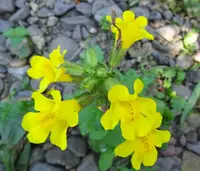
Small leaved monkeyflower, Erythranthe guttata, is a moisture-loving perennial often found along streams, pond edges, and wet meadows. It is commonly grown in native and wildlife-friendly gardens. This plant forms low, spreading clumps with small leaves and bright yellow, spotted, tubular flowers that attract bees and other pollinators. It can self-seed and spread where conditions are suitable. Erythranthe guttata is generally easy to grow if given consistently damp soil and good light, though it may become less vigorous in dry or very hot sites. Understanding how to care for small leaved monkeyflower starts with providing a cool, moist root zone and avoiding prolonged drought.

Care Difficulty
Moderate Care

Light Preference
Full Sun

Water Requirements
Aquatic

Temperature Preference
Cool Climate

Hardiness Zone
3–9

Soil Texture
Loamy, Silty, Organic-rich

Soil pH
Acidic (5.5–6.5), Slightly acidic (6.5–7.0)

Soil Drainage
Waterlogged tolerant

Fertilization
Minimal (feed rarely)
Scan your plant to receive care tips personalized for your specific plant
Available on iOS and Android
This moisture-loving wildflower prefers bright conditions with protection from harsh midday sun.
This species thrives in consistently moist to wet soil and does poorly if allowed to dry out deeply.
This plant grows best in cool to mild conditions and prefers avoidance of temperature extremes.
This species prefers moderate to high humidity but adapts to many outdoor conditions.
This riparian species prefers consistently moist, organic-rich, fine-textured soil.
This species is suitable for container growing when moisture needs are managed carefully.
This wetland perennial needs only light feeding, especially when grown in natural or rich soil sites.
Targeted pruning keeps Erythranthe guttata dense, tidy, and flowering well.
This species is more often transplanted in garden beds or wet margins than grown long term in containers.
Erythranthe guttata is commonly propagated by seed, division, and soft stem cuttings.
In many regions this plant behaves as a hardy or short-lived perennial with modest winter needs.

Plant Health Check
Not sure what's wrong with your plant? Check your plant's health inside the app.
This species shows striking phenotypic plasticity, forming tiny creeping mats in nutrient-poor seeps but tall, branched plants with much larger leaves and flowers in richer, wetter soils, all within the same genetic population.
It commonly occupies stream banks, seeps, and saturated soils where roots tolerate periodic flooding and moving water, helping stabilize fine sediments in these dynamic riparian zones.
Although native to western North America, it has become naturalized and locally invasive in parts of Europe and New Zealand, where it can form dense stands that compete with local wetland flora.

The flowers are adapted for bee pollination with a wide, speckled lower lip that acts as a landing platform, and the corolla reacts to touch so that when a bee pushes inside, the stigma lobes close around the body and increase the chance of precise pollen transfer.
This species spreads quickly by seed and creeping stems in moist soil, especially along ponds or streams. In favorable conditions it can form dense patches, so use edging, containers, or regular thinning if space is limited.
Keep your plants happy and healthy with plant identification, disease detection, and easy care guidance.