Cut-and-come harvesting
Harvest outer leaves regularly by cutting them 2–3 cm above the crown instead of pulling, which encourages continuous new growth and reduces damage to the root system when growing Ribwort Plantain.

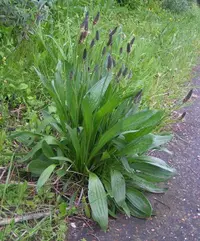
Ribwort plantain (Plantago lanceolata) is a hardy perennial herb often found in lawns, meadows, and roadsides. It forms a low rosette of narrow, upright leaves with distinct parallel veins and sends up slender flower spikes.
This species is native to Europe and western Asia but is now naturalized across much of North America and other temperate regions. It tolerates mowing, foot traffic, and poor soils, which makes it persistent in managed grass areas.
The plant is generally easy to grow, adapting to full sun or light shade and a wide range of soil types, as long as drainage is reasonable. Those who want to learn how to care for Ribwort Plantain usually find it forgiving and resilient once established.

Care Difficulty
Easy Care

Light Preference
Full Sun

Water Requirements
Moderate Water

Temperature Preference
Cold Hardy

Hardiness Zone
3–9

Soil Texture
Sandy, Loamy, Clay

Soil pH
Slightly acidic (6.5–7.0), Slightly alkaline (7.0–7.5)

Soil Drainage
Well-drained

Fertilization
Minimal (feed rarely)
Scan your plant to receive care tips personalized for your specific plant
Available on iOS and Android
This species prefers open, bright conditions typical of meadows and grasslands.
This plant is adapted to moderately dry, well-drained soils and does not need frequent watering once established.
This hardy perennial tolerates a wide temperature range typical of temperate climates.
Humidity is rarely critical for Plantago lanceolata, which adapts well to typical outdoor air levels.
Plantago lanceolata prefers lean, well-drained mineral soils and tolerates relatively poor conditions.
This species can be grown in containers if the setup avoids prolonged wetness and shallow rooting.
Plantago lanceolata grows well in modest soils and usually needs only light feeding in cultivation.
Pruning Plantago lanceolata is simple and mainly helps keep plants tidy and productive.
This species is usually grown outdoors and benefits more from careful transplanting than frequent repotting.
Plantago lanceolata is most often propagated from seed, with division used for established clumps.
This hardy perennial tolerates typical outdoor winter conditions in much of the US and generally needs little special care.

Plant Health Check
Not sure what's wrong with your plant? Check your plant's health inside the app.
This species has long, narrow, ribbed leaves that are specially adapted to withstand mowing and trampling in lawns, pastures, and along paths, allowing the plant to persist where broader-leaved species are damaged.
Unlike many meadow plants that rely on insects, this plant is primarily wind‑pollinated; its tall, slender flower spikes lift the stamens into the air so pollen can be carried efficiently by wind currents.
It commonly appears and persists in grazed pastures and compacted soils, so its presence is often used by agronomists and ecologists as an indicator of disturbed, nutrient-rich grassland conditions.

Genetic studies show that this species, although native to Europe and western Asia, has rapidly formed locally adapted populations in North America and other introduced regions, making it a frequently used model organism for research on plant adaptation and evolution in new environments.
This species spreads readily by seed and short rhizomes, especially in lawns, paths, and disturbed ground. It is not as aggressive as some invasive weeds, but unmanaged plants can form dense patches and outcompete low-growing vegetation.
Keep your plants happy and healthy with plant identification, disease detection, and easy care guidance.