Container depth choice
Use a wide, shallow aquatic basket or pot 20–30 cm deep so rhizomes can spread horizontally while leaves and flower spikes remain upright and stable in moving or still water.

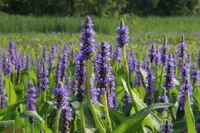
Pickerelweed, Pontederia cordata, is a hardy aquatic perennial commonly found along the edges of ponds, lakes, and slow-moving streams. It forms dense clumps that stabilize shallow shorelines and provide habitat for wildlife. Its upright, lance-shaped leaves and spikes of violet-blue flowers create a strong vertical accent in water gardens and naturalistic landscapes. Plants spread gradually by rhizomes and can form attractive colonies in suitable conditions. This species prefers full sun, consistently wet or shallowly submerged roots, and nutrient-rich, muddy or sandy substrates. These traits make it relatively straightforward to care for pickerelweed in most outdoor water features.

Care Difficulty
Easy Care

Light Preference
Full Sun

Water Requirements
Aquatic

Temperature Preference
Cold Hardy

Hardiness Zone
3–10

Soil Texture
Loamy, Silty, Organic-rich

Soil pH
Slightly acidic (6.5–7.0), Neutral (7.0)

Soil Drainage
Waterlogged tolerant

Fertilization
Minimal (feed rarely)
Scan your plant to receive care tips personalized for your specific plant
Available on iOS and Android
This aquatic perennial grows best with strong light that supports dense foliage and flowering.
This species is adapted to shallow water margins and needs consistently saturated conditions.
This hardy marginal plant tolerates a broad temperature range but grows most actively in warm conditions.
This aquatic species prefers very high humidity and constant water saturation rather than typical room air conditions.
This plant grows best in permanently wet, organic-rich substrates that mimic shallow pond or marsh edges.
This species is suitable for container growing when the pot is treated as a mini aquatic or bog environment.
This aquatic perennial grows well in nutrient-rich water but benefits from moderate, targeted feeding in containers or poor soils.
Pruning helps Pontederia cordata stay tidy, limit self-seeding, and direct energy into strong new growth.
This marginal aquatic is more often transplanted or divided than traditionally repotted, especially in ponds and water gardens.
Pontederia cordata is commonly propagated by division and can also be grown from seed under controlled conditions.
This hardy marginal aquatic tolerates typical temperate winters with minimal intervention, especially when grown in-ground in ponds.

Plant Health Check
Not sure what's wrong with your plant? Check your plant's health inside the app.
The purple flower spikes are mainly pollinated by long-tongued bees, which are able to reach nectar deep inside the tubular flowers while transferring pollen between tightly packed blooms.
Its spongy stems and rhizomes contain extensive aerenchyma, a tissue filled with air spaces that helps transport oxygen from the leaves to submerged roots in low-oxygen mud.
The plant’s hard, nut-like seeds often survive passage through the digestive tracts of ducks and other waterfowl, which then spread the seeds to new wetlands as they travel.
In some constructed wetland systems, Pontederia cordata is intentionally planted because its dense root and rhizome network helps stabilize shorelines and supports microbial communities that aid in filtering and improving water quality.
This aquatic species is highly attractive to bees, butterflies, and other pollinating insects. The dense spikes of blue flowers provide nectar and pollen through summer, supporting local biodiversity and improving ecological value around ponds and wetlands.
Keep your plants happy and healthy with plant identification, disease detection, and easy care guidance.