Early wind training
Expose young plants to moderate wind or gently move stems by hand a few times per week so they develop thicker, sturdier stems that better resist lodging in midsummer storms.


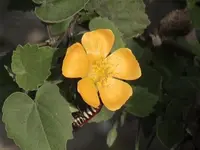
Kenaf, Hibiscus cannabinus, is a fast-growing annual fiber crop in the mallow family, related to okra and hibiscus. It is grown mainly for its strong, lightweight stem fibers. The plant forms tall, upright stems with lobed leaves and hibiscus-like flowers, usually cream or yellow with a darker center.
Kenaf is native to Africa and Asia but is now cultivated in warm regions worldwide for industrial fiber, paper, and biocomposite uses. It grows quickly in full sun, warm temperatures, and well-drained, fertile soil. Once established, it is generally robust, which makes it straightforward to care for Kenaf in suitable outdoor conditions.

Care Difficulty
Moderate Care

Light Preference
Full Sun

Water Requirements
Regular Water

Temperature Preference
Tropical / Frost Sensitive

Hardiness Zone
9–11

Soil Texture
Sandy, Loamy, Organic-rich

Soil pH
Acidic (5.5–6.5), Slightly acidic (6.5–7.0)

Soil Drainage
Moist but well-drained

Fertilization
Moderate (every 2–4 weeks)
Scan your plant to receive care tips personalized for your specific plant
Available on iOS and Android
Hibiscus cannabinus performs best in strong, direct sun during the growing season.
Hibiscus cannabinus prefers consistently moist, but not waterlogged, soil during active growth.
This species grows best in warm, frost-free conditions typical of long summer seasons.
This species prefers moderate humidity but adapts to typical indoor air if watered correctly.
Hibiscus cannabinus performs best in loose, deep, well‑drained soil that still holds consistent moisture.
This tall annual can be grown in containers if the pot provides enough depth and stability for its fast growth.
Hibiscus cannabinus responds well to modest, steady nutrition during its active growing season.
Pruning Hibiscus cannabinus helps maintain a manageable shape and encourages bushier growth.
Hibiscus cannabinus is usually grown as an annual field or garden crop, so transplanting young plants is more relevant than repotting mature ones.
Hibiscus cannabinus is most often propagated from seed, which provides reliable and uniform stands.
Hibiscus cannabinus is typically grown as a frost-sensitive annual and does not tolerate freezing conditions.

Plant Health Check
Not sure what's wrong with your plant? Check your plant's health inside the app.
This species has been cultivated for thousands of years as a bast fiber plant, especially in Africa and Asia, for making rope, coarse textiles, and sackcloth due to its strong, long fibers in the stem bark.
The plant flowers in response to shortening day length, which means its flowering time and productivity are strongly influenced by latitude and sowing date in field cultivation.
Under warm, frost-free conditions with adequate moisture, this annual can reach 2–4 m in a single season and produce substantial stem biomass that is used for paper pulp and bio-based materials.

Kenaf was trialed by several paper manufacturers as a wood-pulp alternative because its fast growth and high cellulose content allow paper production with less land and potentially lower environmental impact than traditional timber sources.
Leaf yellowing often comes from nutrient deficiency, waterlogging, or natural aging of older foliage. Check drainage, avoid standing water, and provide balanced fertilizer with nitrogen and micronutrients. Cool temperatures and root damage can also slow metabolism and cause chlorosis.
Keep your plants happy and healthy with plant identification, disease detection, and easy care guidance.