Green Feather Alga Care (Caulerpa sertularioides)

Green Feather Alga

About Green Feather Alga

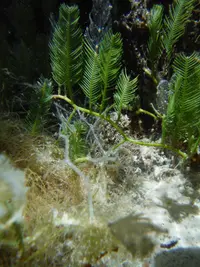
Green feather alga, Caulerpa sertularioides, is a marine macroalga commonly kept in saltwater aquariums and refugiums. It forms dense, feather-like fronds rising from creeping stolons that spread across sand or rock.

In nature it occurs in shallow tropical and subtropical coastal waters, especially in the Caribbean and western Atlantic, where it stabilizes sandy substrates and provides habitat for small marine animals. It grows quickly under stable conditions, which makes it useful for nutrient export but also means it can overrun small tanks if not managed.

To care for Green Feather Alga, provide stable salinity, good water movement, and moderate to strong light, with access to dissolved nutrients but not heavily polluted water.

Main Plant Requirements

Care Difficulty

Moderate Care

Light Preference

Partial Sun

Water Requirements

Aquatic

Temperature Preference

Tropical / Frost Sensitive

Hardiness Zone

Unknown

Soil Texture

Sandy, Organic-rich

Soil pH

Slightly alkaline (7.0–7.5), Alkaline (7.5–8.5)

Soil Drainage

Waterlogged tolerant

Fertilization

Minimal (feed rarely)

Get Personalized Care Plan

Scan your plant to receive care tips personalized for your specific plant

Available on iOS and Android

How to Care for the Green Feather Alga

This marine alga needs stable, moderate light that mimics bright, shallow coastal waters.

  • Provide 6–10 hours of moderate, indirect light per day; in shallow outdoor setups, use filtered sunlight or light shade rather than intense, overhead midday sun.
  • Green Feather Alga tolerates partial shade but becomes sparse or elongated if light is too low; increase intensity gradually if fronds pale or stretch.
  • In aquaria, use full-spectrum lighting matched to marine setups and adjust seasonally, reducing intensity slightly in midsummer to limit overheating and algal stress.

This species requires consistently clean, well-oxygenated saltwater rather than soil-based watering.

  • Maintain stable salinity and avoid sudden changes; top off evaporation with fresh water while matching the marine system’s usual parameters to prevent osmotic stress in Caulerpa sertularioides.
  • Strong water movement is important; aim for steady circulation that gently moves the fronds, which helps prevent detritus buildup and localized oxygen depletion.
  • Signs of poor conditions include yellowing, melting fronds, or foul odor from decaying tissue; improve flow, check salinity, and perform partial water changes instead of simply adding more water.

This warm-water marine alga prefers stable, mild temperatures with minimal daily swings.

  • Aim for 72–79°F (22–26°C) for steady growth; this range suits most tropical marine systems and supports healthy photosynthesis and nutrient uptake.
  • Avoid temperatures below 68°F (20°C); prolonged exposure near 64°F (18°C) or lower slows growth, increases stress, and can lead to tissue dieback.
  • High temperatures above 82–84°F (28–29°C) reduce oxygen levels and may trigger rapid decay; in summer, use fans, chillers, or reduced lighting to keep the system within the optimal band.

This marine alga needs fully submerged, water-saturated conditions rather than air humidity control.

  • Maintain constant submersion in clean, aerated seawater at 100% water saturation, as Green Feather Alga desiccates quickly in exposed air.
  • Avoid emersed setups; fronds exposed to air show paling, shrinking, and crisping tips from dehydration stress.
  • Increase water humidity at the surface with covered tanks or sumps to limit evaporation and salt creep that can dry exposed portions.

Caulerpa sertularioides anchors in substrate rather than true soil, but substrate structure strongly affects health.

  • Use 5–8 cm of fine to medium aragonite sand or marine-grade sand; aim for a loose, friable texture that allows rhizoids to penetrate easily.
  • Ensure moderate water flow through the substrate so it stays oxygenated; very compact or stagnant sand leads to anoxic zones and decaying runners.
  • Keep marine pH stable, typically 8.0–8.4, using aragonite-based substrates that help buffer against pH swings in saltwater systems.
  • Avoid silty, muddy, or deep gravel beds that trap detritus; periodically vacuum around, not directly through, the holdfasts to maintain aeration and prevent smothering.

This species can be grown in containers such as marine refugiums or sectioned aquarium compartments.

  • Choose shallow, wide containers that allow horizontal spread of runners without piling fronds so densely that lower portions lose light and flow.
  • Secure the container to prevent shifting, since moving substrate can uproot holdfasts and cause the alga to float and tangle with equipment.
  • Use a perforated or slotted inner tray so water circulates freely through the substrate while still confining the spreading growth.

Caulerpa sertularioides grows fast and benefits from moderate, controlled nutrition in aquaria or marine systems.

  • Use a balanced NPK marine-safe fertilizer or all-in-one reef plant supplement, never terrestrial compost or slow-release pellets in the tank.
  • Feed lightly every 2–4 weeks in the main growing season, adjusting based on visible growth and nutrient test results.
  • Dilute liquid fertilizers to 25–50% of the aquatic manufacturer’s recommendation to limit algae imbalance and nutrient spikes.
  • Reduce or pause dosing in winter or low-light periods when growth slows, resuming only when new fronds extend actively.

Caulerpa sertularioides responds well to thoughtful trimming, which helps control spread and maintain healthy fronds in aquaria.

  • Trim during active growth, typically spring through early fall, when the alga recovers fastest from cutting.
  • Remove yellowing, damaged, or heavily shaded fronds, plus overly dense patches that block water flow or light.
  • Cut stolons and fronds with clean scissors close to the base, avoiding complete removal of any single patch at once.
  • Shaping through selective thinning encourages compact, healthier mats and reduces the risk of entire-colony die-off.

This marine alga is usually transplanted rather than repotted, as it is anchored in sand or rubble within an aquarium or marine system.

  • Transplant when growth becomes too dense, covers filtration intakes, or shades other organisms, not on a fixed schedule.
  • Best timing is during strong growth, typically warmer months, to help the alga re-anchor and resume photosynthesis rapidly.
  • Gently lift sections with attached holdfasts and substrate, disturbing the root-like structures as little as possible.
  • Replant small clumps in similar light and flow conditions, and avoid drastic changes in salinity or temperature to limit stress.

This species is commonly multiplied by vegetative division, using stolon and frond sections rather than spores or seeds.

  • Take cuttings from healthy, fast-growing stolons in the main growing season when light and temperature are stable.
  • Cut segments with several side branches and intact holdfasts, using sharp, clean scissors to reduce tissue damage.
  • Place cut pieces on or slightly into sandy or rubble substrate with moderate water flow and good lighting for photosynthesis.
  • Maintain stable salinity, nutrients, and 72–80°F water to support growing Green Feather Alga fragments and prevent decay.

In indoor marine systems with stable heating, Caulerpa sertularioides needs minimal seasonal adjustment, but cold exposure is harmful.

  • Maintain water temperature within the species’ preferred range, avoiding drops below roughly 68°F that can damage tissue.
  • For outdoor or unheated systems, move containers indoors or to a heated setup before ambient temperatures fall in late fall.
  • Stabilize light duration and intensity in winter to reduce stress that might trigger large-scale die-off events.

Care Tips

Regular Thallus Trimming

Trim fast-growing runners weekly with clean scissors to prevent overgrowth, maintain good water flow, and reduce the risk of the alga going sexual (sudden mass spore release).

Secure To Substrate

Pin or lightly weigh down young fronds and stolons with reef-safe plant weights or small rocks so the holdfasts can attach firmly and form a dense, stable mat.

Nutrient Export Management

Harvest and remove a portion of the biomass on a schedule (for example every 1–2 weeks) to physically export absorbed nitrates and phosphates and keep nutrient levels stable in the system.

Reverse-Phase Lighting

Run the alga’s light on a reverse schedule to the main display tank (refugium lit at night, dark by day) to help stabilize pH and reduce nighttime pH swings in marine systems.

Quarantine And Rinse

Before introducing to a display tank, keep new specimens in a separate saltwater container for several days and rinse thoroughly to reduce hitchhiking pests and unwanted algae, which simplifies caring for Green Feather Alga over time.

Common Pests and Diseases

Herbivorous snails

These pests scrape and tear fronds, leaving ragged edges, clear bite marks, and thinning areas on the thallus. Symptoms include slowed growth and sometimes complete loss of fine feather-like tips.

Solution

Remove visible snails by hand, use snail traps, and reduce overfeeding of fish that supports large snail populations. In tanks without sensitive invertebrates, a snail-eating fish or carefully chosen invertebrate grazer can help, and damaged fronds should be trimmed to encourage healthy regrowth.

Turf algae overgrowth

This disease-like overgrowth occurs when fast-growing filamentous or turf algae colonize fronds, smothering them and blocking light. Symptoms include fuzzy, dark green or brown coatings and gradual dieback of shaded sections.

Solution

Manually remove affected fronds or gently brush off algae, then reduce nutrient levels by adjusting feeding, improving filtration, and performing regular water changes. Increasing herbivorous cleanup crew species and stabilizing lighting duration helps prevent recurring overgrowth and supports Caulerpa sertularioides care instructions in marine aquaria.

Bryopsis infestation

This pest algae grows as fine, fern-like tufts on or around the plant, competing for nutrients and light. Symptoms include localized patches of soft, dark green filaments that are hard to dislodge and spread quickly.

Solution

Carefully remove infested fronds and siphon out loose tufts during water changes, avoiding fragmentation that can spread it. Stabilize and slightly lower nutrient levels, keep magnesium, alkalinity, and other water parameters within recommended reef ranges, and use appropriate herbivores known to graze Bryopsis where compatible with the system.

Caulerpa melt

This disease-like collapse occurs when the plant suddenly turns pale, translucent, and begins to disintegrate, often after stress from drastic light, temperature, or salinity changes. Symptoms include rapid breakdown of entire sections, releasing greenish liquid into the water.

Solution

Immediately remove all melting material to prevent nutrient spikes, then perform substantial water changes and increase mechanical filtration and activated carbon use. Stabilize light intensity, photoperiod, temperature, and salinity, and reintroduce only healthy, quarantined fronds once tank conditions are steady.

Bacterial frond decay

This disease develops as localized soft, brown or darkened patches on fronds that become mushy and detach easily, often following mechanical damage or poor water quality. Symptoms include foul odor from decaying tissue and progressive loss of affected branches.

Solution

Prune and remove all soft or discolored sections and siphon away debris, then correct underlying stress by improving water movement, oxygenation, and filtration. Maintain low organic waste levels, avoid overfeeding, and keep temperature within the recommended range for the tank inhabitants to reduce recurrence.

Interesting Facts

Feather-like thallus structure

This alga forms highly divided, feather-shaped fronds arising from creeping stolons, creating dense underwater meadows that increase habitat complexity for small invertebrates and juvenile fishes.

Rapid vegetative spread

Instead of producing many visible reproductive structures, it primarily expands by fast-growing stolons and upright fronds, allowing quick colonization of sandy and muddy substrates in shallow tropical and subtropical waters.

Nighttime toxin release

Laboratory studies show that its tissues contain caulerpenyne, a defensive compound that can be released into the surrounding water, especially at night, helping deter herbivorous fishes and invertebrates from grazing heavily on the fronds.
Botan icon

Did you know?

In some coastal areas of the Caribbean and Gulf of Mexico, this species forms extensive underwater carpets that can stabilize soft sediments, reducing erosion and creating sheltered microhabitats that markedly increase local small-animal diversity compared with adjacent bare sand.

FAQs about Green Feather Alga

In stable marine aquarium conditions, this species can extend several centimeters per week. Growth speed depends on light intensity, nutrient availability, and water stability. Regular trimming is important to prevent it from shading corals or clogging rockwork.

Grow Healthy Plants with Botan Care

Keep your plants happy and healthy with plant identification, disease detection, and easy care guidance.


Botan plant care app — identify plants on mobile

Explore More Plants