Provide climbing support
Install a sturdy trellis or vertical mesh and loosely tie young shoots with soft garden ties so the plant can climb and form a stable framework instead of sprawling and snapping under its own weight.

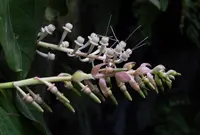
Cavendishia grandifolia is an evergreen shrub or small vine in the heath family, valued for its showy tubular flowers and glossy foliage. It often grows as an epiphyte, rooting into mossy tree branches rather than soil. Native to cloud forests of the Andes in South America, it prefers cool, moist, and humid conditions with bright, filtered light. The plant can be challenging outside specialized collections because it dislikes heat, dry air, and hard, alkaline water. Gardeners who care for Cavendishia grandifolia usually focus on providing consistently moist, acidic, well-drained substrate and protection from strong sun and temperature extremes.

Care Difficulty
Hard Care

Light Preference
Partial Shade

Water Requirements
Keep Soil Moist

Temperature Preference
Tropical / Frost Sensitive

Hardiness Zone
11–12

Soil Texture
Loamy, Peaty, Organic-rich

Soil pH
Strongly acidic (4.5–5.5), Acidic (5.5–6.5)

Soil Drainage
Moist but well-drained

Fertilization
Light (every 4–6 weeks)
Scan your plant to receive care tips personalized for your specific plant
Available on iOS and Android
This cloud-forest shrub prefers bright, gentle light that mimics high-elevation woodland edges.
Moist, cool, well-drained soil is essential for healthy root function in this species.
This plant performs best in cool to mild conditions similar to humid highland forests.
This cloud-forest shrub needs high, consistent humidity to thrive in cultivation.
This species prefers an airy, organic, acidic substrate similar to epiphytic ericaceous shrubs.
This species adapts well to container growing when the pot supports its shrubby, sometimes scandent habit.
This cloud-forest shrub benefits from modest, steady nutrition rather than heavy feeding.
Light, thoughtful pruning keeps this shrub compact and flowering well without stressing it.
This species dislikes frequent disturbance, so repot or transplant only when clear signs appear.
Propagation is possible but somewhat specialized, so it is usually done by experienced growers or nurseries.
This is a frost-sensitive shrub that needs protection in climates with cold winters.

Plant Health Check
Not sure what's wrong with your plant? Check your plant's health inside the app.
In its native Andean cloud forests, this species is primarily pollinated by hummingbirds that can access nectar from the long, tubular flowers, while at the same time transferring pollen between plants.
Although it forms a woody shrub, it often grows as an epiphyte on mossy tree branches, using them only for physical support while obtaining water and nutrients from rain, mist, and decomposing organic matter around its roots.
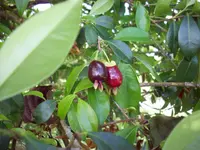
The plant produces striking bright blue to bluish-purple berries that are edible and have a mildly sweet flavor, and in some regions they are collected locally as a small wild fruit resource.

This species is native to high-elevation cloud forests in countries such as Ecuador and Colombia, where it is adapted to persistently cool, moist, and foggy conditions that many other shrubs cannot tolerate.
This species performs best outdoors in mild, humid, frost‑free climates where it can develop a larger framework and flower more heavily. In cooler regions, it can be grown in containers and moved indoors during cold periods.
Keep your plants happy and healthy with plant identification, disease detection, and easy care guidance.