Early framework training
In the first 2–3 years, select 3–5 strong main stems and remove weak, crossing, or low branches to build an open, vase-like framework that is easier to maintain and harvest around later.

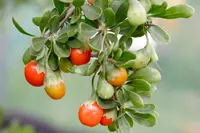
African boxthorn (Lycium ferocissimum) is a dense, woody shrub known for its stiff, spiny branches and small, glossy green leaves. It often forms tangled thickets that can become very robust over time.
The plant produces pale purple flowers followed by bright orange to red berries, which are attractive but not suitable for eating. It naturally occurs in South Africa and has become naturalized in coastal and semi-arid regions of Australia and other mild climates.
This species is tough and drought-tolerant, adapting well to poor, sandy, or rocky soils. It prefers full sun and good drainage, so understanding how to care for African boxthorn starts with giving it a bright, dry, and open position.

Care Difficulty
Easy Care

Light Preference
Full Sun

Water Requirements
Low Water

Temperature Preference
Warm Climate

Hardiness Zone
8–11

Soil Texture
Sandy, Loamy, Rocky

Soil pH
Slightly acidic (6.5–7.0), Slightly alkaline (7.0–7.5)

Soil Drainage
Well-drained

Fertilization
Minimal (feed rarely)
Scan your plant to receive care tips personalized for your specific plant
Available on iOS and Android
Lycium ferocissimum thrives in strong sunlight typical of open, coastal or inland scrub habitats.
This drought-tolerant shrub prefers infrequent, deep watering rather than frequent light applications.
This hardy shrub adapts to a wide range of outdoor temperatures once established.
This shrub tolerates a wide humidity range and usually does not need special humidity management.
Lycium ferocissimum prefers lean, well-drained, slightly alkaline soil that does not stay wet.
This species can be grown in containers, but it needs careful control of root space and stability.
Lycium ferocissimum is a tough shrub that usually needs only light feeding in average garden soil.
Lycium ferocissimum responds well to controlled pruning that maintains a dense, manageable form.
This species is more often transplanted in the landscape than grown long term in containers.
Lycium ferocissimum is commonly propagated from both seeds and semi‑hardwood cuttings.
This shrub is moderately cold hardy and usually needs little winter care in mild to medium climates.

Plant Health Check
Not sure what's wrong with your plant? Check your plant's health inside the app.
This South African shrub has become a serious invasive species in Australia and New Zealand, forming dense, thorny thickets that displace native coastal vegetation and alter dune dynamics.
Its bright orange-red berries are eaten by many bird species, which pass the hard seeds through their digestive systems and spread them over long distances, greatly aiding its invasion.
The branches carry long, rigid, often three-pronged thorns that can seriously injure livestock and people, and these spines help create nearly impenetrable hedges once plants are established.

In parts of southern Australia, dense thickets of this species have been used historically as makeshift fences and boundary barriers on farms because their interlocking, thorny branches can block livestock about as effectively as conventional wire fencing when allowed to grow unchecked.
This species spreads very aggressively through bird-dispersed seeds and suckering roots. In many regions it is classed as a serious invasive shrub and should be contained with barriers, regular pruning, and prompt removal of unwanted seedlings.
Keep your plants happy and healthy with plant identification, disease detection, and easy care guidance.