Encourage Deep Roots
Provide occasional deep soakings followed by long dry periods during establishment so roots grow downward rather than remaining near the surface, which improves drought resilience when growing Cheesebush in arid landscapes.

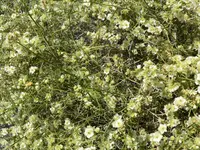
Cheesebush (Ambrosia salsola) is a small, aromatic shrub native to arid and semi-arid regions of the southwestern United States and northern Mexico. It often grows on dry, sandy, or rocky soils in open desert landscapes and scrub.
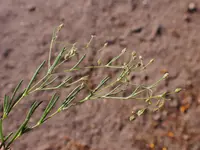
Plants form rounded, bushy mounds with many thin, gray-green stems and small, narrow leaves that can give a soft, hazy look from a distance. The foliage has a distinct scent when crushed.
This species is adapted to drought, poor soils, and strong sun, which makes it tough in dry climates but less suitable for lush, high-water gardens. Those who care for Cheesebush should provide full sun, minimal irrigation, and sharply drained soil to mimic its native conditions.

Care Difficulty
Easy Care

Light Preference
Full Sun

Water Requirements
Low Water

Temperature Preference
Warm Climate

Hardiness Zone
8–11

Soil Texture
Sandy, Loamy, Rocky

Soil pH
Neutral (7.0), Slightly alkaline (7.0–7.5)

Soil Drainage
Well-drained

Fertilization
Minimal (feed rarely)
Scan your plant to receive care tips personalized for your specific plant
Available on iOS and Android
Ambrosia salsola thrives in strong sun typical of arid and semi-arid habitats.
This desert-adapted shrub prefers infrequent, deep watering and fast-drying soil.
This species is heat-tolerant but less tolerant of hard freezes.
This desert shrub tolerates low humidity and usually does not need special moisture control indoors.
Ambrosia salsola prefers very lean, fast-draining, sandy soil that mimics arid habitats.
This species can be grown in containers if the pot is set up to drain and dry quickly.
This desert-adapted shrub usually needs little feeding, so focus on avoiding excess nutrients when caring for Cheesebush.
Pruning Ambrosia salsola is mainly corrective, helping maintain a compact, healthy shrub in managed landscapes.
Ambrosia salsola is usually grown in the ground, so focus on careful transplanting rather than frequent repotting.
This species is most often propagated by seed, which reflects its natural life cycle in dry habitats.
In its typical range Ambrosia salsola is quite cold tolerant and usually needs minimal winter care.

Plant Health Check
Not sure what's wrong with your plant? Check your plant's health inside the app.
This species is a low, intricately branched shrub native to arid regions of the southwestern United States and northern Mexico, adapted to dry washes, desert slopes, and disturbed sandy soils where few other broadleaf plants persist year-round.
Although it looks like a small shrub rather than a typical ragweed, it belongs to the same genus as common ragweed and produces inconspicuous wind-pollinated flowers that can contribute to seasonal airborne pollen in its native range.
The plant often appears on overgrazed rangelands, roadsides, and other disturbed sites, where its tolerance of poor, compacted, and saline soils allows it to establish and help stabilize the surface against erosion.
This species can spread readily by seed in open, disturbed, or dry sites. In suitable climates it may form dense patches and displace other vegetation, so regular monitoring and prompt removal of unwanted seedlings are important.
Keep your plants happy and healthy with plant identification, disease detection, and easy care guidance.