Summer dormancy rest
Reduce handling and avoid repotting or dividing during the plant’s hot, dry summer dormancy, as disturbing the roots at this stage weakens the next growth cycle.

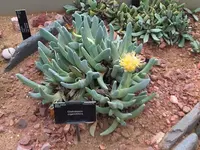
Fag Clockfig is a compact, clump-forming succulent from the arid regions of South Africa and Namibia. It belongs to the genus Cheiridopsis, known for drought-adapted species. Cheiridopsis namaquensis has thick, paired leaves that form small, low rosettes and often develop a bluish or grey-green surface with a waxy bloom. In season it produces daisy-like flowers that open in bright light and give the plant a striking look despite its small size. This species suits patient growers who can mimic a dry, bright habitat and respect its strong seasonal rest period. Those who care for Fag Clockfig should provide very fast-draining soil and careful watering to avoid root problems.

Care Difficulty
Moderate Care

Light Preference
Full Sun

Water Requirements
Low Water

Temperature Preference
Tropical / Frost Sensitive

Hardiness Zone
10–11

Soil Texture
Sandy, Rocky, Loamy

Soil pH
Slightly acidic (6.5–7.0), Neutral (7.0)

Soil Drainage
Well-drained

Fertilization
Minimal (feed rarely)
Scan your plant to receive care tips personalized for your specific plant
Available on iOS and Android
Cheiridopsis namaquensis thrives in bright, intense light that mimics its South African desert habitat.
Cheiridopsis namaquensis requires very sparse watering and is highly sensitive to excess moisture.
This succulent prefers warm, dry conditions with mild winters and does not tolerate hard frost.
This South African succulent prefers very dry air and rarely needs added humidity.
Cheiridopsis namaquensis requires a very fast-draining, mineral-rich mix to prevent root rot.
This compact succulent is well suited to container growing.
Cheiridopsis namaquensis is a low-nutrient desert succulent that needs only light feeding in containers, an important point when caring for Fag Clockfig.
Cheiridopsis namaquensis needs minimal pruning, focused on hygiene rather than reshaping the plant.
This compact succulent prefers infrequent repotting and only needs a move when clearly rootbound or the soil has degraded.
This species is most often propagated from seed, with some growers also dividing mature clumps.
This succulent is not frost hardy and needs cool, very dry, and bright conditions in winter, especially in colder climates.

Plant Health Check
Not sure what's wrong with your plant? Check your plant's health inside the app.
The daisy-like flowers typically open in the late afternoon or evening and close again by morning, an adaptation to the cooler, low-humidity hours in its native arid habitat.
This species grows in compact pairs of thick, bluish-green leaves each season, with new pairs emerging from between the older ones, which gradually shrivel and protect the developing growth.
In the wild it often grows among pale quartz gravel in Namaqualand, where the leaf color and spotting help it blend into the stony background and reduce overheating from intense sun.
Lack of flowers usually comes from insufficient cool, bright winter conditions or too much summer water. This species needs a distinct rest period when older leaf pairs dry. Avoid fertilizing heavily and keep growth compact to support flowering.
Keep your plants happy and healthy with plant identification, disease detection, and easy care guidance.