Establish strong framework
In the first 3–4 years, select 3–5 well-spaced main stems and remove competing shoots or narrow crotch branches to create a stable, vase-shaped framework that resists storm damage as the tree matures.

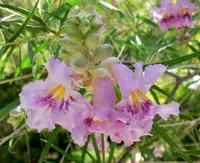
Desert willow, Chilopsis linearis, is a small, deciduous tree or large shrub native to arid regions of the southwestern United States and northern Mexico. It naturally grows along desert washes and dry streambeds.
This plant has narrow, willow-like leaves and produces abundant tubular flowers in shades of pink, purple, or white that attract hummingbirds and pollinators. Its open, multi-stemmed form and textured bark give it strong landscape character.
Desert willow is generally easy to grow because it tolerates heat, drought, and poor, well-drained soils once established. It prefers full sun and low to moderate moisture, which guides how to care for desert willow in home gardens.

Care Difficulty
Easy Care

Light Preference
Full Sun

Water Requirements
Low Water

Temperature Preference
Cold Hardy

Hardiness Zone
7–11

Soil Texture
Sandy, Loamy, Rocky

Soil pH
Slightly acidic (6.5–7.0), Slightly alkaline (7.0–7.5)

Soil Drainage
Well-drained

Fertilization
Minimal (feed rarely)
Scan your plant to receive care tips personalized for your specific plant
Available on iOS and Android
This sun-loving desert willow performs best with strong, direct light in open sites.
Chilopsis linearis is drought-tolerant once established and prefers infrequent, deep watering.
This species handles wide temperature swings but has specific limits for long-term health.
This species is adapted to arid climates and does not have special humidity requirements indoors or outdoors.
Chilopsis linearis grows best in lean, well-aerated mineral soils that shed water quickly.
This species can be grown in containers, mainly for young plants or patio specimens.
This drought-adapted desert willow needs minimal fertilization in typical garden soils.
Thoughtful pruning helps Chilopsis linearis maintain a strong framework and abundant flowering.
This species is usually grown in-ground, so focus on careful transplanting rather than frequent repotting.
Chilopsis linearis is commonly propagated from seed and semi-hardwood cuttings.
This desert tree is generally cold hardy in much of its range and needs limited winter care once established.

Plant Health Check
Not sure what's wrong with your plant? Check your plant's health inside the app.
In the wild, this species typically grows along desert washes, arroyos, and ephemeral stream beds, where its deep roots can tap into underground moisture even when the surface soil is extremely dry.
The large, tubular, nectar-rich flowers are shaped and colored to attract native bees and hummingbirds, making this tree an important nectar source in hot, arid landscapes.
Despite its common name and narrow leaves, this species is not related to true willows (genus Salix) and instead belongs to the Bignoniaceae, the same family as catalpa and trumpet vine.

This species often functions as a desert nurse plant, creating cooler, slightly moister microhabitats under its canopy that allow more sensitive seedlings and understory plants to establish in otherwise hostile, exposed desert conditions.
Insufficient light, excessive watering, or heavy fertilizing with high nitrogen often reduce flowering. Very young plants may also take a few years to bloom heavily. Prune only lightly in late winter to preserve flower buds.
Keep your plants happy and healthy with plant identification, disease detection, and easy care guidance.