

Shaggy Parasol Identification (Chlorophyllum brunneum)

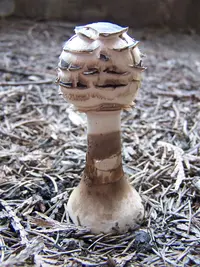
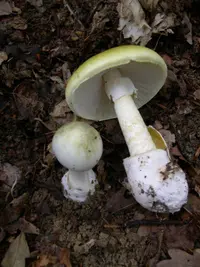
To recognize Shaggy Parasol, look for a stout mushroom with a broad cap covered in coarse brown scales on a pale background and a thick stem that swells into a bulb at the base.

The gills are white and free from the stem, and a substantial ring sits high on the stalk.

Chlorophyllum brunneum Identification

Scan to Confirm Shaggy Parasol

Take or upload a photo to confirm your plant ID with Botan.

Clear images work best. Avoid photos taken too close or too far away

Check the cap, gills, ring, and stem base by eye.

  • Cap broad, often 4-8 inches (10-20 cm), with a pale background broken into coarse brown scales.
  • Gills are crowded, free from the stem, and appear white to cream.
  • A thick, skirt-like ring hangs on the upper stem and is usually easy to see.
  • Stem is stout with a noticeably swollen, bulb-like base and often a smooth surface above.

Use several features together, especially the scaled cap, free gills, ring, and bulbous base.

Chlorophyllum brunneum shows clear visual changes from button stage to expanded, spore-shedding mushroom.

  • Young plant: At first it appears as a rounded button, with the cap still closed over the gills and a thick, short stem mostly hidden.
  • Mature plant: As it expands, the cap opens broadly to about 4-8 inches (10-20 cm), showing a pale surface broken into coarse brown scales and a stout stem.
  • Flowering stage: The cap margin lifts enough to expose crowded white gills, and the movable ring becomes obvious as the veil tears away from stem and cap edge.
  • Fruiting stage: In the final visible stage, the cap flattens further, gills remain free from the stem, and the whole fruiting body stands fully above ground.

Chlorophyllum brunneum is most noticeable in warm, wet periods, when its large white mushrooms appear quickly from the ground. Fruiting is often seen from spring into fall, depending on local weather. As the cap expands, the shaggy surface and prominent ring become easy to see. Outside fruiting periods, there is usually no persistent above-ground structure to identify.

A few parasol-like mushrooms are regularly mistaken for Chlorophyllum brunneum.

false parasol(Chlorophyllum molybdites)

Confused because both are large white parasol mushrooms with brown scales and a ringed stem. The quickest check is the gills: false parasol develops greenish gills with age, while Shaggy Parasol keeps white to pale gills. Spore print is green in false parasol.

parasol mushroom(Macrolepiota procera)

Often confused at a glance because both have tall stems and broad scaly caps. Macrolepiota procera usually has a slimmer stem with a snakeskin-like brown pattern, not the thicker, smoother stem and abrupt swollen base typical of Chlorophyllum brunneum.

  • Poisonous if eaten: Chlorophyllum brunneum is a poisonous mushroom. Ingestion of the fruiting body causes gastrointestinal poisoning in humans and can also sicken pets if eaten.
  • Risk of dangerous confusion: It can be confused with edible parasol-type mushrooms. A key warning sign is the thickened, abrupt bulb at the base of the stem, which should be checked carefully before any handling for food use.

Check Your Plant ID

Upload a photo to Botan for a quick second opinion and clearer next steps before labeling or comparing similar plants.

FAQ

Young specimens are button-like to egg-shaped, with a white cap still closed over the gills. The stem is stout and bulbous at the base, and the cap surface soon breaks into brownish scales as it expands.

More Plant Identification Guides

Identify Your Plant with Botan

Use a photo to identify it, then get plant details, care information, and safety notes tailored to the result.

Botan app identifying a plant from a photo
12 Best Plants That Repel Spiders For Your Home and Garden

8 min read · 24 Jul 2026

12 Best Plants That Repel Spiders For Your Home and Garden

Spiders constantly appear in places you don't want them. A few common plants can help repel them using scent alone. Here are 12 options suitable for both indoors and outdoors, plus care tips for each.

Plant Recommendations
12 Best Plants That Repel Spiders For Your Home and Garden
20 Funny Plant Names That Make You Laugh

8 min read · 16 Oct 2026

20 Funny Plant Names That Make You Laugh

Some plants carry names that sound like jokes. This guide explains the origins of 20 funny plant names. You will also see which of these plants you can grow at home.

Plant Recommendations
20 Funny Plant Names That Make You Laugh
Planting Grass Seed in Summer – What Works and What Fails

7 min read · 6 Aug 2026

Planting Grass Seed in Summer – What Works and What Fails

Summer seeding succeeds when the grass type suits the season, and the soil stays moist. Find out how to prepare the seedbed and choose a safe window for planting.

Plant Care
Planting Grass Seed in Summer – What Works and What Fails