Control Self-Seeding
Deadhead spent flower heads before seed set if you want to limit spread, but always wear thick gloves and use long-handled pruners to avoid the spines.

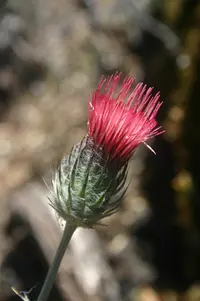
Cobwebby thistle, Cirsium occidentale, is a perennial or short-lived biennial thistle native to dry, open habitats of California and parts of the western United States. It often grows on rocky slopes, coastal bluffs, and desert edges.
The plant forms spiny, silver-gray rosettes and sends up tall, branched stems topped with showy, fuzzy-looking flower heads in shades of white to deep magenta. The dense, cobweb-like hairs reduce water loss and give the plant its name.
This species prefers full sun, sharply drained, low-fertility soil, and dry conditions once established. Spines and drought tolerance make care for cobwebby thistle relatively low effort outdoors, but handling requires some caution.

Care Difficulty
Moderate Care

Light Preference
Full Sun

Water Requirements
Low Water

Temperature Preference
Cold Hardy

Hardiness Zone
7–10

Soil Texture
Sandy, Loamy, Rocky

Soil pH
Slightly acidic (6.5–7.0), Neutral (7.0)

Soil Drainage
Well-drained

Fertilization
Minimal (feed rarely)
Scan your plant to receive care tips personalized for your specific plant
Available on iOS and Android
This drought-adapted native thistle thrives in strong, open sun typical of dry, western landscapes.
This species is adapted to dry, fast-draining habitats and is easily damaged by excess moisture.
This thistle is well adapted to warm, dry climates with cool winters and hot summers.
This species prefers dry air and typically does not need humidity adjustment in home or outdoor settings.
This drought-adapted perennial prefers mineral, sharply drained soil that mimics dry, open habitats.
This species can be grown in containers if provided with a deep, fast-draining setup that stays relatively dry between waterings.
This drought-adapted native usually needs minimal feeding, but light supplementation can support container-grown or very poor-soil Cirsium occidentale.
Thoughtful pruning helps maintain health and manage seeding in Cirsium occidentale.
Cirsium occidentale is usually grown in the ground, so focus on careful transplanting rather than frequent repotting.
Propagation of Cirsium occidentale is most reliable from seed under suitable conditions.
Established Cirsium occidentale is generally cold hardy in its suitable climate range and needs little winter care.

Plant Health Check
Not sure what's wrong with your plant? Check your plant's health inside the app.
This species is strongly associated with sandy, coastal habitats in California and Baja California, including dunes and coastal bluffs, where its deep taproot helps anchor loose, shifting substrates.
The leaves and flower heads are covered with dense, white, cobweb-like hairs that reduce water loss and sun damage, a typical xerophytic adaptation to intense sun and dry winds.
The showy crimson to purplish flower heads provide abundant nectar and pollen for native bees, butterflies, and other insects, making it an important component of coastal pollinator networks and relevant to Cirsium occidentale care in habitat restoration projects.

Some coastal populations of this species help stabilize fragile dune systems by trapping wind-blown sand around their rigid stems and spiny leaves, gradually building small hummocks that support other native plants over time.
This species usually forms clumps and spreads slowly by seed, not by running roots. In dry, open plantings it rarely becomes aggressive if old flower heads are deadheaded before seeds mature and blow into surrounding areas.
Keep your plants happy and healthy with plant identification, disease detection, and easy care guidance.