Protect Mycelium Layer
Mark the fruiting spot and avoid raking, digging, or compacting the soil there, since the underground mycelium network is sensitive and damage can stop fruiting for several years.

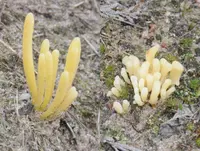
Moor club, Clavaria argillacea, is a small club fungus rather than a leafy plant. It forms tight clusters of slender, upright clubs that are usually whitish to pale cream. These fruiting bodies emerge directly from the ground and create a fine, grass-like texture.
This species is typically found in nutrient-poor, often acidic moorland and heath habitats, especially in cool, temperate regions. It depends on stable, undisturbed soils and consistent moisture, which makes it challenging to cultivate. Gardeners who want to learn how to care for Moor Club should understand that it is best appreciated in natural or semi-natural landscapes rather than as a typical indoor or container specimen.
In the wild, it favors open light, damp but not waterlogged soils, and low-competition grass or moss carpets.

Care Difficulty
Hard Care

Light Preference
Partial Shade

Water Requirements
Keep Soil Moist

Temperature Preference
Cool Climate

Hardiness Zone
Unknown

Soil Texture
Peaty, Organic-rich, Sandy

Soil pH
Strongly acidic (4.5–5.5)

Soil Drainage
Moist but well-drained

Fertilization
Minimal (feed rarely)
Scan your plant to receive care tips personalized for your specific plant
Available on iOS and Android
This fungus prefers cool, open moorland light rather than dense forest shade or intense summer sun.
Water conditions for this fungus focus on consistently moist, not saturated, acidic soil or moss.
This species favors cool, temperate climates and declines in sustained heat or hard frost.
This fungus is not suited to typical home conditions and requires consistently moist, cool air similar to bog or moor habitats.
This species is a mycorrhizal fungus of acidic, nutrient-poor, peaty soils rather than a typical potted plant.
This species is generally unsuitable for container growing because it depends on complex interactions with acidic moorland soils and host plants.
This fungus grows in nutrient-poor, acidic moorland soils and usually does best without added fertilizer when left in natural ground.
Clavaria argillacea does not need structured pruning, but small hygiene steps help when monitoring colonies in managed sites.
This species is not suited to normal container culture, so management focuses on careful transplanting of surrounding soil rather than the fungus itself.
This fungus spreads mainly via spores and its underground mycelium, so deliberate propagation of Clavaria argillacea is technically complex and rarely attempted at home.
In suitable climates this species is naturally cold hardy and typically requires no special winter care once established in the ground.

Plant Health Check
Not sure what's wrong with your plant? Check your plant's health inside the app.
This coral fungus is strongly associated with acidic, nutrient-poor heathland and upland grassland, where it often grows among mosses rather than directly on exposed soil.
Populations are frequently used as part of the waxcap–grassland indicator group, meaning its presence can signal long‑established, low‑input grasslands that have not been heavily fertilized or disturbed.
Its upright, club-shaped fruiting bodies are typically whitish to pale cream with only subtle yellowish tones, which makes it stand out among the more vividly colored coral and club fungi in the same habitats.

This species is considered of conservation concern in several European countries because the heathland and semi-natural grassland ecosystems it depends on have declined significantly due to land-use change and agricultural intensification.
In suitable acidic, moist, nutrient-poor soil, this fungus appears and matures within a single season, often over a few weeks. Fruiting bodies do not increase much in size after emergence, but new clusters may appear nearby.
Keep your plants happy and healthy with plant identification, disease detection, and easy care guidance.