


Spore print confirmation
Before harvesting, take a spore print from one mature cap on white and dark paper to confirm white spore color and avoid confusing it with similar, potentially harmful russula species.

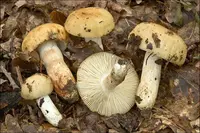
Almond-scented russula (Russula grata) is a mycorrhizal mushroom, not a typical houseplant. It forms symbiotic associations with tree roots, helping trees absorb water and nutrients. The cap is usually pale to reddish-brown with a firm, brittle texture, and the gills are white to cream. A distinct almond or marzipan-like scent is its key identifying feature.
This species is found in temperate forests, often with beech or conifer trees, growing directly from the soil in leaf litter. It is not suited to normal pot culture, and attempts to care for Almond-scented Russula at home are usually unsuccessful without its specific tree partners and forest-like conditions.

Care Difficulty
Hard Care

Light Preference
Partial Shade

Water Requirements
Keep Soil Moist

Temperature Preference
Cool Climate

Hardiness Zone
Unknown

Soil Texture
Loamy, Sandy, Organic-rich

Soil pH
Strongly acidic (4.5–5.5), Acidic (5.5–6.5)

Soil Drainage
Moist but well-drained

Fertilization
Minimal (feed rarely)
Scan your plant to receive care tips personalized for your specific plant
Available on iOS and Android
This ectomycorrhizal fungus prefers dappled woodland light rather than direct open sun.
This woodland mushroom depends on consistently moist, not saturated, soil conditions around its host trees.
This species fruits best in mild to cool conditions typical of late summer to autumn woodlands.
Humidity is not a meaningful care factor for Russula grata, which develops outdoors in natural forest conditions.
Russula grata is an ectomycorrhizal forest mushroom that relies on undisturbed, naturally structured soil rather than a constructed potting mix.
This species is not suitable for container growing, as it depends on complex root associations in natural woodland soil.
Russula grata is a wild ectomycorrhizal mushroom that does not need direct fertilization in gardens or containers.
Russula grata cannot be pruned because the visible mushroom is only the fruiting body of an underground fungus.
This fungus naturally associates with tree roots in soil and is not suited to normal repotting or transplanting.
Propagation of this ectomycorrhizal Russula is complex and not practical for home growers.
No special winter care is needed; the underground mycelium tolerates natural seasonal cold in its native range.

Plant Health Check
Not sure what's wrong with your plant? Check your plant's health inside the app.
Mature fruiting bodies have a strong aroma reminiscent of bitter almonds or marzipan, caused mainly by benzaldehyde and related aromatic compounds that are also found in some stone fruits and nuts.
This species is most often recorded in coniferous or mixed forests on acidic, nutrient-poor soils, where it forms ectomycorrhizal associations with tree roots and helps them acquire water and minerals.
Although the sweet almond-like smell is characteristic, R. grata is part of a complex of similar, pale Russula species, and mycologists often rely on microscopic features such as spore ornamentation and pileipellis structure for reliable identification.

Chemical analyses have reported traces of hydrocyanic acid-related compounds in the aroma profile of this species, which explains the bitter almond scent but also means the smell alone is not a safe indicator of edibility.
This mushroom is generally classified as inedible due to its brittle texture and often unpleasant, slightly bitter taste, despite the almond-like smell. It is not recommended for consumption and should be left for observation only.
Keep your plants happy and healthy with plant identification, disease detection, and easy care guidance.

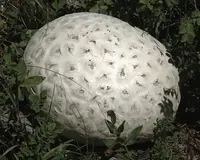
Western Giant Puffball
Calvatia booniana
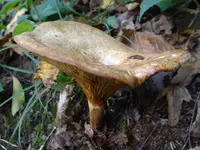
alder rollrim
Paxillus rubicundulus
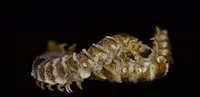
Arthrophaga myriapodina
Arthrophaga myriapodina
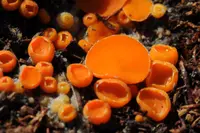
Byssonectria terrestris
Byssonectria terrestris
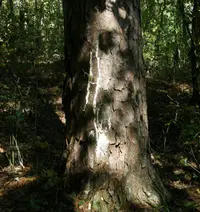
Butyrea luteoalba
Butyrea luteoalba
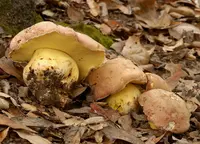
Butter Bolete
Butyriboletus appendiculatus
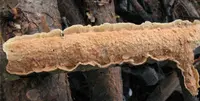
Netted Crust
Byssomerulius corium
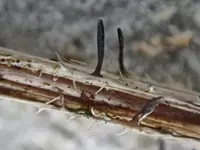
Acrospermum compressum
Acrospermum compressum