Calibrate substrate depth
Maintain a 5–10 cm deep, loose forest-floor style substrate so the extensive mycelium network has enough vertical space to expand without drying out too quickly at the surface.

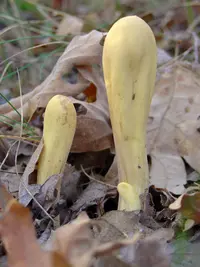
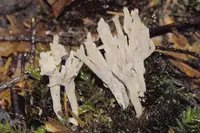
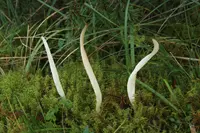
The common club coral fungus, Clavariadelphus pistillaris, is a club-shaped woodland fungus, not a leafy plant. It forms tall, smooth, candle-like fruiting bodies rising from the forest floor. Colors range from pale yellow to warm orange-brown, often appearing in small groups on soil rich in decaying leaf litter. It is typically found in temperate forests of Europe and North America, especially in mixed or beech woodlands.
This species grows in association with trees, which makes it difficult to cultivate at home or in containers. Because of this close relationship with forest soils and roots, most people enjoy it in its natural habitat rather than trying to care for common club coral fungus indoors.

Care Difficulty
Hard Care

Light Preference
Partial Shade

Water Requirements
Keep Soil Moist

Temperature Preference
Cool Climate

Hardiness Zone
Unknown

Soil Texture
Loamy, Silty, Organic-rich

Soil pH
Strongly acidic (4.5–5.5), Acidic (5.5–6.5)

Soil Drainage
Moist but well-drained

Fertilization
Minimal (feed rarely)
Scan your plant to receive care tips personalized for your specific plant
Available on iOS and Android
This woodland fungus prefers cool, filtered light similar to a shaded forest floor.
This mycorrhizal fungus depends on consistently moist, not saturated, forest soil.
This species fruits best in cool to mild conditions typical of temperate forests.
This fungus needs consistently moist, high-humidity conditions to fruit well.
Clavariadelphus pistillaris relies on loose, humus-rich forest soil rather than standard container potting mixes.
This species is not well suited to typical container growing, as it depends on outdoor forest soil and tree-associated conditions.
This woodland fungus relies mainly on its tree partners for nutrition and usually does not need extra fertilizer in cultivation.
Clavariadelphus pistillaris requires no true pruning, only minimal hygiene to keep culture areas clean and disease free.
Transplanting focuses on moving the host tree or soil habitat rather than the fungus itself, which is sensitive to disturbance.
Propagation of this mycorrhizal fungus is specialized and rarely attempted by home growers, as it depends on complex tree–fungus relationships.
This native woodland fungus is naturally cold hardy in its range and usually needs no specific winter care in the ground.

Plant Health Check
Not sure what's wrong with your plant? Check your plant's health inside the app.
The club-shaped fruit bodies resemble an enlarged plant pistil and can reach 10–20 cm tall, which is why the species is often called the giant club or club coral fungus.
This fungus forms ectomycorrhizal associations with beech and other broadleaf trees, exchanging mineral nutrients for sugars from the host roots in temperate forests.
It produces a pale yellow to ochre spore print and has smooth, ellipsoid spores, features used by mycologists to distinguish it from similar club-shaped fungi.

In parts of Europe, this species is considered a regional indicator of old, relatively undisturbed beech forests, so its presence can help mycologists and foresters assess long-term forest continuity.
Growth is relatively slow. From spore to visible fruiting body often takes several months, and reliable colonies usually establish over 2–3 years, depending on soil organic matter, moisture stability, and absence of disturbance or heavy compaction.
Keep your plants happy and healthy with plant identification, disease detection, and easy care guidance.