


Rotate log sections
When cultivating this fungus on cut hardwood, rotate or flip log sections every few months so new moist surfaces and micro-cracks are exposed, which encourages fresh fruiting bodies rather than only along one edge.

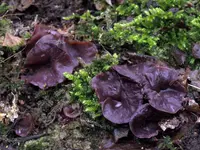
Ascocoryne cylichnium is a small jelly fungus rather than a typical leafy plant. It forms clustered, cup- or disc-shaped fruiting bodies with a soft, gelatinous texture and usually a pinkish to purple color. These cushions often merge into irregular masses as they mature.
This species grows mainly on decaying hardwood in cool, damp forests, especially in temperate regions of the Northern Hemisphere. It plays an important role in breaking down dead wood and recycling nutrients.
For those interested in how to care for Ascocoryne cylichnium in cultivation, it requires consistently moist, shady conditions and well-rotted wood as its main substrate instead of regular soil.

Care Difficulty
Moderate Care

Light Preference
Partial Shade

Water Requirements
Keep Soil Moist

Temperature Preference
Cool Climate

Hardiness Zone
Unknown

Soil Texture
Loamy, Organic-rich, Peaty

Soil pH
Acidic (5.5–6.5)

Soil Drainage
Moist but well-drained

Fertilization
Minimal (feed rarely)
Scan your plant to receive care tips personalized for your specific plant
Available on iOS and Android
This fungus thrives in shaded, cool woodland conditions with very limited direct sun exposure.
This wood-inhabiting fungus depends on consistently moist, but not waterlogged, decaying wood and surrounding leaf litter.
This species favors cool to mild conditions typical of temperate woodlands.
This saprophytic fungus prefers consistently moist, humid conditions around 60–90% to fruit well.
Ascocoryne cylichnium grows on decaying wood, so cultivation focuses on wood-based, moist, well-aerated substrate rather than true soil.
This fungus can be grown in containers as long as the wood-based substrate and moisture conditions are carefully controlled.
This saprophytic fungus usually grows on nutrient-rich wood and needs no added fertilizer in typical culture.
Ascocoryne cylichnium needs no deliberate pruning, as fruiting bodies are short-lived and decay naturally.
Cultivation in containers is uncommon, so focus on placing fresh substrate rather than true repotting.
Ascocoryne cylichnium is normally propagated in specialist culture rather than by home growers.
In natural settings this fungus is cold hardy and usually requires no special winter care.

Plant Health Check
Not sure what's wrong with your plant? Check your plant's health inside the app.
This species forms clusters of lilac to purple, gelatinous disc- or cup-like fruiting bodies on decaying hardwood, often coalescing into irregular masses as they age.
It is a common saprotrophic fungus on fallen branches and stumps of broadleaf trees, helping initiate the breakdown of lignin-rich wood and preparing it for later colonization by other decomposers.
It is often misidentified as its close relative Ascocoryne sarcoides, but A. cylichnium typically develops more distinct cup-shaped apothecia and has different microscopic spore characteristics used by mycologists for reliable identification.
This jelly fungus is generally regarded as inedible or of no culinary value due to its rubbery texture and limited flavor. It is not considered poisonous, but it is not recommended for regular consumption.
Keep your plants happy and healthy with plant identification, disease detection, and easy care guidance.

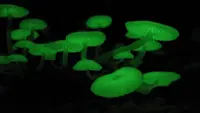
green pepe
Mycena chlorophos
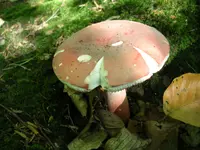
Fruity Brittlegill
Russula queletii
Arthrophaga myriapodina
Arthrophaga myriapodina
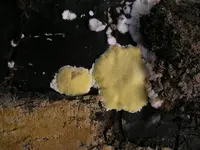
Lemon-colored Antrodiella
Antrodiella citrinella
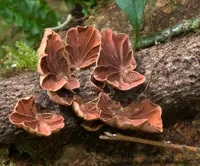
Orange Fan
Anthracophyllum archeri
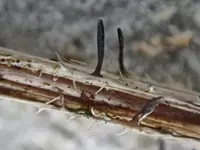
Acrospermum compressum
Acrospermum compressum
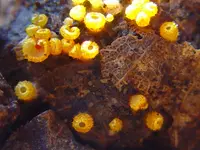
Arachnopeziza aurelia
Arachnopeziza aurelia
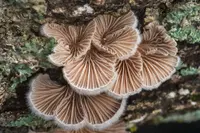
Splitgill
Schizophyllum commune