Use clean substrate
Prepare a fruiting substrate from pasteurized hardwood sawdust or a sawdust–bran mix and handle it with clean tools and gloves to reduce contamination from competing fungi and bacteria when growing angel's wings.

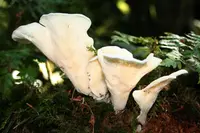
Angel's wings, Pleurocybella porrigens, is a small white wood-decay fungus, not a leafy houseplant. It forms thin, shell-shaped caps that resemble delicate white petals, usually growing in overlapping clusters.
This species typically appears on dead or decaying conifer wood in cool, moist forests, especially in temperate regions. It has a short life cycle and depends on humid, shaded conditions, which makes it challenging to maintain indoors.
Those who try to care for angel's wings should know it needs consistently cool, moist air, shaded light, and access to suitable, decomposing wood rather than ordinary potting soil.

Care Difficulty
Hard Care

Light Preference
Shade

Water Requirements
Keep Soil Moist

Temperature Preference
Cool Climate

Hardiness Zone
Unknown

Soil Texture
Organic-rich, Loamy

Soil pH
Acidic (5.5–6.5)

Soil Drainage
Moist but well-drained

Fertilization
Minimal (feed rarely)
Scan your plant to receive care tips personalized for your specific plant
Available on iOS and Android
Pleurocybella porrigens develops best on shaded, cool, decaying conifer wood with limited direct sun exposure.
This fungus depends on consistently moist, not waterlogged, wood rather than direct watering of the fruiting bodies.
This species fruits in cool, moist conditions and slows or stops under high heat or hard frost.
This fungus prefers consistently moist air and substrate rather than very dry conditions.
This wood-decaying fungus does not use soil but needs a structured, well-prepared lignocellulosic substrate.
This species can be grown in containers when the substrate and moisture are carefully controlled.
Pleurocybella porrigens, often called angel's wings, generally needs minimal fertilization when grown on nutrient-rich hardwood substrates.
Pruning is not applicable to Pleurocybella porrigens because it is a saprophytic fungus rather than a typical vascular plant.
Transplanting Pleurocybella porrigens focuses on moving colonized substrate rather than handling roots or traditional pot-bound symptoms.
Propagation of Pleurocybella porrigens relies on spores or mycelium transfer rather than standard plant methods like cuttings or division.
Outdoor cultures of Pleurocybella porrigens are generally cold tolerant in temperate climates and usually need little targeted winter care.

Plant Health Check
Not sure what's wrong with your plant? Check your plant's health inside the app.
The caps of this fungus are typically narrow and spoon- or tongue-shaped, often forming dense overlapping clusters that resemble small angel wings on decaying conifer wood.
It grows almost exclusively on well-rotted wood of conifer trees such as spruce, fir, and hemlock, playing a role in breaking down lignin and cellulose in cool, moist forests.
Although long considered edible in some regions, it has been linked to fatal encephalopathy cases in Japan, particularly in individuals with kidney problems, and is now widely regarded as a species that should not be eaten.

This species often appears in large flushes during cool autumn weather, and its pale, translucent tissue can become almost glassy in appearance after rain, making the clustered fruiting bodies very difficult to spot against bleached conifer wood until light catches their thin edges.
This species is no longer considered safe to eat. Serious and sometimes fatal poisoning has been reported, especially in older adults or those with kidney problems. For safety, it is best treated strictly as a non-edible ornamental fungus.
Keep your plants happy and healthy with plant identification, disease detection, and easy care guidance.