Sturdy stem support
In windy or exposed sites, insert low, discreet twiggy branches or thin bamboo canes around clumps and loosely tie stems with soft garden twine to prevent lodging and stem breakage without creating a rigid, artificial look.

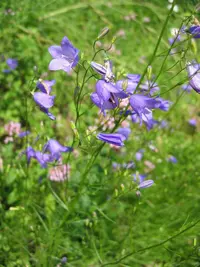
Campanula rotundifolia, commonly called bluebell bellflower or harebell, is a delicate, cold-hardy perennial from the campion family. It forms thin, wiry stems with small, nodding, bell-shaped blue flowers. Leaves are mostly at the base and quite narrow higher up the stem, giving the plant a light, airy look. In nature it often grows in meadows, rocky slopes, and open woodlands across cooler regions of Europe, Asia, and North America.
This species adapts well to poor, sandy, or rocky soils, provided drainage is good. It prefers full sun to light shade and steady, moderate moisture. Once established, it is relatively low-maintenance, which makes it easier to care for bluebell bellflower in garden settings.

Care Difficulty
Moderate Care

Light Preference
Partial Sun

Water Requirements
Moderate Water

Temperature Preference
Cold Hardy

Hardiness Zone
3–7

Soil Texture
Sandy, Loamy, Rocky

Soil pH
Acidic (5.5–6.5), Slightly acidic (6.5–7.0)

Soil Drainage
Well-drained

Fertilization
Minimal (feed rarely)
Scan your plant to receive care tips personalized for your specific plant
Available on iOS and Android
Campanula rotundifolia prefers bright conditions that mimic open meadows and light woodland edges.
This species prefers evenly moist but not saturated soil, with slight drying between waterings.
This hardy perennial tolerates a wide temperature range but flowers best in cool to mild conditions.
Humidity is only a minor factor for Campanula rotundifolia in typical home and outdoor conditions.
Campanula rotundifolia prefers light, well-aerated soil that drains quickly yet holds some moisture.
This species is suitable for container growing, especially in cool or mild climates.
This wild species needs only light feeding, since many bluebell bellflower plants grow well in lean soils.
Campanula rotundifolia benefits from light, targeted pruning to keep plants tidy and flowering well.
This species is more often transplanted in the garden than kept as a long-term container plant.
Campanula rotundifolia is commonly propagated by seed and by careful division of established clumps.
This plant is generally cold hardy in much of the US and needs little winter care in the ground.

Plant Health Check
Not sure what's wrong with your plant? Check your plant's health inside the app.
This species is the true harebell of Europe and much of the Northern Hemisphere, despite many different local names, and it forms slender, wiry stems with few leaves that distinguish it from most other bellflowers.
It is naturally adapted to cool, windy habitats such as cliffs, dunes, upland grasslands, and subalpine slopes, tolerating poor, thin soils where many broad-leaved perennials cannot persist.
Although the plant looks fragile, individual clumps can be long-lived perennials in stable, open turf, slowly spreading by short rhizomes and self-seeding into small gaps in the vegetation.

In parts of northern Europe and the British Isles, this species has deep cultural roots as a symbol of remoteness and the supernatural, appearing in folklore as a flower linked to fairies or spirits that was traditionally avoided or treated with caution.
Lack of flowering usually comes from low light, nutrient-poor or over-rich soil, or heavy cutting back at the wrong time. Ensure moderate fertility, good light, and avoid removing foliage too early after flowering to support bud formation.
Keep your plants happy and healthy with plant identification, disease detection, and easy care guidance.