Spore-friendly substrate
Use a shallow tray filled with a mix of well-rotted hardwood leaf litter and native forest soil from an area where the fungus naturally occurs to encourage mycelium establishment and fruiting.

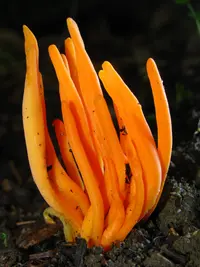
Clavulinopsis aurantiocinnabarina is a small coral fungus, not a traditional leafy plant. It produces bright orange, upright, branching clubs that resemble tiny underwater corals on the forest floor. Fruiting bodies usually appear in dense clusters on soil rich in decaying leaf litter. The species is native to temperate regions of North America and parts of Europe, where it is found in mixed woodlands. It relies on cool, moist conditions and undisturbed organic matter, which makes it challenging to cultivate at home. For most enthusiasts, it is easier to observe and care for Clavulinopsis aurantiocinnabarina in its natural habitat rather than attempt indoor culture.

Care Difficulty
Hard Care

Light Preference
Partial Shade

Water Requirements
Keep Soil Moist

Temperature Preference
Cool Climate

Hardiness Zone
Unknown

Soil Texture
Loamy, Peaty, Organic-rich

Soil pH
Strongly acidic (4.5–5.5), Acidic (5.5–6.5)

Soil Drainage
Moist but well-drained

Fertilization
Minimal (feed rarely)
Scan your plant to receive care tips personalized for your specific plant
Available on iOS and Android
This woodland fungus prefers soft, indirect light that mimics filtered forest conditions.
Moist, but not waterlogged, soil is essential for this saprophytic woodland species.
This species fruits best in cool to mild conditions typical of temperate woodlands.
This species develops in naturally moist, decaying leaf litter, so humidity around the fruiting area matters for stable development.
Clavulinopsis aurantiocinnabarina fruits best in loose, organic-rich, consistently moist but well-drained substrates.
This species is challenging but can be attempted in containers that simulate a shallow woodland litter layer.
This woodland fungus generally grows without added nutrients, so fertilization is rarely needed in gardens or containers.
Clavulinopsis aurantiocinnabarina does not respond to pruning like a typical plant, so only light hygiene is appropriate.
This species is a soil-dwelling fungus, so any moving focuses on its substrate rather than classic repotting.
Propagation of this fungus is technically complex and not usually attempted by home gardeners, so natural spread is recommended.
In suitable climates this fungus is naturally hardy and usually needs no specific winter care beyond stable habitat.

Plant Health Check
Not sure what's wrong with your plant? Check your plant's health inside the app.
This fungus produces slender, coral-like clubs in vivid orange to cinnabar-red shades, which often stand out strongly against dark, damp woodland leaf litter and moss.
It lives as a saprobe, breaking down dead wood and plant debris in temperate forests, and in doing so contributes to nutrient recycling in the soil ecosystem.
The fruiting bodies commonly appear in dense clusters or small troops, sometimes forming loose patches that can cover several decaying sticks or buried woody fragments at once.
This small coral fungus is not considered a good edible species and is often classified as inedible. Identification is difficult, and similar fungi may be toxic, so it is safest not to consume it.
Keep your plants happy and healthy with plant identification, disease detection, and easy care guidance.