Salt tolerance management
If grown near coastal or road-salted areas, flush the pot thoroughly with clean water every 2–3 months to reduce salt buildup that can burn leaf edges and roots.

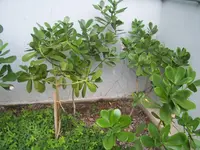
Clusia fluminensis is an evergreen shrub or small tree, valued for its thick, leathery leaves and dense, upright growth. It often forms a compact hedge or screen when pruned. In nature, it occurs in coastal and lowland areas of Brazil and nearby regions, where it experiences warm, humid conditions year-round. The plant is quite resilient once established and tolerates pruning and shaping well, which makes it suitable for both landscapes and large containers. Its main demands are steady warmth, moderate to bright light, and soil that drains well but does not stay dry for long. Understanding how to care for Clusia fluminensis starts with providing stable conditions and avoiding cold drafts.

Care Difficulty
Moderate Care

Light Preference
Partial Sun

Water Requirements
Moderate Water

Temperature Preference
Tropical / Frost Sensitive

Hardiness Zone
10–12

Soil Texture
Sandy, Loamy, Organic-rich

Soil pH
Acidic (5.5–6.5), Slightly acidic (6.5–7.0)

Soil Drainage
Moist but well-drained

Fertilization
Minimal (feed rarely)
Scan your plant to receive care tips personalized for your specific plant
Available on iOS and Android
This tropical shrub prefers bright, filtered light that mimics high, open forest edges.
This species prefers evenly moist, well-draining soil and does not like long dry spells or waterlogged conditions.
This shrub thrives in warm, frost-free climates with stable temperatures.
This shrub benefits from moderately humid air but tolerates typical home conditions.
This species prefers a loose, slightly acidic to neutral, well‑draining mix that stays evenly moist without staying waterlogged.
This species adapts well to container growing when the pot is chosen for root space and stability.
Nutrient inputs support steady growth in Clusia fluminensis, especially in containers.
Thoughtful pruning keeps Clusia fluminensis compact, dense, and healthy.
Container-grown Clusia fluminensis benefits from occasional repotting or transplanting to maintain root health.
New Clusia fluminensis plants are most commonly produced from stem cuttings.
Cold conditions can damage Clusia fluminensis, so some winter preparation is important in cooler climates.

Plant Health Check
Not sure what's wrong with your plant? Check your plant's health inside the app.
In its native range in Brazil, Clusia fluminensis often starts life on other trees as a hemiepiphyte, then sends roots down to the ground and can eventually envelop or outcompete its host tree as its own trunk thickens.
The plant produces a sticky, resinous latex in its stems and leaves that helps seal wounds and may deter many herbivores, a trait that also makes pruning cuts slow to dry and often visibly exude sap.
C. fluminensis naturally occurs in coastal Atlantic forest environments and shows notable tolerance to salt-laden winds and sandy, nutrient-poor soils, which is one reason it is widely used as a hedge and screening shrub in seaside landscapes.

Although compact when grown in containers, in suitable subtropical and tropical climates Clusia fluminensis can form dense, thicket-like stands that significantly alter local understory light levels and can displace native shrub communities where it becomes naturalized.
Growth is moderate. In warm climates with consistent moisture and fertilizer, it may add 20–40 cm per year. In containers or cooler areas, growth slows noticeably, especially if rootbound or exposed to low light and irregular care.
Keep your plants happy and healthy with plant identification, disease detection, and easy care guidance.