Staggered Succession Sowing
Sow small patches every 2–3 weeks in early spring so flowering is extended and gaps from early losses are naturally filled without replanting whole beds.

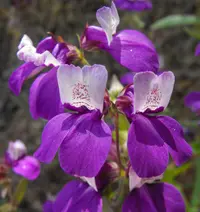
Purple Chinese houses, Collinsia heterophylla, is a small, cool-season annual wildflower native to California and parts of the western United States. It belongs to the plantain family and is valued for its soft, upright habit.
The plant forms tiered whorls of purple and white flowers that resemble small pagodas, held above light green, delicate foliage. It is often found in open woodlands, shady slopes, and grassy clearings.
This species grows quickly from seed, prefers mild temperatures, and completes its life cycle in one season, which makes it well suited to informal beds and naturalistic plantings. It generally favors bright, indirect light, moderate moisture, and well-drained soil, and is considered relatively easy to care for purple Chinese houses from seed in suitable climates.

Care Difficulty
Moderate Care

Light Preference
Partial Sun

Water Requirements
Moderate Water

Temperature Preference
Cool Climate

Hardiness Zone
6–10

Soil Texture
Sandy, Loamy, Organic-rich

Soil pH
Acidic (5.5–6.5), Slightly acidic (6.5–7.0)

Soil Drainage
Well-drained

Fertilization
Minimal (feed rarely)
Scan your plant to receive care tips personalized for your specific plant
Available on iOS and Android
Collinsia heterophylla prefers bright conditions that mimic open woodland edges or lightly shaded meadows.
Collinsia heterophylla needs consistently moist but not saturated soil during active growth and flowering.
This annual wildflower prefers mild temperatures and performs best in cool spring and early summer conditions.
This species grows well in typical outdoor humidity and rarely needs special humidity management.
This annual prefers light, well-drained soil that stays slightly moist but not waterlogged.
This species is suitable for containers, especially for small, seasonal displays of purple Chinese houses.
Collinsia heterophylla, or purple Chinese houses, needs only light fertilization in most garden soils.
Pruning Collinsia heterophylla is simple and mainly supports tidy growth and extended flowering.
Collinsia heterophylla is usually treated as a direct-sown annual, so transplanting is limited and repotting is rarely necessary.
Collinsia heterophylla is most commonly propagated from seed rather than vegetative methods.
Collinsia heterophylla is an annual and generally does not need special winter protection once its life cycle ends.

Plant Health Check
Not sure what's wrong with your plant? Check your plant's health inside the app.
The flowers develop in distinctive whorls around the stem, often stacked in two levels that give the plant its common name, purple Chinese houses, because the tiers resemble a pagoda-like roofline.
The bicolored violet-and-white flowers provide both nectar and pollen and are mainly pollinated by native solitary bees and syrphid flies, which can navigate the small, tubular corolla.
This species is an annual wildflower native mainly to California and parts of Baja California, commonly found in open woodlands and chaparral, where it completes its life cycle quickly before the dry summer season.

Collinsia heterophylla was historically placed in the snapdragon family Scrophulariaceae, but molecular phylogenetic studies reclassified it into the plantain family Plantaginaceae, reflecting a major revision in flowering plant relationships based on DNA evidence rather than flower shape alone.
This species usually blooms in spring to early summer, often from April to June, depending on climate. Individual flowers last several days, but a plant can stay in color for several weeks as new blooms open.
Keep your plants happy and healthy with plant identification, disease detection, and easy care guidance.