Wire hanger support
Mount the orchid on a cork slab or small basket and use a rust-proof wire hanger so the long, pendant flower spikes can hang freely without kinking against a windowsill or shelf edge.

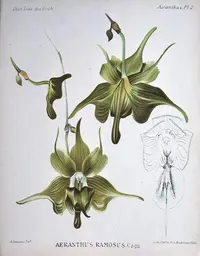
Aeranthes ramosa is an epiphytic orchid, usually found growing on trees rather than in soil. It forms a compact clump of narrow leaves and produces delicate, often translucent flowers on arching stems.
This species is native to Madagascar, where it grows in humid forest environments with mild temperatures and moving air. Its need for stable humidity, gentle light, and good air circulation makes it moderately challenging for beginners, but very rewarding once conditions are correct.
Understanding how to care for Aeranthes ramosa starts with viewing it as a miniature piece of cloud forest that prefers clean water, airy orchid media, and protection from harsh sun or extreme dryness.

Care Difficulty
Hard Care

Light Preference
Bright Indirect Light

Water Requirements
Keep Soil Moist

Temperature Preference
Tropical / Frost Sensitive

Hardiness Zone
12–13

Soil Texture
Sandy, Peaty, Organic-rich

Soil pH
Acidic (5.5–6.5)

Soil Drainage
Moist but well-drained

Fertilization
Light (every 4–6 weeks)
Scan your plant to receive care tips personalized for your specific plant
Available on iOS and Android
This orchid prefers bright, filtered light similar to bright forest shade.
This species prefers consistently moist but airy roots rather than wet, stagnant conditions.
This orchid benefits from intermediate, frost-free temperatures year-round.
This orchid prefers consistently high humidity to keep foliage and roots healthy.
This species needs a very open, airy substrate that mimics an epiphytic orchid’s natural conditions.
This orchid is well suited to container culture, including baskets and slotted orchid pots.
This orchid benefits from light, consistent feeding during active growth but is sensitive to excess salts.
This species needs minimal pruning, focused mainly on hygiene and spent flowering material.
This epiphytic orchid prefers stable conditions and only occasional repotting when the medium breaks down.
Propagation of this orchid is specialized and not often attempted by home growers.
This tropical orchid is frost-sensitive and needs mild, stable winter conditions.

Plant Health Check
Not sure what's wrong with your plant? Check your plant's health inside the app.
This epiphytic orchid is native to eastern Madagascar, where it grows attached to trees in humid evergreen forests at moderate elevations, relying on moving air and frequent moisture rather than soil for support and water.
The translucent greenish flowers often release a stronger scent in the evening and nighttime, an adaptation that helps attract nocturnal pollinators such as moths in its native habitat.
Its flower spikes hang down and can grow quite long, positioning the blooms away from the foliage, which improves access for pollinators and helps keep the delicate flowers well ventilated.
Reluctant blooming often comes from insufficient light intensity, overly warm nights, or lack of a slight seasonal drop in temperature. Mature plants also need balanced fertilization and stable humidity. Avoid frequent repotting, which can delay spike initiation for many months.
Keep your plants happy and healthy with plant identification, disease detection, and easy care guidance.


_4-1-200x112.webp)