Canopy training
Select 3–5 strong primary branches while the tree is young and lightly stake or tie them to create an open, vase-shaped canopy that improves airflow and reduces fungal problems when growing Bentham's cornel.

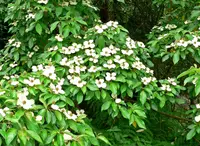
Bentham's cornel (Cornus capitata) is an evergreen small tree or large shrub from the dogwood family. It forms a rounded crown with layered branching and dense foliage. Mature plants carry creamy flower bracts followed by ornamental red, strawberry-like fruits. The bark becomes attractively textured with age. In the wild, it occurs in the Himalayas and parts of East Asia, often in cooler, moist mountain forests. It adapts best in mild, frost-free or only lightly frosty climates, where heat and drought are not extreme. Gardeners who learn how to care for Bentham's cornel usually find it manageable if given well-drained, humus-rich soil and consistent moisture in partial sun.

Care Difficulty
Moderate Care

Light Preference
Full Sun

Water Requirements
Moderate Water

Temperature Preference
Warm Climate

Hardiness Zone
8–10

Soil Texture
Loamy, Sandy, Organic-rich

Soil pH
Acidic (5.5–6.5), Slightly acidic (6.5–7.0)

Soil Drainage
Moist but well-drained

Fertilization
Minimal (feed rarely)
Scan your plant to receive care tips personalized for your specific plant
Available on iOS and Android
Cornus capitata prefers bright conditions with some protection from intense afternoon sun.
Cornus capitata needs consistent moisture in well-drained soil, especially while establishing.
This species prefers mild, frost-protected climates with moderate seasonal variation.
Cornus capitata grows well in moderate outdoor humidity but benefits from slightly moist air in hot, dry climates.
Cornus capitata prefers deep, moisture-retentive yet free-draining soil with steady organic content.
This species can be grown in large containers for several years, but only with careful attention to root space and stability.
Cornus capitata benefits from light, balanced feeding but often grows adequately in fertile garden soil.
Pruning Cornus capitata is useful for maintaining structure, clearance, and plant health rather than for heavy size control.
This species is most often grown as a landscape tree, so management usually focuses on transplanting young Cornus capitata from containers into the ground.
Propagation of Cornus capitata is moderate in difficulty and usually done by semi-ripe cuttings or seeds rather than division.
Cornus capitata is only moderately frost tolerant and benefits from extra winter care in colder regions or exposed sites.

Plant Health Check
Not sure what's wrong with your plant? Check your plant's health inside the app.
This species is unusual among dogwoods because it is fully evergreen in mild climates, keeping its foliage year-round rather than dropping leaves in winter.
The large creamy structures that look like petals are actually bracts, while the true flowers are small and clustered in the center, a typical dogwood trait expressed very prominently in this species.
Its red, strawberry-like aggregate fruits are soft and fleshy and are eaten by birds, which disperse the seeds and help the tree spread in suitable habitats.

Cornus capitata is native to the Himalayas and parts of East Asia but has naturalized in milder regions such as parts of the UK, New Zealand, and Australia, where its ability to self-seed and bird-dispersed fruits allow it to establish beyond cultivated gardens.
This species is generally evergreen in mild, frost-free climates, holding foliage year-round. In colder areas it can behave semi-evergreen, dropping part of its leaves after hard freezes or during stress, then refoliating in spring.
Keep your plants happy and healthy with plant identification, disease detection, and easy care guidance.