Mycelium-friendly mulching
Apply a loose layer of leaf litter or pine needles over the colonized area to protect the mycelium from drying and temperature swings while still allowing air movement through the substrate.

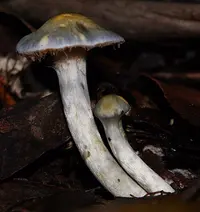
The elegant blue webcap, Cortinarius rotundisporus, is a small to medium-sized woodland mushroom, not a true plant. It belongs to a large and complex genus of forest fungi. Caps often show soft blue to bluish-gray tones that fade with age, with pale gills and a slender stem, giving it a delicate appearance on the forest floor.
This species is typically found in eucalyptus and mixed forests in Australia, forming mycorrhizal partnerships with trees, where fungus and roots exchange nutrients. It is not suited to standard home cultivation, so information on how to care for elegant blue webcap is limited and experimental. Any attempt to grow it would require host trees, stable moisture, and undisturbed, humus-rich soil.

Care Difficulty
Hard Care

Light Preference
Partial Shade

Water Requirements
Keep Soil Moist

Temperature Preference
Cool Climate

Hardiness Zone
Unknown

Soil Texture
Loamy, Silty, Organic-rich

Soil pH
Strongly acidic (4.5–5.5), Acidic (5.5–6.5)

Soil Drainage
Moist but well-drained

Fertilization
Minimal (feed rarely)
Scan your plant to receive care tips personalized for your specific plant
Available on iOS and Android
This forest fungus thrives in dappled woodland light rather than direct, open sun.
This species prefers consistently moist but not waterlogged soil that mimics a stable forest floor.
This fungus is adapted to mild, temperate conditions with cool nights and moderate daytime warmth.
This woodland fungus requires consistently moist, humid conditions to fruit well.
This species fruits best in moist, well-aerated forest soil with steady organic decay.
This ectomycorrhizal fungus is not realistically suitable for container growing because it depends on complex root and soil relationships that are difficult to reproduce in pots.
Cortinarius rotundisporus is a wild, mycorrhizal fungus that relies on its tree partners and natural soil nutrients, so added fertilizer is neither required nor recommended.
Pruning is not applicable to Cortinarius rotundisporus, as this species is a wild mushroom that completes its life cycle naturally without structural shaping or deadheading.
This fungus grows in natural soil in association with host trees, so repotting or transplanting is generally not practical or successful.
Intentional propagation of Cortinarius rotundisporus is difficult and rarely attempted outside research, because it depends on complex mycorrhizal relationships with tree roots.
No specific winter care is needed for this naturally cold-tolerant forest mushroom, as the main mycelium persists underground while fruiting bodies are temporary.

Plant Health Check
Not sure what's wrong with your plant? Check your plant's health inside the app.
The cap of this species shows blue to blue-green tones when young due to water-soluble pigments that fade to more brownish or ochre shades as the fruiting body matures and dries.
It forms ectomycorrhizal associations with eucalyptus trees in southeastern Australia, exchanging mineral nutrients from the soil for sugars produced by the tree through photosynthesis.
The species name rotundisporus refers to its relatively rounded spores, which are finely ornamented and visible under a microscope as an important feature for accurate identification.

This species belongs to a large and taxonomically complex genus where DNA sequencing has been crucial for confirming its placement and distinguishing it from visually similar blue Cortinarius species in Australian forests.
This species is not considered edible and should be treated as potentially poisonous. Identification within Cortinarius is difficult, and some close relatives can cause severe kidney damage. For safety, avoid consuming any look-alike fungi.
Keep your plants happy and healthy with plant identification, disease detection, and easy care guidance.