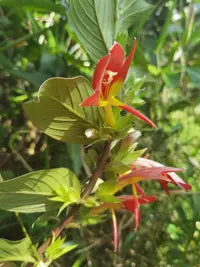
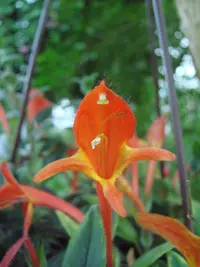
Provide sturdy support
Install a slim moss pole or rough wooden stake near the rhizome when potting, then loosely tie new canes as they elongate so tall shoots stay upright and the spiral growth pattern is clearly displayed.

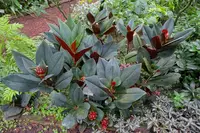
Costus erythrophyllus is a tropical perennial from the ginger family, valued mainly for its striking foliage rather than its flowers. It typically forms upright, cane-like stems with spiraling leaves that are green on top and deep red to purple underneath.
In nature, it occurs in humid tropical forests of South America, often growing in bright shade with consistent warmth and moisture. The plant is considered moderately easy to grow if humidity is adequate and soil never stays dry for long.
Those who want to learn how to care for Costus erythrophyllus should note that it prefers filtered light, regular watering, and a loose, well-drained, organic-rich substrate.

Care Difficulty
Moderate Care

Light Preference
Bright Indirect Light

Water Requirements
Keep Soil Moist

Temperature Preference
Tropical / Frost Sensitive

Hardiness Zone
10–11

Soil Texture
Loamy, Peaty, Organic-rich

Soil pH
Acidic (5.5–6.5), Slightly acidic (6.5–7.0)

Soil Drainage
Moist but well-drained

Fertilization
Light (every 4–6 weeks)
Scan your plant to receive care tips personalized for your specific plant
Available on iOS and Android
This tropical understory shrub prefers bright, indirect light that mimics forest shade.
This species prefers evenly moist conditions but reacts poorly to waterlogged soil.
This plant grows best in warm, stable temperatures similar to a humid tropical understory.
This species prefers consistently high humidity similar to a warm rainforest environment.
This plant needs airy, moisture-retentive soil that still drains freely around the rhizomes.
This species is well suited to container growing when the pot supports its clumping, upright habit.
This tropical ginger benefits from light, steady nutrition during its active growing season.
Pruning helps maintain a compact, healthy form and encourages fresh shoots.
Container-grown plants benefit from occasional repotting to refresh soil and support vigorous rhizome growth.
This species is most commonly propagated by stem cuttings or division of rhizomes.
This tropical plant is frost-tender and needs protection in regions with cool winters.

Plant Health Check
Not sure what's wrong with your plant? Check your plant's health inside the app.
This species is notable for its strongly bicolored leaves, with a deep green upper surface and a striking red to maroon underside caused by high concentrations of anthocyanin pigments that help protect the leaf from excess light in its native forest understory.
The stems grow in a tight spiral, a characteristic growth form in this genus, which allows the plant to expose more leaf area to filtered light while staying compact and stable in shaded, humid habitats.
In its native South American range, the tubular white flowers with red bracts are adapted for pollination by hummingbirds, which can easily access the nectar while transferring pollen between plants.

In collections and botanic gardens, this species is often used as a reference plant for studying leaf pigment distribution, because the strong contrast between the green upper surface and red lower surface of the leaves makes changes in light acclimation and anthocyanin expression easy to observe over time.
Lack of blooms usually comes from insufficient light, nutrients, or maturity. This species often needs a stable warm season, consistent moisture, and regular, balanced feeding. Young plants may take a couple of seasons before flowering reliably.
Keep your plants happy and healthy with plant identification, disease detection, and easy care guidance.