Jade Plant Care (Crassula ovata 'Variegata')

Jade Plant

About Jade Plant

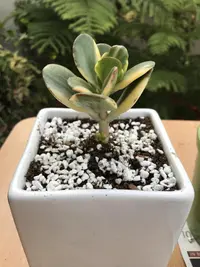
Crassula ovata 'Variegata' is a compact succulent shrub with thick, water-storing leaves marked by creamy white and light green patterns. It stays relatively slow-growing and forms a branching, tree-like shape over time.

This plant comes from arid regions of South Africa, where it evolved to handle strong light and irregular rainfall. Its fleshy leaves and stems make it drought-tolerant and generally forgiving if watering is not perfect.

It suits indoor containers and bright windowsills, making it a popular choice for those learning how to care for Jade Plant. It prefers bright light, well-draining soil, and infrequent watering that allows the root zone to dry between waterings.

Main Plant Requirements

Care Difficulty

Easy Care

Light Preference

Partial Sun

Water Requirements

Low Water

Temperature Preference

Tropical / Frost Sensitive

Hardiness Zone

10–11

Soil Texture

Sandy, Loamy, Rocky

Soil pH

Slightly acidic (6.5–7.0), Slightly alkaline (7.0–7.5)

Soil Drainage

Well-drained

Fertilization

Minimal (feed rarely)

Get Personalized Care Plan

Scan your plant to receive care tips personalized for your specific plant

Available on iOS and Android

How to Care for the Jade Plant

This variegated succulent prefers bright, steady light to keep compact growth and good leaf coloration.

  • Provide 4–6 hours of bright light daily, ideally with gentle morning sun and filtered light or light shade in the afternoon to protect pale variegated areas.
  • Outdoors, place in bright, dappled exposure; indoors, a south- or west-facing window usually works for Jade Plant indoor care if leaves do not scorch.
  • Insufficient light causes elongated, floppy stems and faded variegation, while intense all-day summer sun can lead to leaf scorch or pink, stressed margins.

This plant stores water in its leaves and stems, so it needs infrequent but thorough watering.

  • Water only when the top 3–5 cm of soil is completely dry; in active growth this may mean every 10–21 days, less often in cool or low-light conditions.
  • Use very free-draining, gritty soil and let excess water drain away fully to reduce the risk of root rot in Crassula ovata 'Variegata'.
  • Overwatering shows as soft, yellowing, dropping leaves and blackened stems, while underwatering causes wrinkled, dull leaves that slowly shrivel from the tips.

This succulent prefers warm, stable conditions and is sensitive to frost.

  • Aim for 65–80°F (18–27°C) for best growth, with slightly cooler nights; protect from sudden temperature swings near doors or open windows.
  • Avoid letting temperatures drop below 40°F (4°C); brief dips to 35°F (2°C) may be tolerated, but frost can damage leaves and young shoots.
  • In hot spells above 90°F (32°C), provide light shade and good airflow, and reduce watering slightly so roots are not sitting wet in high heat.

This succulent tolerates typical indoor humidity and does not need special humidity control.

This plant needs a sharply draining, mineral-based substrate that dries quickly after watering.

  • Use a gritty mix such as 50–60% cactus/succulent mix with 40–50% added mineral amendments like perlite, pumice, or coarse sand.
  • Aim for a loose, open texture so water runs through in seconds and roots receive constant air access.
  • Keep pH slightly acidic to neutral (pH 6.0–7.0), avoiding very acidic or strongly alkaline mixes that can limit nutrient uptake.
  • Avoid fine, peat-heavy or clayey substrates that stay wet, compact easily, and increase risk of root rot in Crassula ovata 'Variegata'.

This species is well suited to container growing and adapts readily to long-term pot culture.

  • Choose a squat, heavy pot to counterbalance the woody, top-heavy canopy and reduce tipping risk as stems thicken.
  • Select unglazed terracotta if slower-drying, gritty mixes are used, since the porous walls help moisture evaporate faster.
  • Leave 1–2 cm between the substrate surface and pot rim to prevent overflow when watering and to keep stems from resting in water.

This variegated succulent benefits from light, controlled feeding during active growth while remaining unfertilized in true dormancy.

  • Use a balanced liquid fertilizer (around 10-10-10 or 20-20-20) diluted to 1/4–1/2 strength for Jade Plant indoor care.
  • Feed once every 4–6 weeks in spring and summer, only on moist soil to avoid root burn.
  • Skip or greatly reduce fertilization in fall and winter when growth slows.
  • Avoid heavy organic compost; instead, use a cactus or succulent fertilizer low in nitrogen to keep growth compact.

Thoughtful pruning keeps Crassula ovata 'Variegata' compact, stable, and well-lit inside the canopy.

  • Carry out main pruning in late winter or early spring before strong new growth starts.
  • Use clean, sharp scissors or pruners to remove dead, damaged, or crossing stems at their base.
  • Shorten overly long or top-heavy branches to encourage branching and a balanced, tree-like form.
  • Thin crowded interior shoots so light reaches lower leaves, which reduces leaf drop and weak, stretched growth.

This slow-growing succulent prefers slightly tight pots and infrequent repotting to maintain stability and root health.

  • Check for roots circling the pot, distortion, or slow growth as signs it needs more space.
  • Repot every 3–5 years in late winter or early spring using a gritty cactus or succulent mix and a pot with large drainage holes.
  • Move only 1 pot size up to avoid waterlogged soil, and keep the root ball as intact as possible.
  • After repotting, water lightly once, then let the soil dry almost completely before the next watering to limit root stress.

New plants are most commonly produced from short stem cuttings rather than seeds.

  • Take 5–10 cm stem cuttings from healthy, non-flowering shoots in late spring or early summer.
  • Let cut surfaces dry and callus for 1–3 days to reduce rot risk before planting.
  • Place cuttings in a very well-drained cactus mix, then keep slightly moist and bright with indirect light.
  • Maintain warmth around 70–80°F; roots usually form in several weeks, after which watering can follow normal succulent routines.

Cold-sensitive Crassula ovata 'Variegata' needs indoor or sheltered conditions in climates with freezing winters.

  • Keep plants above 40°F; short exposure near 32°F can damage leaves and young stems.
  • Move containers indoors before frost, placing them in bright light with good air circulation.
  • Water sparingly in winter, allowing the mix to dry almost fully between waterings to prevent rot.

Care Tips

Rotate For Even Variegation

Rotate the pot 90° every 1–2 weeks so all sides receive similar light, which helps prevent lopsided growth and keeps variegation more evenly distributed across the plant.

Stabilize Top-Heavy Stems

If older, woody stems become top-heavy, use a short, sturdy stake and soft plant ties to support them temporarily until new side branches thicken the structure.

Encourage Branching Cuts

When a stem becomes too tall or bare, make a clean cut just above a node and allow the plant to dry the cut naturally, which encourages new side shoots and a fuller canopy.

Use Leaf Propagation

Select firm, variegated leaves, let the cut end dry for 2–3 days, then lay them on top of slightly moist, gritty mix to root new plants and preserve desirable color patterns.

Quarantine New Arrivals

Keep any new succulents in a separate area for 2–3 weeks and inspect them closely for mealybugs or scale before placing them near established plants, which supports safer long-term caring for Jade Plant collections.

Common Pests and Diseases

Mealybugs

This pest feeds on leaf and stem sap, often hiding in leaf joints and along wrinkled stems, causing yellowing and stunted growth. Symptoms include cottony white clusters on stems, between leaves, and around the base of the plant.

Solution

Isolate the plant, then dab visible colonies with cotton swabs dipped in 70% isopropyl alcohol and repeat weekly until clear. For heavier infestations, rinse the plant under lukewarm water to dislodge insects and follow with several treatments of a ready-to-use insecticidal soap, keeping the foliage dry between treatments to prevent scarring.

Soft scale

These insects appear as tan or brown dome-shaped bumps on stems and older leaves and cause leaf yellowing, honeydew, and sticky residue. This pest often affects older jade plants kept indoors for many years.

Solution

Gently scrape or wipe off individual scales with a fingernail, blunt tool, or alcohol-moistened cotton pad, taking care not to damage the succulent tissue. Follow up with repeated applications of horticultural oil or insecticidal soap to newly hatched crawlers, and improve light levels and air movement to reduce reinfestation risk.

Spider mites

These insects thrive in warm, dry indoor air and feed on the undersides of leaves, causing fine stippling, dull foliage, and occasional webbing between stems and leaves. Symptoms include slow decline and a dusty appearance on variegated leaves that can be easy to overlook.

Solution

Rinse the plant thoroughly with a gentle shower of lukewarm water, focusing on the undersides of leaves, then allow it to dry in bright, indirect light. Apply insecticidal soap or neem oil spray every 5–7 days for several cycles and maintain slightly higher humidity and better air circulation to discourage future outbreaks.

Edema

This disorder occurs when roots take up water faster than the leaves can release it, leading to corky, tan or brown raised spots or patches on leaves. Symptoms include blister-like lesions that later become dry, rough, and sometimes cause cosmetic scarring on variegated tissue.

Solution

Allow the soil to dry more thoroughly between waterings, keeping the potting mix well-drained and the container unglazed or with drainage holes to prevent waterlogging. Provide strong light, stable temperatures, and avoid sudden shifts from very dry to very wet soil to reduce recurrence while leaving unaffected tissue in place.

Powdery mildew

This disease appears as a white, dusty coating on leaves and stems, more visible on the darker green portions of variegated foliage. Symptoms include distorted new growth and reduced vigor under crowded, low-light, or poorly ventilated conditions.

Solution

Increase light and airflow, avoid overhead watering, and remove heavily affected leaves to reduce spore load. Treat remaining foliage with a sulfur-based fungicide or a potassium bicarbonate product labeled for succulents, repeating as directed and ensuring the plant dries quickly after each application for effective Jade Plant indoor care.

Interesting Facts

Stable leaf variegation

The pale cream and green marbling in its leaves is genetically stable, so new growth typically keeps the variegation pattern rather than reverting fully to solid green under normal conditions.

Lower chlorophyll content

The cream-colored leaf sectors contain little or no chlorophyll, which slightly reduces photosynthetic capacity compared to solid green jade plants and explains why this cultivar grows more slowly.

South African garden origin

This variegated form is not known from wild populations; it is considered a horticultural selection that arose in cultivation from the species native to South Africa and Mozambique.

FAQs about Jade Plant

This species usually flowers only when mature and slightly rootbound, with strong light and a cool, dry rest in winter. Indoors, stable warmth and low light often prevent buds from forming, so lack of blooms is common.

Grow Healthy Plants with Botan Care

Keep your plants happy and healthy with plant identification, disease detection, and easy care guidance.

Botan plant care app — identify plants on mobile

Explore More Plants