Encourage Compact Growth
Pinch or lightly trim the soft tips of elongated stems in late spring to keep the plant low, dense, and prevent leggy growth, then allow cut surfaces to dry for 1–2 days before any contact with moisture.

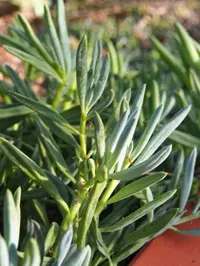
Blue chalksticks, Curio repens, is a compact succulent valued for its blue-gray, finger-like leaves and low, spreading growth habit. It usually forms dense, trailing mats that work well in containers, rock gardens, and coastal landscapes.
This species is native to South Africa, where it grows in sunny, dry habitats with fast-draining, sandy or rocky soils. It stores water in its leaves, which makes it drought-tolerant but sensitive to overwatering.
Because it prefers bright light, lean soil, and careful watering, it is generally easy to grow if drainage is good. Understanding how to care for blue chalksticks mainly involves avoiding excess moisture and frost exposure.

Care Difficulty
Easy Care

Light Preference
Full Sun

Water Requirements
Low Water

Temperature Preference
Warm Climate

Hardiness Zone
9–11

Soil Texture
Sandy, Loamy, Rocky

Soil pH
Slightly acidic (6.5–7.0), Neutral (7.0)

Soil Drainage
Well-drained

Fertilization
Minimal (feed rarely)
Scan your plant to receive care tips personalized for your specific plant
Available on iOS and Android
This succulent prefers bright, direct sun but tolerates light shade, especially in hot regions.
This drought-tolerant succulent stores water in its leaves and needs infrequent, thorough watering.
This plant prefers mild, dry conditions and does not tolerate hard frost.
This succulent tolerates typical indoor humidity and rarely needs special adjustment.
Curio repens needs a sharply draining, mineral-rich substrate to avoid root rot.
This species is well suited to container growing, including hanging baskets and low dishes.
Curio repens benefits from light, controlled feeding during its active growing season.
Curio repens responds well to light pruning to maintain a compact, tidy mat of foliage.
Curio repens in containers needs infrequent repotting, mainly to refresh soil and manage root crowding.
Curio repens is commonly propagated from stem cuttings taken during the active growing season.
Curio repens has limited frost tolerance and benefits from simple winter protection in colder climates.

Plant Health Check
Not sure what's wrong with your plant? Check your plant's health inside the app.
In its native South African coastal habitat, this species often grows in sandy, shallow soils where its creeping, mat-forming stems help stabilize dunes and low banks against wind erosion.
The blue color of the leaves comes from a glaucous waxy coating that reflects intense sunlight and reduces water loss, an adaptation that helps the plant cope with strong coastal sun and dry air.
Trailing stems root easily at the nodes when they touch soil, allowing a single plant to form wide, genetically identical clumps that can outcompete nearby low-growing vegetation in favorable conditions.

This species was long cultivated and traded under the name Senecio serpens and closely related look-alikes, so living plants in collections and in the nursery trade often represent mixed or misapplied names, making accurate identification and curation of wild-origin material particularly important for botanic gardens and collectors.
Yellowing leaves usually result from overwatering, poor drainage, or low light. Check that the pot drains well, allow soil to dry between waterings, and increase light. Remove mushy roots and any consistently soggy potting mix.
Keep your plants happy and healthy with plant identification, disease detection, and easy care guidance.