white champaca Care (Magnolia × alba)

Also known as: white sandalwood, white jade orchid tree
white champaca

About white champaca

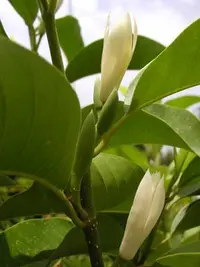
White champaca, Magnolia × alba, is a tropical evergreen tree valued for its intensely fragrant, creamy white flowers. It is often grown as a specimen tree or large shrub in warm climates, and can be container-grown in cooler regions. The plant has glossy green leaves and a narrow, upright growth habit, which makes it suitable for small gardens and patios. It originates from Southeast Asia and is commonly used near homes and temples for its perfume-like scent. Magnolia × alba prefers warm temperatures, bright light, and evenly moist, well-drained soil. With protection from cold and attention to humidity, it is moderately challenging to care for white champaca indoors or in marginal climates.

Main Plant Requirements

Care Difficulty

Moderate Care

Light Preference

Partial Sun

Water Requirements

Regular Water

Temperature Preference

Tropical / Frost Sensitive

Hardiness Zone

10–11

Soil Texture

Loamy, Sandy, Organic-rich

Soil pH

Acidic (5.5–6.5), Slightly acidic (6.5–7.0)

Soil Drainage

Moist but well-drained

Fertilization

Minimal (feed rarely)

Get Personalized Care Plan

Scan your plant to receive care tips personalized for your specific plant

Available on iOS and Android

How to Care for the white champaca

Magnolia × alba needs bright, warm conditions with protection from harsh midday sun.

  • Provide 4–6 hours of direct morning sun with light afternoon shade, or bright filtered light all day, especially in hot climates.
  • In hotter zones, shield from strong sun between 11 a.m. and 3 p.m. to prevent leaf scorch and faded blooms in white champaca.
  • In cooler climates, choose a south or west exposure with at least 6 hours of light, avoiding deep shade that causes leggy, weak growth.

Magnolia × alba prefers evenly moist, never waterlogged soil with slight surface drying between waterings.

  • Water when the top 3–5 cm of soil feels dry, applying a slow, deep soak so moisture reaches the root zone, then allow excess to drain away.
  • Increase frequency during hot, dry periods and flowering; reduce in cool seasons while preventing the root ball from fully drying out.
  • Watch for yellowing, soft leaves and sour-smelling soil as overwatering signs, and dull, curling leaves as indicators of underwatering; improve drainage if puddles persist.

This magnolia thrives in warm, frost-free climates with stable temperatures year-round.

  • Aim for 68–86°F (20–30°C) for active growth; brief peaks to 90°F (32°C) are tolerated if soil moisture is maintained.
  • Avoid temperatures below 40°F (4°C); prolonged exposure near or below freezing can damage leaves, buds, and young wood.
  • In areas with cool winters, plant in a sheltered microclimate, away from cold winds, and protect young trees during cold snaps with covers or mulch at the root zone.

This species prefers consistently warm, moderately humid air to support lush foliage and flowering.

  • Aim for 50–70% relative humidity, especially in warm indoor or sheltered patio locations.
  • It tolerates brief dips to 40–45% but prolonged very dry air causes leaf-edge browning and stalled buds.
  • Increase humidity with grouped plants, a wide pebble tray under the pot, or a room humidifier rather than frequent misting.

Magnolia × alba grows best in deep, moisture-retentive yet freely draining soil.

  • Use a loamy, organic-rich substrate that holds moisture but does not stay waterlogged, with visible structure rather than fine sludge.
  • Aim for slightly acidic to neutral pH around 6.0–7.0, avoiding strongly alkaline mixes that can lock up nutrients and cause chlorosis.
  • Combine roughly 50% compost or leaf mold with 30–40% pine bark fines and 10–20% perlite or coarse sand to improve drainage and aeration.
  • Avoid heavy, compacted clay or peat-only mixes; if planting in such conditions, amend generously with bark and coarse mineral grit to keep roots oxygenated.

This tree can be grown in containers for several years, provided the pot supports its vigorous, top-heavy form.

  • Choose a wide, heavy container that lowers the center of gravity so the tall crown does not tip in strong winds.
  • Select a pot deeper than typical shrubs to accommodate the strong taproot and prevent circling roots near the surface.
  • Ensure multiple large drainage holes so excess water leaves quickly, then raise the pot on feet to prevent the base from sitting in runoff.

Magnolia × alba benefits from moderate, targeted feeding during the warm growing season.

  • Apply a balanced slow-release fertilizer (around 10-10-10) in early spring at label rates to support steady growth and flowering in white champaca.
  • Supplement with light applications of compost or well-rotted manure around the drip line, keeping material off the trunk.
  • During active growth, liquid feed every 4–6 weeks at 1/2 strength if foliage looks pale or growth is weak.
  • Stop feeding in late summer and avoid fertilization in winter to prevent soft, frost-sensitive growth.

Magnolia × alba needs only light, purposeful pruning to maintain structure and health.

  • Carry out main pruning just after flowering, so buds for the next season are not removed.
  • Use clean, sharp bypass pruners or a fine-toothed saw to make smooth cuts just outside the branch collar.
  • Remove dead, diseased, crossing, or inward-growing branches first to improve airflow and reduce disease risk.
  • Limit shaping cuts to light thinning of crowded outer branches to preserve the tree’s natural form and flowering.

Magnolia × alba is usually grown in the ground, so focus on careful transplanting rather than frequent repotting.

  • Transplant young trees in late winter or very early spring while still dormant, before new growth begins.
  • Look for signs such as circling roots, restricted root ball, or poor vigor in containers as triggers for a larger pot or planting out.
  • Move up only 1–2 pot sizes, keeping the root ball intact, and backfill with a free-draining, slightly acidic mix.
  • Water thoroughly after planting, mulch 5–8 cm deep around the root zone, and shade temporarily to reduce transplant shock.

Magnolia × alba is slow and somewhat challenging to propagate, mainly using cuttings or air layering.

  • Take semi-hardwood cuttings in late spring to mid-summer, using 10–15 cm pieces with at least 2–3 nodes.
  • Dip the cut base in rooting hormone, then place in a sterile, sharply drained medium kept at 70–77°F with high humidity.
  • Use air layering on flexible branches in late spring, enclosing a wounded section in moist sphagnum moss and plastic wrap.
  • Seeds are rarely used; if attempted, provide fresh seed, stratification (cold treatment), and expect slow, uneven germination.

Magnolia × alba is frost-sensitive and needs thoughtful winter care in cooler climates.

  • In regions below about 30–32°F, grow in a large container so the plant can be moved indoors or to a heated greenhouse.
  • Mulch the root zone with 5–10 cm of bark or leaf mold, keeping mulch a few cm away from the trunk.
  • Wrap young outdoor trunks with breathable frost cloth or burlap during cold spells to limit bark damage.

Care Tips

Stake Young Trunks

Install a sturdy stake on the windward side and loosely tie the young trunk with soft, wide ties to keep it upright while roots establish, checking and adjusting ties every 3–4 months so they do not cut into the bark.

Shape For Airflow

When pruning after flowering, remove a few crowded interior branches rather than only shortening tips to open the canopy, which improves airflow and reduces fungal leaf problems in humid climates.

Mulch The Root Zone

Apply a 5–8 cm layer of organic mulch in a wide ring kept 5–8 cm away from the trunk to keep roots cool, conserve moisture, and buffer against temperature swings that can stress buds.

Protect From Windburn

In exposed sites, use a temporary windbreak such as shade cloth or a slatted screen on the prevailing-wind side to reduce leaf scorch and petal damage, especially on young plants or during hot, dry winds.

Monitor Root Spread

Site the tree at least 3–4 m away from hardscape and check every few years for roots pushing up paving, then redirect growth by carefully cutting problem surface roots and improving soil beyond the canopy edge to safely grow Magnolia × alba in smaller gardens.

Common Pests and Diseases

Scale insects

This pest feeds on stems and leaf undersides, producing sticky honeydew and causing yellowing, leaf drop, and general decline, especially on stressed trees or container plants.

Solution

Physically remove clustered scales with a soft brush or cloth, then wash branches with a mild soap solution; for heavier infestations, use a horticultural oil spray targeting crawlers and repeat applications while improving plant vigor with proper watering and balanced fertilization.

Leaf spot

This disease causes small brown to black spots on leaves that may merge into larger blotches, leading to premature leaf drop during warm, humid weather.

Solution

Remove and dispose of affected leaves, increase air circulation by light thinning of crowded branches, avoid overhead watering, and if the problem recurs yearly, apply a labeled copper or chlorothalonil fungicide at the first sign of spotting during the growing season.

Sooty mold

This disease appears as a black, soot-like coating on leaves and stems that develops on the sugary honeydew secreted by sap-sucking insects such as scale or aphids, reducing photosynthesis and making foliage look dull and dirty.

Solution

First control the underlying insects with a gentle soap or horticultural oil spray, then wash affected foliage with plain water or mild soapy water to remove the mold layer and improve light exposure to the leaves.

Spider mites

These insects are tiny sap-feeding arachnids that thrive in hot, dry conditions, causing stippled, dull foliage, fine webbing, and eventual leaf drop on stressed magnolia plants, especially when grown in containers or near heat-reflective surfaces.

Solution

Rinse foliage thoroughly with a strong but controlled stream of water, increase humidity around the plant, and use insecticidal soap or horticultural oil on both leaf surfaces at 5–7 day intervals until new growth appears clean; regular monitoring is important for effective Magnolia × alba care instructions.

Interesting Facts

Hybrid of fragrant parents

Magnolia × alba is a natural or ancient hybrid between Michelia champaca and Magnolia montana, combining the strong perfume of the former with the larger, magnolia-like flowers of the latter.

Night-active fragrance release

Its creamy white flowers release the strongest scent at night and early morning, a pattern that suggests adaptation to moth pollinators that are active in low light.

Cultural role in perfumery

In parts of Southeast and East Asia, the highly aromatic flowers are traditionally used for hair adornments, garlands, and as a subtle natural perfume in homes and temples.

Botan icon

Did you know?

In some tropical cities, long-established Magnolia × alba trees have become important for urban biodiversity, providing nectar and shelter for night-flying moths, beetles, and roosting birds despite being an introduced ornamental species.

FAQs about white champaca

Lack of flowering usually comes from insufficient light, young age, or nutrient imbalance, especially excess nitrogen. Ensure strong light, avoid heavy pruning of flowering wood, and use a balanced, low-nitrogen fertilizer to support bud formation.

Grow Healthy Plants with Botan Care

Keep your plants happy and healthy with plant identification, disease detection, and easy care guidance.

Botan plant care app — identify plants on mobile

Explore More Plants