Protective handling gear
Use thick leather gloves and long-handled tongs whenever you repot or move the plant to avoid injury and accidental stem breakage, which also reduces the risk of fungal infection through damaged tissue.

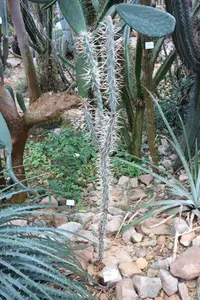
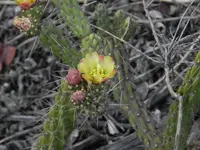
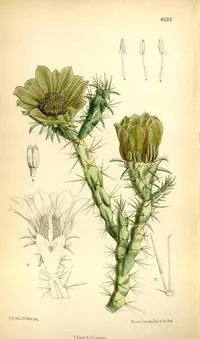
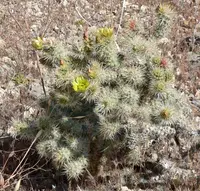
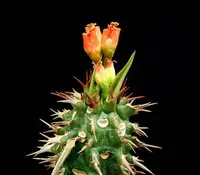
Long-spine cholla, Cylindropuntia molesta, is a shrubby cactus known for its jointed cylindrical stems covered in dense, very long spines. It forms thickets or irregular clumps that can become quite large in open, arid landscapes.
This species is native to desert and semi-desert regions of the southwestern United States and northern Mexico, where it thrives in full sun and rocky, fast-draining soils. Its main challenge for cultivation is managing the sharp spines, which require careful handling and thoughtful placement.
For those who want to care for Long-spine Cholla, it generally prefers bright, dry conditions, low humidity, and minimal water once established, making it suitable for xeric and low-maintenance plantings.

Care Difficulty
Easy Care

Light Preference
Full Sun

Water Requirements
Low Water

Temperature Preference
Warm Climate

Hardiness Zone
8–11

Soil Texture
Sandy, Loamy, Rocky

Soil pH
Slightly acidic (6.5–7.0), Slightly alkaline (7.0–7.5)

Soil Drainage
Well-drained

Fertilization
Minimal (feed rarely)
Scan your plant to receive care tips personalized for your specific plant
Available on iOS and Android
This desert cactus needs strong, direct light to maintain compact, healthy growth.
This species is highly drought-tolerant and requires infrequent, careful watering.
This cactus thrives in hot, dry conditions and tolerates a fairly wide temperature range.
This cactus thrives in dry air and does not need extra humidity.
Cylindropuntia molesta needs a very fast-draining, mineral-rich substrate to prevent root rot.
This species is suitable for container growing when stability and fast drainage are prioritized.
Cylindropuntia molesta adapts to poor, sandy soils and needs only light feeding in cultivation.
Pruning Cylindropuntia molesta is mainly for safety, shape control, and plant health.
This species is usually grown in the ground, so focus on careful transplanting rather than frequent repotting.
Propagation of Cylindropuntia molesta is commonly done from stem cuttings, with seeds used less often.
This hardy desert cactus tolerates light to moderate frost but still benefits from thoughtful winter care in wet or very cold regions.

Plant Health Check
Not sure what's wrong with your plant? Check your plant's health inside the app.
This species is native to a narrow stretch of the Pacific coast in northwestern Baja California, Mexico, where it grows on rocky slopes and maritime scrub exposed to salt-laden winds.
It is recognized by its very long, often slightly curved spines that can exceed those of nearby cholla species, providing strong physical defense against large herbivores in its open, coastal habitat.
Field observations and taxonomic studies indicate that this species can form natural hybrids with closely related Cylindropuntia species in overlapping ranges, which complicates identification and contributes to local morphological variation.
This species usually grows slowly, adding roughly 5–15 cm per year. Growth speed depends on light intensity, warmth, drainage, and how often it is disturbed or damaged. Poor drainage and frequent handling significantly slow development.
Keep your plants happy and healthy with plant identification, disease detection, and easy care guidance.