Cool-night trigger
Provide a consistent 10–15°F drop between day and night for 4–6 weeks in late summer to early autumn, as this temperature differential strongly promotes spike initiation and reliable flowering when growing Day's Cymbidium.

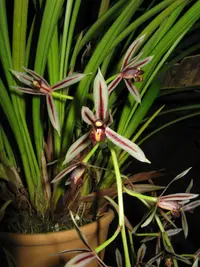
Day's Cymbidium, Cymbidium dayanum, is a compact, evergreen orchid known for its slender, arching leaves and elegant flower spikes. The blooms are typically cream to pale yellow with striking red or maroon markings on the lip.
This species grows as an epiphyte or lithophyte, naturally occurring in humid, montane forests of Southeast Asia. It usually prefers cool to intermediate temperatures and good air movement, which influences how to care for Day's Cymbidium in home conditions.
The plant is considered moderately demanding, mainly because it needs stable conditions, bright but filtered light, and regular moisture without staying waterlogged. With appropriate light and humidity, it can flower reliably each year.

Care Difficulty
Moderate Care

Light Preference
Partial Shade

Water Requirements
Regular Water

Temperature Preference
Cool Climate

Hardiness Zone
10–11

Soil Texture
Loamy, Peaty, Organic-rich

Soil pH
Acidic (5.5–6.5)

Soil Drainage
Moist but well-drained

Fertilization
Moderate (every 2–4 weeks)
Scan your plant to receive care tips personalized for your specific plant
Available on iOS and Android
This orchid prefers bright conditions with protection from harsh midday sun.
Watering should keep roots moist but never waterlogged.
This species prefers cool to intermediate temperatures with a marked day–night difference.
This orchid prefers moderately humid air and reacts quickly to very dry conditions.
This epiphytic orchid needs a loose, airy medium rather than regular potting soil.
This species is well suited to container growing when root space and drainage are carefully managed.
Balanced, dilute feeding supports steady growth and flowering in Cymbidium dayanum grown in pots.
Targeted pruning helps Cymbidium dayanum stay clean and direct energy to healthy growth and flowers.
Container-grown Cymbidium dayanum benefits from periodic repotting to renew media and manage roots.
Division is the standard method for increasing Cymbidium dayanum plants at home.
Cool-tolerant Cymbidium dayanum still needs protection from hard frost and prolonged freezing.

Plant Health Check
Not sure what's wrong with your plant? Check your plant's health inside the app.
This species has unusually narrow, almost grass-like leaves for a cymbidium, giving it a fine, arching foliage texture that differs from the broader leaves of many related orchids.
The flowers typically show pale backgrounds with prominent reddish-brown longitudinal stripes on the petals and sepals, a pattern that makes the blooms easy to distinguish from other cymbidiums in collections.
In nature, this orchid usually grows as an epiphyte on trees in cooler, mid-elevation forests in parts of Southeast Asia and southern China, rather than as a ground-dwelling plant.

Historical records indicate that this species was already cultivated and traded in Asia by the 19th century, and it contributed to early cymbidium breeding lines that helped popularize cool-growing cymbidium orchids in European collections.
Lack of flowers usually comes from insufficient light, warm winter nights, or overcrowded pseudobulbs. Provide bright, filtered light, a cooler drop at night before the blooming season, and divide or repot when clumps become very dense.
Keep your plants happy and healthy with plant identification, disease detection, and easy care guidance.