Basket mounting strategy
Grow large plants in slatted wooden baskets with coarse orchid mix so thick roots can anchor securely and excess water drains quickly, which reduces crown rot risk in mature specimens.

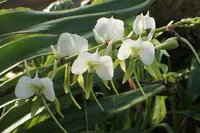
Ivory-Colored Angraecum (Angraecum eburneum) is a large, evergreen orchid known for its thick leaves and striking, ivory-white star-shaped flowers with a long nectar spur. It usually grows as an epiphyte, anchored to trees rather than soil, forming sturdy clumps over time.
This species is native to Madagascar and nearby islands in the western Indian Ocean, where it experiences bright light, warm temperatures, and good air movement. It is considered moderately challenging, mainly because it needs stable warmth, consistent moisture, and excellent drainage. With the right orchid substrate and bright, indirect light, it is possible to care for Ivory-Colored Angraecum successfully indoors.

Care Difficulty
Hard Care

Light Preference
Bright Indirect Light

Water Requirements
Keep Soil Moist

Temperature Preference
Tropical / Frost Sensitive

Hardiness Zone
12–13

Soil Texture
Sandy, Organic-rich

Soil pH
Acidic (5.5–6.5)

Soil Drainage
Well-drained

Fertilization
Moderate (every 2–4 weeks)
Scan your plant to receive care tips personalized for your specific plant
Available on iOS and Android
This orchid prefers bright, indirect light with some gentle direct sun for best flowering.
Angraecum eburneum prefers evenly moist but never waterlogged roots.
This species prefers warm, stable conditions with no exposure to frost.
This orchid prefers consistently moist air to flower and grow well.
Angraecum eburneum grows best in a very airy, fast-draining orchid medium rather than standard potting soil.
This species adapts well to container growing when the pot supports its tall, top-heavy growth habit.
This orchid benefits from light, consistent feeding during active growth for balanced Angraecum eburneum plant care.
Pruning needs for Angraecum eburneum are minimal and focus on cleanliness rather than shaping.
This orchid prefers infrequent disturbance, so repot only when the plant clearly outgrows its container or medium breaks down.
Home propagation of Angraecum eburneum is possible but slow and usually reserved for patient growers.
This tropical orchid is frost-sensitive and needs warm, stable conditions through winter, especially in temperate climates.

Plant Health Check
Not sure what's wrong with your plant? Check your plant's health inside the app.
This orchid is pollinated almost exclusively by long-tongued hawkmoths that can reach nectar at the base of its very long floral spur, a classic example of coevolution between an orchid and its pollinator.
Its large white flowers open mostly at night and release a strong, sweet fragrance after dusk, an adaptation that helps guide nocturnal moths to the bloom in low light.
In parts of its native range around Madagascar and nearby islands, this species often grows on exposed coastal rocks and trees, tolerating strong air movement and salt-laden breezes better than many other orchids.

Charles Darwin and later Alfred Russel Wallace used closely related long-spurred Angraecum orchids from the same region as key evidence to predict the existence of moths with extremely long proboscises, helping to shape early ideas about coevolution long before the specific pollinators were observed in nature.
Lack of blooms usually comes from insufficient light intensity, too-warm or inconsistent night temperatures, or missing a slightly cooler, drier rest after flowering. Old, depleted potting mix or skipping balanced orchid fertilizer can also reduce flowering performance.
Keep your plants happy and healthy with plant identification, disease detection, and easy care guidance.