Root containment strategy
When planting near structures, install a vertical root barrier 45–60 cm deep along foundations or paths to prevent aggressive surface roots from lifting paving or damaging pipes.

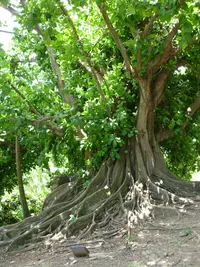
The wild banyantree, Ficus citrifolia, is a fast-growing evergreen fig tree that often starts life as an epiphyte on other trees. Over time, its aerial roots thicken into multiple trunks, forming a broad, spreading canopy with dense, glossy green foliage.
This species is native to Florida, the Caribbean, and parts of Central and South America, where it thrives in warm, humid climates. It is vigorous and can become very large, which makes outdoor planting easier than long-term container culture.
For those who want to learn how to care for wild banyantree, it generally prefers bright light, consistent moisture in well-drained soil, and protection from cold temperatures.

Care Difficulty
Moderate Care

Light Preference
Full Sun

Water Requirements
Moderate Water

Temperature Preference
Tropical / Frost Sensitive

Hardiness Zone
10–11

Soil Texture
Sandy, Loamy, Organic-rich

Soil pH
Acidic (5.5–6.5), Slightly acidic (6.5–7.0)

Soil Drainage
Well-drained

Fertilization
Minimal (feed rarely)
Scan your plant to receive care tips personalized for your specific plant
Available on iOS and Android
Ficus citrifolia thrives in bright outdoor conditions with protection from harsh afternoon sun.
This species prefers evenly moist but well-drained soil rather than constant saturation.
This fig grows best in consistently warm, frost-free climates.
This species prefers moderately humid air but usually adapts to typical indoor humidity.
Ficus citrifolia prefers loose, well‑aerated, fast‑draining soil that still retains some moisture.
This fig can be grown in containers if the pot is chosen to control its strong root system and canopy size.
This native fig benefits from light feeding but usually grows well in reasonably fertile soil without heavy inputs.
Thoughtful pruning keeps Ficus citrifolia manageable, healthy, and safely sized for its location.
Management focuses more on transplanting young trees than long-term container culture.
Ficus citrifolia is usually propagated from cuttings or seed for restoration and landscape use.
This tropical to subtropical species is not frost tolerant and needs protection in colder climates.

Plant Health Check
Not sure what's wrong with your plant? Check your plant's health inside the app.
Ficus citrifolia relies almost exclusively on the tiny wasp Pegoscapus mexicanus for pollination, forming an obligate mutualism where both species depend on each other to reproduce.
This fig naturally colonizes disturbed coastal habitats in Florida, the Caribbean, and parts of Central and South America, often establishing on exposed limestone, dunes, and rocky shorelines where many tree species cannot survive.
The small, frequent fig crops of this species provide a critical, nearly year‑round fruit source for many birds, bats, and other animals in subtropical and tropical ecosystems, helping sustain wildlife when other fruits are scarce.

Genetic and field studies have shown that individual Ficus citrifolia trees can host multiple pollinator wasp lineages at once, making this species a key model for understanding coevolution and species diversification in the fig–fig wasp relationship.
This species is generally fast-growing in warm, frost-free climates, especially during the rainy season. Young trees can add noticeable height and spread each year, then gradually slow as they mature and invest more in trunk and root thickening.
Keep your plants happy and healthy with plant identification, disease detection, and easy care guidance.