Giant boat-lip orchid Care (Cymbidium madidum)

Also known as: Arrowroot Orchid, Northern Cymbidium, Moist Forest Cymbidium, Buttercup Orchid
Giant boat-lip orchid

About Giant boat-lip orchid

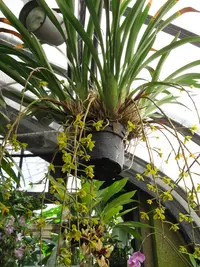
Giant boat-lip orchid, Cymbidium madidum, is a large, terrestrial orchid native to eastern Australia, often found in moist forests and rocky gullies. It forms dense clumps of arching, strap-like leaves and tall flower spikes.

The plant carries many waxy, yellow-green to brownish flowers with a distinctive boat-shaped lip, creating an impressive display in season. Its robust rhizomes store water and nutrients, making it tougher than many tropical orchids.

This species prefers bright, filtered light, cool to mild temperatures, and evenly moist but free-draining media. These traits make it relatively forgiving for growers learning how to care for Giant boat-lip orchid.

Main Plant Requirements

Care Difficulty

Moderate Care

Light Preference

Partial Shade

Water Requirements

Keep Soil Moist

Temperature Preference

Warm Climate

Hardiness Zone

10–11

Soil Texture

Sandy, Loamy, Organic-rich

Soil pH

Acidic (5.5–6.5), Slightly acidic (6.5–7.0)

Soil Drainage

Moist but well-drained

Fertilization

Light (every 4–6 weeks)

Get Personalized Care Plan

Scan your plant to receive care tips personalized for your specific plant

Available on iOS and Android

How to Care for the Giant boat-lip orchid

This species prefers bright, filtered light that mimics dappled forest or woodland conditions.

  • Provide 3–5 hours of gentle morning sun with bright shade or filtered light for the rest of the day to support flowering.
  • Tolerates partial shade, but if leaves turn dark green and flowering drops, move the Giant boat-lip orchid to a brighter position without exposing it to harsh midday sun.
  • In hot summers, protect from direct sun between 11 a.m.–3 p.m. to avoid leaf scorch; in winter, allow more direct morning light to compensate for shorter days.

This orchid prefers evenly moist but never waterlogged conditions, especially during active growth.

  • Water thoroughly when the top 2–3 cm of the mix feels barely damp rather than wet, allowing excess to drain away fully.
  • During spring and summer growth, increase frequency so roots do not dry out completely; in autumn and winter, reduce watering once growth slows.
  • Watch for signs of stress: yellow, limp leaves and a sour smell suggest overwatering and poor drainage, while wrinkling pseudobulbs and dry leaf tips indicate underwatering.

This orchid performs best in mild, frost-free conditions with distinct day–night temperature differences.

  • Aim for 65–80°F (18–27°C) by day and 50–60°F (10–16°C) at night to support steady growth and flower spike initiation.
  • Tolerates brief drops to about 40°F (4°C) if kept dry, but repeated exposure near freezing damages leaves and pseudobulbs.
  • In hot periods above 86°F (30°C), provide shade and good air movement; avoid placing plants near heat-reflective surfaces that can cause leaf scorch.

This orchid prefers moderately high, stable humidity to mimic its native moist habitats.

  • Aim for 50–70% humidity, as very dry indoor air slows growth and can desiccate leaf tips.
  • Watch for brown, crisp leaf edges and wrinkling pseudobulbs as signs of humidity stress in Giant boat-lip orchid.
  • Increase humidity with a pebble tray under the pot, grouping plants, or a room humidifier rather than misting foliage.

This species needs an airy, fast-draining yet moisture-retentive mix rather than regular garden soil.

  • Use a coarse orchid mix of medium bark, perlite, and a little sphagnum moss or coco husk to hold some moisture without becoming waterlogged.
  • Ensure strong drainage so water runs through within seconds, preventing root rot and suffocation of thick, fleshy roots.
  • Maintain slightly acidic to neutral pH around 5.5–7.0, which supports nutrient uptake and healthy Cymbidium madidum growth.
  • Avoid compact, heavy, or peat-only substrates; mix in extra bark or chunky perlite whenever the medium starts to pack down.

This species is generally suitable for container growing, especially on patios or sheltered outdoor spots.

  • Choose a wide, heavy pot that resists tipping as the clump enlarges and flower spikes extend above the rim.
  • Use a container with many side and bottom drainage holes so excess water leaves rapidly after thorough watering.
  • Select thicker-walled clay or ceramic pots when extra weight and slightly faster evaporation are needed in windy or wet locations.

This terrestrial orchid benefits from light, consistent feeding during its active growth but does not need heavy fertilization.

  • Use a balanced orchid fertilizer (for example 20-20-20) at 1/4–1/2 strength, or a light top-dressing of fine compost around, not on, the pseudobulbs.
  • Feed every 2–3 weeks in spring and summer when Cymbidium madidum produces new leaves and roots.
  • Reduce feeding to monthly at very weak strength in fall, and stop or nearly stop during winter rest.
  • For Giant boat-lip orchid in containers, flush the potting mix with plain water every 4–6 weeks to limit salt buildup.

Pruning is mainly hygienic for Cymbidium madidum and helps direct energy into healthy growth and flowering.

  • Best time is after flowering finishes and spent flower spikes begin to dry.
  • Cut dead or yellow leaves and spent flower spikes at the base with clean, sharp snips or scissors.
  • Remove damaged, rotting, or overcrowded pseudobulbs during repotting to open the clump and improve air flow.
  • Avoid cutting healthy green leaves heavily, as these store energy needed for the next flowering cycle.

This orchid prefers to stay slightly crowded, so repot or transplant only when the root mass clearly outgrows its space.

  • Look for roots circling the pot, climbing over the rim, or mix breaking down and holding water for too long.
  • Plan to repot every 3–4 years, ideally in late winter to early spring just after flowering and before strong new root growth.
  • Gently loosen the root ball, remove dead roots and old, decomposed mix, and keep healthy pseudobulbs intact in clumps.
  • Replant into a snug container or ground position with free-draining orchid mix, water lightly, and keep shaded for 1–2 weeks to limit stress.

Division is the standard method for increasing plants of this species, as seed propagation is slow and specialized.

  • Divide clumps in late winter or early spring when repotting, just after flowering and before vigorous new growth starts.
  • Use a clean, sharp knife or saw to separate sections with at least 3–5 healthy pseudobulbs and a strong lead shoot.
  • Plant divisions into fresh, well-drained orchid mix, keeping the junction of pseudobulbs and roots just above the surface.
  • Maintain bright, filtered light, gentle air movement, and slightly moist but not wet mix until new roots and leaves establish.

This species is relatively cool tolerant but benefits from basic winter protection in colder climates or exposed sites.

  • Mature plants tolerate light frost, but repeated freezes below about 28°F can damage foliage and young growth.
  • In-ground plants in marginal climates benefit from 5–8 cm of mulch around, but not against, pseudobulbs to insulate roots.
  • Move container plants under cover or indoors to a bright, cool, frost-free spot and reduce watering in winter.

Care Tips

Stabilize heavy clumps

As the clump enlarges, secure the pot in a heavy cachepot or wedge bricks around it so wind or handling does not tip and crack the crowded pseudobulbs.

Segment old clumps

When dividing, cut between natural growth fans and keep at least 4–6 healthy pseudobulbs per division to maintain vigor and reduce post-division stress.

Use graded bark

Combine medium and coarse orchid bark in layers, with coarser pieces at the base, to keep the root zone aerated while still holding enough moisture for this species.

Cool-night triggering

If flowering is poor, move the plant to a brighter, cooler position in late summer to provide several weeks of 50–55°F nights, which helps initiate flower spikes when caring for Giant boat-lip orchid.

Monitor spike direction

As new spikes emerge, rotate the container very slightly every 1–2 weeks so flower stems develop evenly and do not lean heavily to one side or against hard surfaces where buds can bruise.

Common Pests and Diseases

Cymbidium aphids

This pest commonly colonizes young flower spikes and undersides of leaves, sucking sap and excreting sticky honeydew that can lead to sooty mold. Symptoms include distorted new growth, sticky residue, and stunted flower spikes.

Solution

Remove heavily infested spikes or leaves and rinse the plant thoroughly with a strong but gentle stream of water. For ongoing issues, use an insecticidal soap or ready-to-use neem oil spray, repeating every 7–10 days and reducing excess nitrogen fertilization that promotes soft, aphid-prone growth.

Soft scale

These insects attach along leaf midribs and pseudobulbs, feeding on sap and producing honeydew that encourages black sooty mold on Cymbidium madidum foliage. Symptoms include yellowing leaves, sticky surfaces, and raised, dome-shaped bumps that do not brush off easily.

Solution

Manually remove visible scale with a cotton pad dipped in isopropyl alcohol, then wash the plant with lukewarm water. In heavier infestations, apply horticultural oil or neem oil to thoroughly coat leaves and pseudobulbs, repeating at 2–3 week intervals and improving air movement around clumps growing in baskets or pots.

Orchid mealybugs

This pest hides in leaf sheaths, at the base of pseudobulbs, and in flower stalk joints, appearing as white cottony masses and causing yellowing and weakening of the plant. Symptoms include sticky residue, deformed new growth, and slow decline of clumps.

Solution

Inspect leaf bases and pseudobulb crevices regularly and dab visible mealybugs with isopropyl alcohol on a cotton swab. For broader control, use an insecticidal soap or systemic insecticide labeled for orchids, isolate affected plants, and avoid overfertilization that encourages soft tissue attractive to mealybugs.

Brown leaf spot

This disease appears as small sunken brown to black spots on leaves that can enlarge and merge under cool, wet conditions, especially in crowded clumps. Symptoms include irregular lesions with yellow halos and gradual loss of older foliage.

Solution

Remove and discard heavily spotted leaves, then improve air circulation and reduce overhead watering, especially in the evening. Keep foliage dry when possible and, if spread continues, use a copper-based or other orchid-safe fungicide according to label directions while spacing plants more generously in shaded outdoor benches or shadehouses.

Pseudobulb bacterial rot

This disease attacks thick pseudobulbs and leaf bases, causing water-soaked, foul-smelling patches that rapidly turn brown and collapse, often starting where water sits in warm conditions. Symptoms include sudden yellowing of leaves on a single bulb and soft, mushy tissue at the base.

Solution

Immediately cut out affected pseudobulbs with a sterile tool, removing some healthy tissue around the rot, and discard all infected material. After removal, dust cut surfaces with powdered cinnamon or a commercial fungicide-bactericide, allow the plant to dry in good airflow, and avoid water sitting in leaf axils or overcrowded, constantly wet potting mixes when aiming to grow Cymbidium madidum in containers.

Interesting Facts

Unusual rock-dwelling growth

This orchid often grows as a lithophyte on sandstone rock ledges and cliff faces in eastern Australia, anchoring its thick pseudobulbs in shallow debris pockets rather than typical deep forest soil.

Night-scented flowers

Its yellow to greenish-yellow flower spikes release a stronger fragrance in the evening and night, which helps attract nocturnal pollinators such as moths.

Seasonal dry tolerance

In its native habitat, the plant experiences wet summers and comparatively drier winters and copes by storing water and nutrients in its robust, clustered pseudobulbs.

Botan icon

Did you know?

Wild populations can form large, long-lived clumps on the same rock outcrops or trees for many decades, creating dense colonies that can dominate local orchid communities in suitable moist, sheltered gorges and creek systems.

FAQs about Giant boat-lip orchid

Lack of blooms usually comes from insufficient light, no cool period, or depleted nutrients. Provide bright but indirect light, a distinct cooler season, and balanced orchid fertilizer. Crowded, old clumps may also need division to flower well.

Grow Healthy Plants with Botan Care

Keep your plants happy and healthy with plant identification, disease detection, and easy care guidance.

Botan plant care app — identify plants on mobile

Explore More Plants