Yellow-flowered Monkshood Care (Aconitum lycoctonum)

Also known as: Yellow Monkshood, Yellow wolf's-bane, Yellow-flowered wolf's-bane, wolf's-bane
Yellow-flowered Monkshood

About Yellow-flowered Monkshood

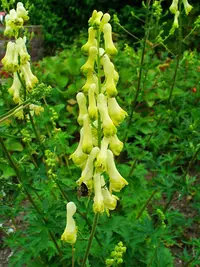
Yellow-flowered monkshood, Aconitum lycoctonum, is a hardy perennial from cool, mountainous regions of Europe and parts of Asia. It belongs to the buttercup family and is grown mainly for its tall spikes of soft yellow, hooded flowers above deeply divided dark green leaves.

Plants usually form upright clumps that suit woodland borders and naturalistic plantings. They prefer cool summers, consistent moisture, and humus-rich, well-drained soil, which makes them easier to grow in temperate climates than in hot, dry areas.

Understanding how to care for Yellow-flowered Monkshood starts with providing partial shade and protection from strong afternoon sun, which helps keep roots cool and foliage healthy.

Main Plant Requirements

Care Difficulty

Moderate Care

Light Preference

Partial Shade

Water Requirements

Keep Soil Moist

Temperature Preference

Cold Hardy

Hardiness Zone

3–7

Soil Texture

Loamy, Silty, Organic-rich

Soil pH

Acidic (5.5–6.5), Slightly acidic (6.5–7.0)

Soil Drainage

Moist but well-drained

Fertilization

Minimal (feed rarely)

Get Personalized Care Plan

Scan your plant to receive care tips personalized for your specific plant

Available on iOS and Android

How to Care for the Yellow-flowered Monkshood

This woodland perennial prefers cool, filtered light rather than strong direct sun.

  • Provide 3–5 hours of gentle morning sun with dappled or open shade the rest of the day; avoid harsh afternoon sun, especially in warmer climates.
  • In hot summers, move Yellow-flowered Monkshood to brighter shade or under high tree canopy to prevent leaf scorch, stunted growth, and premature flowering decline.
  • If stems stretch or flop toward windows or paths, the site is too dim; shift slightly toward brighter, indirect light while still protecting from midday sun.

This species prefers consistently moist but not waterlogged soil throughout the growing season.

  • Water when the top 2–4 cm of soil feels slightly dry, then soak the root zone thoroughly so moisture reaches 15–20 cm deep.
  • Use humus-rich, well-drained soil; standing water or heavy clay without amendments often causes root rot, yellowing foliage, and soft, collapsing stems in Aconitum lycoctonum.
  • During cool spring and fall, reduce frequency but maintain light moisture; in hot, drying weather, watch for wilting or crisp leaf edges as cues to water sooner.

This plant is adapted to cool, temperate climates with cold winters and mild summers.

  • Optimal growth occurs around 55–70°F (13–21°C), especially during spring and early summer when new shoots and flower spikes develop.
  • The crown and roots tolerate winter lows down to about -20°F (-29°C) with mulch; repeated freeze–thaw without snow cover can be more damaging than persistent cold.
  • Above 80–85°F (27–29°C), flowering and foliage quality decline, so provide shade, mulching, and steady soil moisture during heat waves to reduce stress.

This species tolerates a wide humidity range and usually does not need special humidity management outdoors.

This species prefers cool, moist, humus-rich ground with reliable drainage.

  • Use a deep, loose loam with high organic matter from leaf mold or garden compost to support tall stems and fleshy roots.
  • Ensure drainage by avoiding heavy, compacted clay or adding coarse sand or fine grit at 10–20% of volume.
  • Aim for slightly acidic to neutral soil, roughly pH 6.0–7.0, which suits Aconitum lycoctonum nutrient uptake.
  • Improve aeration by working in well-rotted compost and avoiding frequent trampling that compresses the root zone.

This species can grow in containers but needs careful attention to stability and moisture balance.

  • Choose a tall, heavy container that resists tipping as stems elongate and develop dense flower spikes.
  • Use a deep pot to allow long, fibrous roots to anchor well and buffer against rapid drying in warm weather.
  • Position the container where wind exposure is moderate, since tall flowering stems can act as sails and stress the root system.

This woodland perennial benefits from light feeding but grows acceptably in fertile garden soil without it.

  • Apply a balanced, slow-release fertilizer (e.g., 10-10-10) at half strength in early spring as new growth of Yellow-flowered Monkshood emerges.
  • Supplement with a thin layer of compost around the root zone once in spring to support steady growth.
  • Avoid mid-summer overfeeding, which can cause weak, floppy stems instead of sturdy flowering shoots.
  • Do not apply fertilizer in late fall or winter, when the plant is dormant and not actively using nutrients.

Aconitum lycoctonum needs only light, targeted pruning to stay tidy and flowering well.

  • In late winter or very early spring, remove any dead, damaged, or decayed stems with clean, sharp pruners.
  • After flowering, shear off spent flower spikes to improve appearance and direct energy back to the root system.
  • Cut stems back to just above healthy buds, avoiding cutting into the woody crown at soil level.
  • Wear gloves and wash tools after pruning, as all plant parts are toxic and sap should not contact skin.

This species is usually grown in the ground and dislikes frequent disturbance, so transplant only when necessary.

  • Transplant in early spring or early fall, when temperatures are mild and soil moisture is steady.
  • Move plants only if growth has declined, clumps are overcrowded, or the site is clearly unsuitable.
  • Lift the clump with a wide soil ball, disturbing roots as little as possible, and replant at the same depth.
  • Water thoroughly after transplanting, then keep soil evenly moist and shaded for 1–2 weeks to reduce stress.

Aconitum lycoctonum is most reliably propagated by careful division, with seed used mainly for patient growers.

  • Divide established clumps in early spring just as shoots appear, keeping several buds and roots per division.
  • Replant divisions immediately into moist, humus-rich soil, maintaining the original planting depth.
  • Sow fresh seed in pots outdoors in fall; natural winter cold provides stratification that improves germination.
  • Label pots clearly, keep evenly moist, and expect slow, uneven seedling emergence over 1–2 seasons.

This hardy perennial tolerates typical winters in temperate climates and usually needs minimal special care.

  • Once frost blackens the foliage, cut stems down to a few cm above soil level and dispose of debris.
  • Apply a 5–7 cm layer of organic mulch over the root zone in late fall, avoiding direct contact with the crown.
  • Container-grown plants in cold regions can be moved into an unheated, frost-free garage or shed to prevent root damage.

Care Tips

Use Stable Stakes

Install discreet stakes or a low plant support ring early in the season and loosely tie stems with soft garden ties so tall flowering spikes stay upright and do not snap in wind or heavy rain.

Wear Protective Gear

Always wear gloves and long sleeves when handling this plant, and wash tools and hands afterward, because all parts are toxic and sap can irritate skin during routine maintenance or division.

Mulch For Cool Roots

Apply a 5–8 cm layer of leaf mold or shredded bark around, but not touching, the crowns to keep roots cool, reduce weed competition, and maintain even soil moisture through summer.

Plan Child-Pet Safety

Site plants toward the back of borders or in low-traffic areas and use clear plant labels so children, visitors, and pet owners understand that this is a poisonous species when caring for Yellow-flowered Monkshood.

Divide In Cool Season

Divide crowded clumps in early spring or early fall, replanting divisions promptly at the same depth to rejuvenate flowering and maintain long-term vigor while minimizing transplant stress.

Common Pests and Diseases

Aconitum mosaic virus

This disease causes pale mottling, yellow streaks, or distorted, stunted leaves, often reducing flowering and overall vigor. Symptoms include irregular light and dark green patches that can be more obvious on young foliage.

Solution

Remove and destroy affected plants to prevent spread, and immediately rogue out any nearby plants showing similar symptoms. Control sap-sucking insects such as aphids, avoid using tools on healthy plants after handling infected material without disinfecting, and source new aconite plants from reputable, virus-indexed stock as part of careful Aconitum lycoctonum care.

Powdery mildew

This disease produces a white or gray powdery coating on leaves, stems, and sometimes flower stalks, especially in crowded or shaded plantings. Symptoms include dull, distorted foliage and reduced flowering if infections are heavy.

Solution

Improve air circulation by thinning nearby plants, avoid overhead watering, and water early in the day so foliage dries quickly. Remove heavily infected leaves and, if the problem persists, apply a sulfur or potassium bicarbonate fungicide labeled for ornamental perennials, following label directions carefully.

Downy mildew

This disease leads to yellow or pale patches on the upper leaf surface and gray to purplish fuzz on the undersides, especially in cool, damp weather. Symptoms include leaf curling, premature leaf drop, and general decline of the plant.

Solution

Increase spacing between plants, reduce evening overhead watering, and remove and discard infected leaves as soon as they are noticed. In sites with a history of downy mildew, consider rotating planting areas and using a preventative copper-based fungicide at the first sign of cool, wet conditions that favor the disease.

Aphids

These insects cluster on young shoots, stems, and flower stalks, sucking sap and causing curling, distortion, and sticky honeydew on leaves. This pest can weaken plants and may transmit viruses, including mosaic-type diseases.

Solution

Wash colonies off with a firm stream of water, focusing on shoot tips and the undersides of leaves, and repeat as needed. Encourage natural predators such as lady beetles, and if infestations remain heavy, use an insecticidal soap or horticultural oil thoroughly covering all infested surfaces.

Leaf spots

This disease complex causes brown, tan, or black spots on leaves that may have yellow halos and can merge into larger dead patches under humid conditions. Symptoms include premature leaf drop, which can reduce vigor over time if repeated annually.

Solution

Remove and dispose of spotted, fallen leaves during the season and in autumn to reduce the source of infection. Water at the base rather than over the foliage, improve airflow, and in severe or recurrent cases use a labeled ornamental fungicide early in the season when new growth appears and conditions are consistently wet.

Interesting Facts

Ancient wolf poison

The species epithet lycoctonum literally means wolf-killer and reflects its historical use in parts of Europe as a poison for wolves and other large predators, although such use is now largely abandoned and strongly discouraged due to its extreme toxicity.

Northern woodland specialist

This species is naturally distributed across cool, moist woodlands and montane regions of central and northern Europe into western Asia, where it often grows along forest edges, stream banks, and light gaps rather than in fully open habitats.

Bumblebee-adapted flowers

Its pale yellow, helmet-shaped flowers are adapted for pollination primarily by strong bumblebees, which can force their way into the hooded blossom to reach nectar while effectively transferring pollen between plants.

Botan icon

Did you know?

Genetic and morphological studies indicate that this species forms part of a complex group within the genus Aconitum, and plants once lumped under the name Aconitum lycoctonum have been split into several closely related taxa in different parts of Europe and Asia, which is why local floras may treat it differently or under narrower regional concepts.

FAQs about Yellow-flowered Monkshood

This species is highly attractive to bumblebees and some long-tongued bees, which can reach the nectar inside the hooded flowers. Butterflies visit less often. It is useful in cool, moist pollinator borders where summer color is desired.

Grow Healthy Plants with Botan Care

Keep your plants happy and healthy with plant identification, disease detection, and easy care guidance.

Botan plant care app — identify plants on mobile

Explore More Plants