cowhorn orchid Care (Cyrtopodium punctatum)

cowhorn orchid

About cowhorn orchid

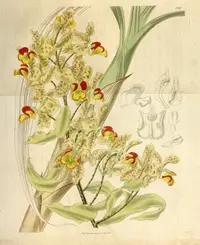
The cowhorn orchid, Cyrtopodium punctatum, is a large, showy orchid native to Florida, the Caribbean, and parts of Central and South America. It often grows as an epiphyte, anchoring to tree trunks or rocks rather than rooting in soil. Its thick, horn-shaped pseudobulbs and tall spikes of yellow, brown-spotted flowers give it a striking, architectural look. Mature plants can form sizable clumps, so they need space and strong support. This species prefers bright, filtered light, good air movement, and a consistently moist but not waterlogged root zone. It is considered challenging, so learning how to care for cowhorn orchid is important before attempting it. Successful cultivation usually requires warm conditions, high humidity, and patience, making it better suited to experienced growers or dedicated hobbyists.

Main Plant Requirements

Care Difficulty

Hard Care

Light Preference

Full Sun

Water Requirements

Moderate Water

Temperature Preference

Tropical / Frost Sensitive

Hardiness Zone

10–11

Soil Texture

Sandy, Loamy, Organic-rich

Soil pH

Acidic (5.5–6.5), Slightly acidic (6.5–7.0)

Soil Drainage

Well-drained

Fertilization

Moderate (every 2–4 weeks)

Get Personalized Care Plan

Scan your plant to receive care tips personalized for your specific plant

Available on iOS and Android

How to Care for the cowhorn orchid

This orchid needs bright, strong light similar to open woodland or exposed branch conditions.

  • Provide 4–6 hours of direct morning sun plus bright, filtered light the rest of the day; avoid harsh midafternoon sun in hot climates.
  • Tolerates light, shifting shade, but prolonged dense shade causes weak, lanky growth and poor flowering in cowhorn orchid.
  • In summer, protect from reflective heat; in winter, give the brightest site available to compensate for shorter days and lower sun angle.

Watering should mirror a seasonally wet-dry cycle while avoiding prolonged saturation.

  • During active growth, water when the top 2–4 cm of substrate feel dry; roots should look plump, not shriveled or constantly soggy.
  • Use a very free-draining mix or mounting so water runs through quickly; yellowing, soft pseudobulbs suggest overwatering and poor aeration.
  • Reduce watering sharply in the dry or dormant season, allowing the medium to dry almost completely while preventing long-term shriveling of Cyrtopodium punctatum pseudobulbs.

This species prefers warm to hot conditions with a mild cooler period in the dry season.

  • Aim for 70–85°F (21–29°C) in the growing season, with good airflow to prevent heat buildup around foliage and pseudobulbs.
  • Tolerates brief peaks near 95°F (35°C) if humidity and air movement are high, but leaves scorch more easily under full sun in extreme heat.
  • Protect from cold below 45°F (7°C); avoid frost, since tissue damage can occur quickly, and resume warmer 65–75°F (18–24°C) conditions as growth restarts.

This species prefers moderately humid air but copes with short dry spells if roots stay adequately watered.

  • Aim for 50–70% humidity during active growth to support healthy pseudobulbs and foliage.
  • Dry air can cause pleated leaves, shriveling pseudobulbs, and brown tips on cowhorn orchid foliage.
  • Increase humidity with a nearby humidifier, grouped plants, or an outdoor position sheltered from strong drying winds.

Cyrtopodium punctatum grows best in a coarse, very free-draining, slightly acidic to neutral medium.

  • Use a mix such as 40% medium orchid bark, 30% coarse perlite or pumice, and 30% chunky peat or coco chips to balance drainage and moisture.
  • Ensure large air spaces around roots; avoid compact, peaty, or clay-based substrates that stay wet and exclude oxygen.
  • A pH around 5.5–7 suits this epiphyte/terrestrial orchid, so avoid strongly limed mixes meant for calciphile plants.
  • For ground planting, improve drainage by raising the planting area and incorporating coarse sand or gravel beneath the root zone.

This orchid can be grown in containers if the pot is prepared for strong, upright, sometimes top-heavy growth.

  • Choose a deep, heavy container that resists tipping as the tall pseudobulbs and leaves develop.
  • Provide a thick drainage layer and multiple open drainage holes so water exits rapidly after each watering.
  • Secure tall growth with discreet stakes or ties anchored to the pot rim to prevent wind rocking that can damage new roots.

This orchid responds to modest, targeted feeding during its active growing season.

  • Use a balanced orchid fertilizer (around 20-20-20) diluted to 1/4–1/2 strength for caring for cowhorn orchid.
  • Apply every 2–3 weeks in spring and summer when new growth and roots are forming.
  • Reduce to monthly or stop feeding in fall and winter when growth slows or pseudobulbs harden.
  • Avoid heavy compost or slow-release granules directly on roots; flush the medium with plain water every few feedings.

Cyrtopodium punctatum needs only light pruning focused on health and hygiene, not shaping.

  • Best time is after flowering and once spent flower spikes have dried.
  • Remove dead, shriveled pseudobulbs, dried flower spikes, and clearly damaged leaves with clean, sharp scissors or pruners.
  • Cut close to the base without injuring firm green tissue to avoid infection entry points.
  • Minimal removal preserves photosynthetic area and stored reserves, supporting flowering the following season.

Handling this species is mainly about careful transplanting rather than frequent repotting.

  • Consider moving a plant when roots circle the container, growth creeps well beyond the pot edge, or new growth is stunted.
  • Plan transplanting for early spring just before strong new root growth, usually every 3–4 years at most.
  • Lift the clump gently, tease roots apart with fingers, and trim only rotten or broken roots with sterile tools.
  • Replant in a free-draining, chunky orchid mix, water thoroughly once, then keep slightly on the dry side for 7–10 days to limit root stress.

Division is the most practical way home growers handle propagation of Cyrtopodium punctatum.

  • Divide established clumps in late winter or early spring, timed with the start of new root growth.
  • Use a sterile, sharp knife to separate sections with at least 3–4 healthy pseudobulbs and active eyes.
  • Dust cut surfaces with fungicidal powder or ground cinnamon, then plant in fresh, coarse orchid mix.
  • Maintain bright, filtered light, 70–80°F warmth, and lightly moist medium to support new root establishment.

This warm-growing orchid is frost sensitive and benefits from planned winter management in most climates.

  • Avoid exposure to temperatures below 40°F; freezing can kill pseudobulbs and roots.
  • Move container plants indoors or into a warm greenhouse before the first frost is forecast.
  • Keep the medium on the dry side during the natural dormancy period, watering lightly only to prevent complete desiccation.
  • In very mild climates, potted plants can stay outside if kept dry, sheltered from cold winds, and above frost level.

Care Tips

Secure Mounting

Use UV-stable plastic ties or soft horticultural wire to anchor pseudobulbs and roots firmly to a large slab or branch, checking once a year that fastenings are not cutting into new growth.

Seasonal Water Shift

Reduce watering sharply and keep the medium almost dry once leaves yellow and drop, then resume more frequent watering only when new shoots and roots are clearly emerging in spring.

Root Zone Aeration

If grown in a basket, periodically lift and gently tease apart congested, dead roots, then top up with coarse, fresh medium so air can circulate freely around the thick roots.

Support Heavy Canes

Install sturdy canes or a rigid frame early in the growth season and loosely tie developing pseudobulbs, as mature stems become tall and heavy and can snap in strong wind or when moved.

Acclimate Outdoor Moves

When moving a plant between indoor and outdoor locations, especially when caring for cowhorn orchid in cooler regions, shift it over 7–10 days by gradually increasing light and air exposure to prevent shock to leaves and new growth.

Common Pests and Diseases

Scale insects

This pest often settles on pseudobulbs and flower spikes, feeding on sap and weakening plants, especially in warm, still conditions. Symptoms include sticky honeydew, sooty mold, and small brown or tan bumps that do not rub off easily.

Solution

Remove heavily infested leaves or spent spikes and gently scrape scales with a cotton swab dipped in isopropyl alcohol. Improve air movement, avoid overfertilizing with high nitrogen, and use a horticultural oil spray labeled for orchids, applied in the early morning and repeated as needed according to label directions.

Orchid aphids

These insects congregate on new growth and flower spikes, sucking sap and distorting young tissue. Symptoms include curled new leaves, deformed flower buds, and shiny honeydew on the plant or nearby surfaces.

Solution

Wash colonies off with a firm stream of water and remove heavily infested buds or spikes. If needed, apply an insecticidal soap or neem oil product labeled for orchids, ensuring full coverage of tender growth and repeating at 5–7 day intervals until populations decline.

Spider mites

This pest becomes a problem in hot, dry conditions, particularly on plants grown under high light where foliage can stress. Symptoms include fine webbing, pale stippling on leaves, and a dull, dusty appearance that can lead to leaf drop if ignored.

Solution

Increase humidity to around 50–60%, rinse foliage thoroughly (top and underside of leaves), and isolate affected plants. For persistent infestations, use a miticide or insecticidal soap labeled for mites and rotate products if instructed to reduce resistance, keeping leaves out of direct sun until dry.

Bacterial soft rot

This disease attacks pseudobulbs and leaf bases, causing rapidly spreading, water-soaked patches with a foul smell. Symptoms include mushy tissue that collapses quickly, often starting where water collects in tight leaf or pseudobulb clusters.

Solution

Immediately cut away all affected tissue with a sterile blade, removing some healthy tissue beyond visible rot, and discard infected material. Keep the plant drier at the base, avoid water standing in crowns or between pseudobulbs, improve air circulation, and treat cut surfaces with a bactericide or dusting of cinnamon powder to dry and disinfect exposed tissue.

Leaf spot fungi

This disease develops on foliage of plants grown in consistently wet, crowded, or low-airflow conditions. Symptoms include small yellow to brown spots that may enlarge, merge, and develop dark margins on older leaves, reducing photosynthesis over time.

Solution

Remove and discard leaves with extensive spotting and space plants to improve light and air movement. Water early in the day so foliage dries quickly, avoid overhead watering where possible, and apply a broad-spectrum fungicide labeled for orchids if new spots continue to appear despite cultural adjustments, following all label instructions as part of broader Cyrtopodium punctatum care instructions.

Interesting Facts

Native Caribbean epiphyte

This orchid naturally occurs in southern Florida, the Caribbean, and parts of Central and South America, where it often grows as an epiphyte on tree trunks or occasionally as a lithophyte on rocks in seasonally dry forests and hammocks.

Showy branching flower spikes

Mature plants can produce tall, branching inflorescences bearing dozens of yellow flowers with brown spotting, which open successively and can create a striking display in late winter to spring in its native range.

Conservation concern in Florida

In Florida, wild populations declined sharply due to habitat loss and collection, and the species is now the focus of conservation and reintroduction projects that use nursery-grown plants to restore it to protected natural areas.

Botan icon

Did you know?

The species was long considered extirpated from several parts of its historical Florida range until documented reintroduction programs, using greenhouse-propagated plants, successfully re-established flowering individuals in the wild after decades of apparent absence.

FAQs about cowhorn orchid

Lack of flowering usually comes from insufficient light, too little seasonal temperature drop, or the plant being immature. Overpotting and heavy nitrogen fertilization also reduce blooms. Stable outdoor conditions that mimic its native climate strongly improve how to take care of cowhorn orchid for flowering.

Grow Healthy Plants with Botan Care

Keep your plants happy and healthy with plant identification, disease detection, and easy care guidance.

Botan plant care app — identify plants on mobile

Explore More Plants