


Mounting selection
Use a long-lasting hardwood slab or large piece of cork bark, as this epiphytic species anchors strongly and dislikes being remounted frequently once established.

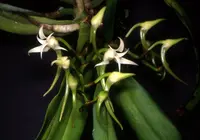
Cyrtorchis arcuata, commonly called wood orchid, is a small epiphytic orchid that grows attached to tree trunks and branches rather than in soil. It produces slender, arching stems with leathery leaves and clusters of white to creamy, often night-scented flowers. In nature it occurs in warm, humid forests of tropical Africa, where it benefits from good air movement and filtered light under the tree canopy. Its need for stable warmth, high humidity, and careful watering makes it moderately challenging for beginners. Growers who understand how to care for Wood orchid as an epiphyte usually find it rewarding and long lived.

Care Difficulty
Hard Care

Light Preference
Partial Shade

Water Requirements
Moderate Water

Temperature Preference
Tropical / Frost Sensitive

Hardiness Zone
12–13

Soil Texture
Sandy, Organic-rich

Soil pH
Acidic (5.5–6.5)

Soil Drainage
Well-drained

Fertilization
Light (every 4–6 weeks)
Scan your plant to receive care tips personalized for your specific plant
Available on iOS and Android
This epiphytic orchid prefers bright, filtered light that mimics high tree canopy conditions.
This species needs consistent moisture around the roots but cannot tolerate waterlogging.
This orchid prefers warm, stable conditions with mild night drops.
This epiphytic orchid prefers consistently humid air to maintain healthy leaves and roots.
This orchid grows best mounted or in a very loose, airy medium rather than compact soil.
This species suits container culture when grown in a very free-draining orchid pot or basket.
This epiphytic orchid benefits from light feeding during active growth but reacts poorly to heavy fertilizer.
Pruning needs for Cyrtorchis arcuata are minimal and focus on hygiene rather than shaping.
This orchid prefers stability and should be repotted or remounted only when clearly necessary.
Propagation of Cyrtorchis arcuata is specialized and not commonly attempted by casual growers.
This tropical orchid is not frost hardy and needs sheltered conditions in winter in most climates.

Plant Health Check
Not sure what's wrong with your plant? Check your plant's health inside the app.
The flowers release a strong fragrance mainly at night and produce nectar in a long spur, an adaptation that targets sphinx moths with long proboscises as primary pollinators.
The species name arcuata refers to its distinctly curved or arched inflorescences, which carry several starry white flowers along a graceful, bow-like spike.
This orchid typically grows as an epiphyte on tree trunks and branches in humid lowland forests of West and Central Africa, anchoring to bark rather than rooting in soil.

Cyrtorchis arcuata often grows alongside ant-inhabited trees, and its exposed aerial roots can benefit indirectly from the cleaner, less competitive microhabitat created by ant activity, although it is not an obligate ant-associated orchid.
Lack of flowers usually comes from insufficient light, too-warm nights, or no cool, drier rest after flowering. This species needs a pronounced seasonal change to set buds, so avoid constant moisture and high fertilizer during its rest period.
Keep your plants happy and healthy with plant identification, disease detection, and easy care guidance.

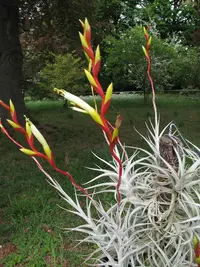
Tillandsia albida
Tillandsia albida
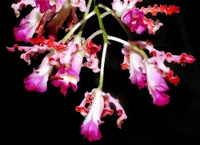
the trumpet player's Schomburgkia
Myrmecophila tibicinis

Philodendron
Philodendron 'Lemon Lime'
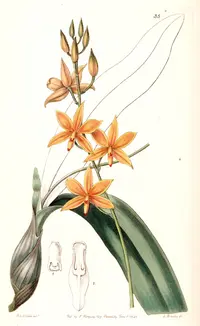
Prosthechea vitellina
Prosthechea vitellina
 POPULAR
Raindrop Peperomia
Peperomia polybotrya
Peruvian wild petunia
Ruellia chartacea
golden shrimp plant
Pachystachys lutea

pale purple coneflower
Echinacea pallida