Staggered Staking
Install sturdy stakes or a low support grid at planting time and tie stems loosely as they elongate so tall flowering shoots do not snap in wind or rain later in the season.

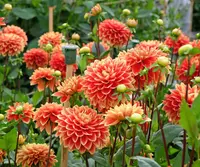
Dahlia × cultorum is a tuberous, herbaceous perennial grown mainly for its large, colorful flower heads. It is a horticultural hybrid, not found in the wild, derived from species native to Mexico and Central America.
Plants form bushy clumps with upright, branching stems and a wide range of flower shapes, from simple single blooms to dense pompons and decorative forms. Flowers come in many colors, which makes them popular in borders and cutting gardens.
This dahlia grows best in sunny, sheltered sites with fertile, well-drained soil and regular moisture. Understanding how to care for Dahlia × cultorum is important, as it can be sensitive to frost, waterlogging, and some common pests and diseases.

Care Difficulty
Moderate Care

Light Preference
Full Sun

Water Requirements
Regular Water

Temperature Preference
Tropical / Frost Sensitive

Hardiness Zone
8–10

Soil Texture
Loamy, Sandy, Organic-rich

Soil pH
Acidic (5.5–6.5), Slightly acidic (6.5–7.0)

Soil Drainage
Moist but well-drained

Fertilization
Moderate (every 2–4 weeks)
Scan your plant to receive care tips personalized for your specific plant
Available on iOS and Android
This plant needs strong, consistent light to flower well outdoors.
This plant needs steady moisture without staying soggy, especially during active growth and flowering.
This plant grows best in warm, frost-free conditions during the growing season.
This plant grows best in moderate ambient humidity but is not highly humidity-sensitive.
Dahlia × cultorum performs best in loose, well-aerated, moisture-retentive yet free-draining soil.
This species is well suited to container growing when pot depth and stability are planned carefully.
Healthy flowering in Dahlia × cultorum depends on steady but moderate nutrition during the active growing season.
Thoughtful pruning helps Dahlia × cultorum produce more blooms and maintain a sturdy, balanced shape.
Dahlia × cultorum is usually grown in beds or large containers and benefits from periodic transplanting of its tubers.
Gardeners often renew and multiply Dahlia × cultorum through division of tubers and softwood cuttings.
Cold-season management is crucial because Dahlia × cultorum tubers are sensitive to hard freezes.

Plant Health Check
Not sure what's wrong with your plant? Check your plant's health inside the app.
This cultivated dahlia group arose from complex hybridization among several Mexican Dahlia species, mainly Dahlia pinnata and Dahlia coccinea, which is why botanists use the hybrid sign × cultorum instead of a single wild species name.
The swollen underground storage organs are technically tuberous roots, not true tubers, and show wide variation in size and shape across cultivars, reflecting intense selection for garden performance rather than uniformity.
Differences between decorative, cactus, pompon, and other flower forms in this group are controlled by a small number of key genes that alter petal shape and arrangement, so very different-looking blooms can be closely related genetically.

Modern garden dahlias in the Dahlia × cultorum group were initially grown in Europe in the late 18th and early 19th centuries as potential root vegetables, but their culinary quality was considered poor, so breeders shifted focus almost entirely to ornamental value, leading to the huge range of flower colors and forms seen today.
Lack of blooms is often due to too little light, excess nitrogen fertilizer, overcrowded tubers, or heat stress. Deadhead spent flowers, feed with a balanced or low-nitrogen fertilizer, and divide congested clumps every few years.
Keep your plants happy and healthy with plant identification, disease detection, and easy care guidance.