Sturdy staking
Install slender stakes or wire mesh when plants are 15–20 cm tall, then loosely tie the main stems as they elongate so the heavy flower plumes stay upright and do not snap in late-season wind or rain.

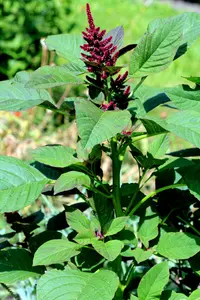
Prince-of-Wales feather, Amaranthus hypochondriacus, is an upright annual flowering plant grown mainly for its striking, feathery flower plumes. It often has vivid red or burgundy flowers and stems, with medium-green leaves that create strong contrast in borders or cutting gardens.
This species is native to Central and South America but is now widely cultivated as an ornamental and sometimes as a grain or leafy green. It is generally easy to grow from seed and adapts well to warm, sunny sites with well-drained soil. Understanding how to care for Prince-of-Wales feather mainly involves providing enough sun and avoiding waterlogged conditions.

Care Difficulty
Easy Care

Light Preference
Full Sun

Water Requirements
Moderate Water

Temperature Preference
Tropical / Frost Sensitive

Hardiness Zone
2–11

Soil Texture
Sandy, Loamy, Organic-rich

Soil pH
Acidic (5.5–6.5), Slightly acidic (6.5–7.0)

Soil Drainage
Well-drained

Fertilization
Moderate (every 2–4 weeks)
Scan your plant to receive care tips personalized for your specific plant
Available on iOS and Android
Amaranthus hypochondriacus thrives in strong light and forms best flower spikes in full sun.
This species prefers consistently moist, well-drained soil without long wet or bone-dry periods.
This warm-season annual grows best in stable, frost-free conditions.
Humidity is rarely critical for Amaranthus hypochondriacus in typical outdoor conditions.
Amaranthus hypochondriacus grows best in loose, well-drained, moderately fertile soil.
This species is suitable for container growing outdoors if the pot is large and stable.
This fast-growing annual benefits from modest feeding in nutrient-poor soils, but heavy fertilization is rarely necessary for caring for Prince-of-Wales feather.
Pruning Amaranthus hypochondriacus is mainly about tidying and managing size rather than strict shaping.
This annual is usually transplanted outdoors from seedlings rather than maintained long-term in containers.
Amaranthus hypochondriacus is most commonly propagated by seed, which allows many plants from minimal material.
This species is a warm-season annual and does not survive hard frost, so winter care focuses on end-of-season cleanup and seed saving.

Plant Health Check
Not sure what's wrong with your plant? Check your plant's health inside the app.
This species was domesticated in pre-Columbian Mexico and Central America as a pseudocereal, with its tiny protein-rich seeds still used in traditional foods such as alegrías (popped amaranth bars).
Unlike many cereal grains, its seeds contain relatively high levels of the amino acid lysine, which helps improve protein quality when eaten with maize or wheat-based foods.
It produces tall, upright spikes of densely packed, deep red flowers whose pigmentation comes largely from betalain compounds, which differ chemically from the anthocyanin pigments found in most flowering plants.

Archaeobotanical evidence from sites in Mexico shows that this species was once one of the three major staple crops of the Aztec Empire, alongside maize and beans, before Spanish colonial authorities restricted its cultivation due to its role in religious rituals.
Lack of flowers is usually due to insufficient light, excess nitrogen fertilizer, or stress from cold or transplanting. Ensure full sun, use a balanced or low-nitrogen fertilizer, and avoid disturbing roots once plants are established.
Keep your plants happy and healthy with plant identification, disease detection, and easy care guidance.